
Krakatoa Resources Ltd (ASX:KTA) has confirmed further visible antimony mineralisation from both surface and underground work at the Zopkhito Antimony-Gold Project in Georgia, as assays remain pending.
The company has completed 18 surface diamond drill holes for a combined 2,309 metres. Of the 15 holes completed to depth, 12 intersected visible antimony mineralisation, while three holes were abandoned due to ground conditions. Surface drilling has now paused with the onset of late-autumn snowfalls.
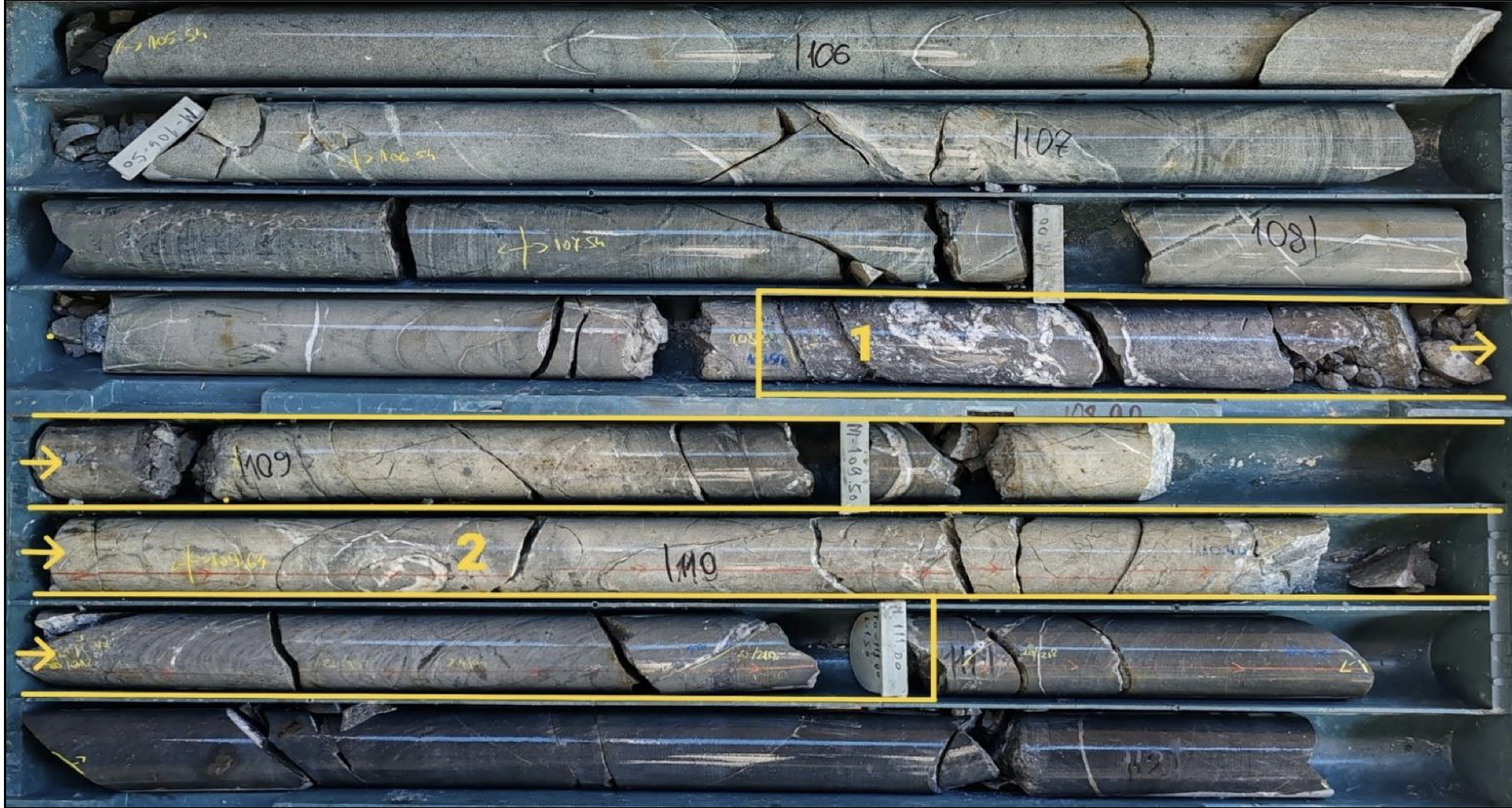
Photo of the mineralised antimony zones (yellow box) within drillhole DD25ZOP014 showing massive stibnite and quartz (~90% antimony) zone transitioning stringer veins of quartz – sulphide – stibnite within the parent rock (noted by 2).
Underground drilling from Adit #80 is continuing.
Krakatoa reports nine core sampling holes completed in the adit, seven of which intersected visible antimony. The in-adit approach enables unbiased sampling behind the adit face and is suitable for use under JORC standards, providing higher confidence in characterising mineralised zones.
According to the company, results from both surface and adit drilling are expected to inform structural and grade controls across the system. In particular, the work is designed to refine vein orientation, map grade distribution and assess the continuity of antimony and associated gold mineralisation to guide next steps in the exploration program.
Sample assays are pending, with initial results from the Zopkhito drilling program expected in Q4 2025 to Q1 2026. In the interim, underground activities will continue to progress data collection while surface work remains on hold due to weather.
Krakatoa’s immediate focus is to integrate the underground and surface datasets to prioritise targets and plan follow-up work once conditions permit a return to surface drilling.

Core from drillhole UG25ZOP003 (~7.3m depth) showing the vein system with a zone of quartz - sulphide breccia. Antimony sulphides (Stibnite Sb2S3 ) in this interval constitute ~30% of the rock shown. Assays are pending for this interval and are expected December 2025 to January 2026.
Converting a historical foreign estimate into a maiden JORC-compliant Mineral Resource
Krakatoa is advancing work at its Zopkhito antimony-gold project in Georgia with a program designed to convert a historical foreign estimate into a maiden JORC-compliant Mineral Resource. Zopkhito currently carries a non-JORC resource of 225,000 tonnes at 11.6% antimony (Sb) and 7.1 million tonnes at 3.7 g/t gold (Au). The present campaign integrates legacy datasets with new core drilling and modern fieldwork, with sampling and logging procedures aligned to JORC standards.
Drilling has progressed on two fronts.
At surface, Krakatoa has completed 18 diamond holes, 15 of which reached target depth; 12 of those intersected antimony-rich veins, while three holes were abandoned at shallow depth due to ground conditions.
As late-autumn weather sets in, surface drilling has paused, but underground work continues from Adit #80, where nine short core holes have been completed using a 41-millimetre Shaw Portable Coring Drill suited to confined headings. Visual inspection indicates seven of the nine adit holes intersect visible antimony, and all nine encounter an arsenopyrite-dominant halo that, based on historical assays, may carry gold. In-adit drilling enables more representative sampling behind the adit face and is considered appropriate for JORC-standard data collection.
What’s to come?
Assays from both surface and adit programs are pending, with initial laboratory results expected in December 2025 to January 2026. In the interim, detailed logging continues, and core imagery — such as samples from UG25ZOP003 underground and DD25ZOP014 at surface — highlights zones of stibnite mineralisation.
The results are expected to refine the orientation of quartz–stibnite veins, map grade distribution, and assess continuity across antimony and associated gold systems, informing the resource conversion and guiding follow-up drilling when surface conditions allow a restart.
Critical minerals corridor
Strategically, Zopkhito sits within Europe’s critical minerals corridor at a time when antimony is designated a critical mineral by both the European Union and the United States, with the majority of global supply concentrated in China. Georgia’s mining framework, transport links and trade access to European markets add to the project’s appeal.
Krakatoa plans a steady cadence of operational updates through late 2025 as underground work advances toward its initial JORC resource milestone and broader resource growth objectives across the licence area.