While investors will scrutinise fees from local investments like spreads and commissions on stocks and ETFs, you could be losing out on up to 8% every time you wire money overseas. Fixing this oversight can get you better value on your international payments.
If you like to invest in foreign markets from Singapore to the United Kingdom, and still send money through your banks, it’s time for you to look at some new methods to lower your fees.
The Reality of International Payments
According to currency payments specialist Wise, Americans paid $8.7 billion in hidden fees through inflated exchange rates. With stats like these, it's a surprise people don’t care enough to do something about it. Some providers get away with charging over 8% on your transfers, essentially ripping you off.
Justin Grossbard, CEO of CompareForexBrokers, discusses the impact of these hidden fees: “Sending $10,000 to another currency could cost you $400-$800, giving you much less buying power. If you send funds abroad regularly, this is a huge cost and compounds over time.”
Justin continues: “Traditional methods like your bank are the main culprits. They charge larger exchange fees than offered at the market, allowing them to grab a healthy profit for transferring your funds.”
The Hidden Cost Behind International Payments
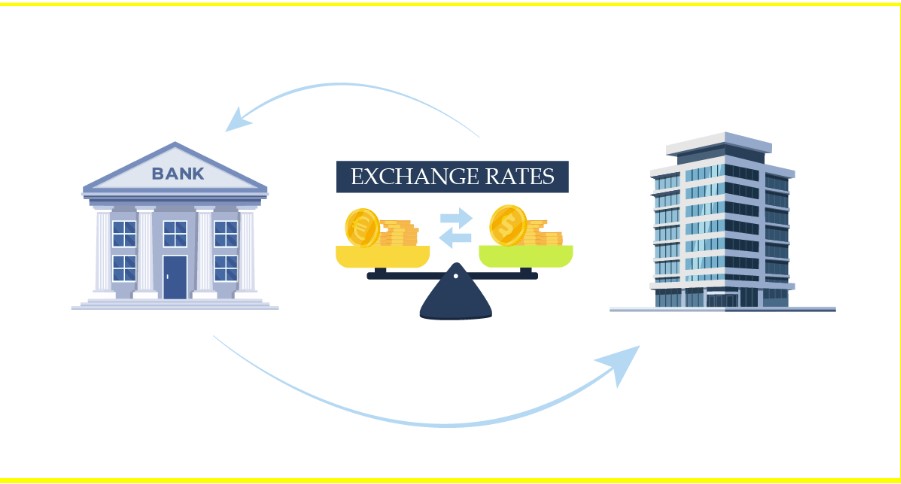
Banks and other foreign exchange brokers make it sound like they are doing you a favour by offering their services for free. This is because they quote you an exchange rate far away from the current price and pocket this large difference.
Before you question your bank, this is completely legal. It’s just like a shop buying a product at one price, and selling it to you at a premium for profit. The good news is that competition has developed for this industry, so you can get better rates more easily.
How Finding Better Rates Improves Your Prospects
Do forex fees really have an impact? Yes, they most certainly do. The less money you send, the likelihood increases you’ll pay more in foreign exchange fees. If you go online and get a quote, most services and banks will quote 4-8% above the current mid-market price.
Naturally, you won’t ever receive the interbank price, for this reason you want to use a service that doesn’t widen the rate too much.
Let’s say you are looking to invest $100,000 into the Singaporean technology sector with companies like ST Engineering (S63.SI).
- If the exchange rate is 1.28 SGD, you would expect to receive $128,000 SGD.
- In reality, if your bank offers you 1.22 SGD, you’d end up with $122,000 SGD.
That’s 6,000 SGD less - increasing your costs for purchasing the shares. The stock will have to rise 4% just to break even on your FX exchange rate commissions.
Equally, if you look to buy property in Canada for $550,000 CAD, you would actually need to send more US dollars to cover the exchange rate fees.
- With the USD/CAD market rate of $1.39 CAD, you’d need to transfer $396,000 to complete the purchase.
- But if your bank charges you wider rates like 1.33 CAD, you’d actually need $414,000.
The difference here is paying $18,000 extra. This money doesn’t add to the property value, it just disappears in the exchange rate costs.
Don’t forget, it's not just about purchasing but also receiving funds back into USD. So even your profits can be hit if you avoid getting better rates.
Choosing a specialist foreign exchange broker lets you shop around for better rates. While this involves extra steps, it can save you thousands over time.
Taking the Canadian property example, by using a specialist you could have paid $1.37 CAD. This rate lowers the amount of USD to $401,000, saving you $14,000 on the exchange rate fees.
How To Get Better Exchange Rates
When you are looking to make the international payments, here is how you can reduce your fees:
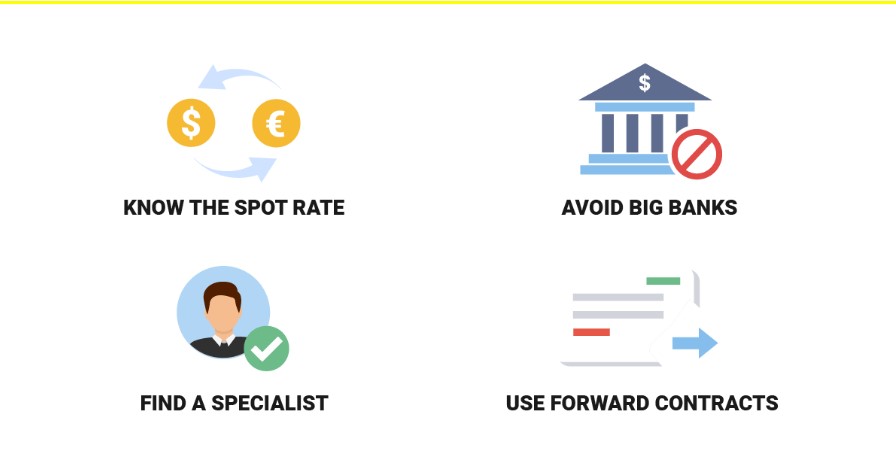
- Know the spot rate. You can look up the current exchange rate online through a quick Google search. Now, you’ll never get the same price but you want to find a service that will exchange for a similar price. The lower the quoted price, the worse the exchange rate is.
- Avoid big banks. Banks provide the most convenient way to send money, but it is also one of the most expensive options. If you deal in large volumes, some banks will offer better rates.
- Find a specialist. Competition against banks is increasing through boutique forex brokers and international payment specialists. Some offer a self-service option, offering much cheaper rates that are closer to the spot price.
- Use forward contracts. If you are making investments or making large purchases like property, forward contracts are your friend. These lock-in the current exchange rate for a transfer in the future. This is a good option if you feel the exchange rate will weaken before making your large purchase.