
Terrain Minerals Ltd (ASX:TMX, OTC:TMXAF) has defined multiple drill targets at the Wildflower prospect within its 100%-owned Smokebush Project, about 350 kilometres north of Perth, after completing an induced polarisation (IP) survey.
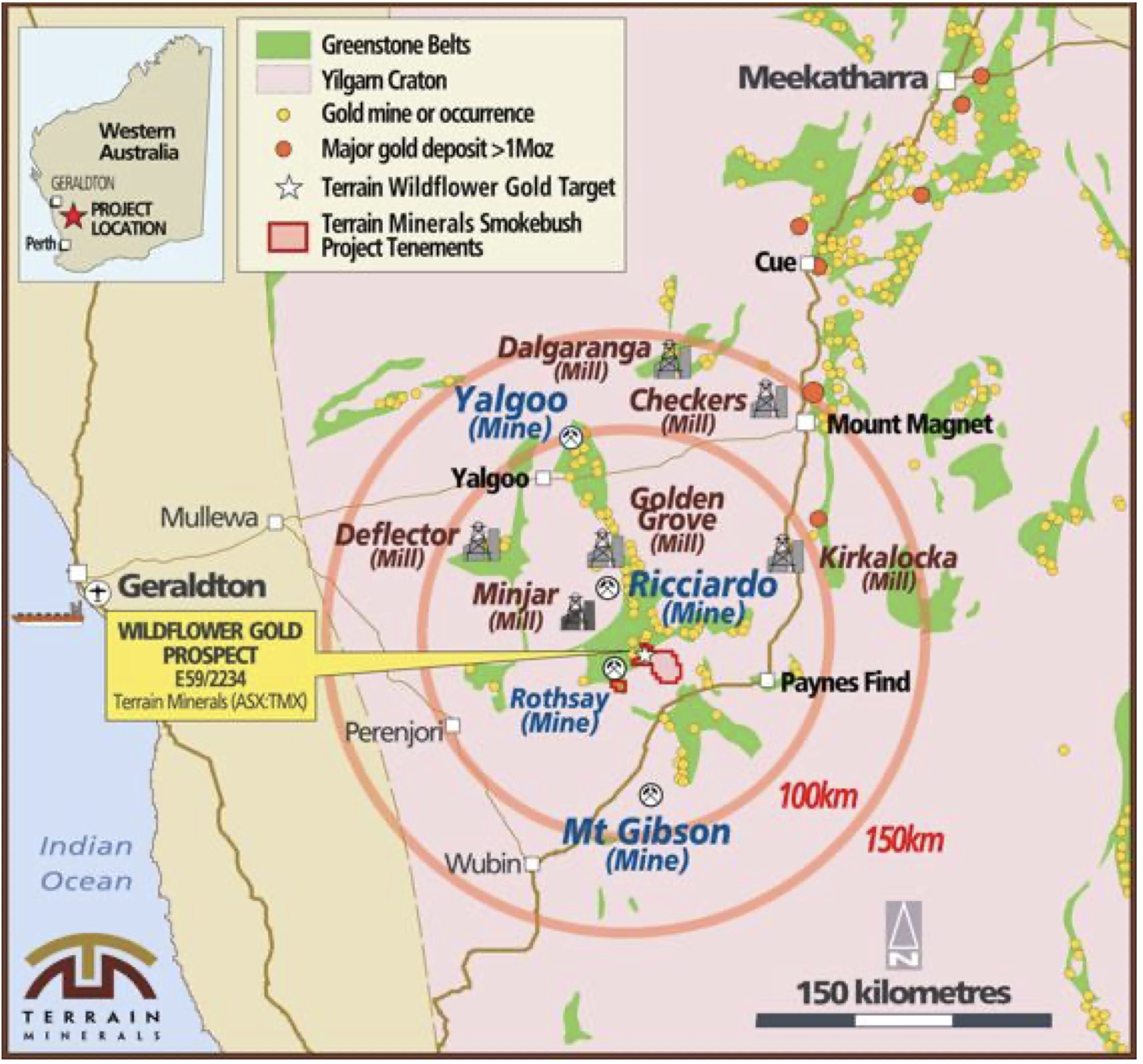
Location of Terrain Minerals 100% owned Wildflower Gold Prospect. The prospect is approximately 350 kilometres north of Perth, Western Australia and is located within the Yalgoo-Singleton Greenstone Belt, being a 190-kilometre-long Archean greenstone belt situated in the southwestern Murchison Domain.
The survey outlined large chargeability and resistivity zones extending for more than 800 metres, with three priority targets emerging across three structures. The structural setting at Wildflower mirrors the controls seen at its nearby Lightning gold-silver discovery, with both target areas positioned around the same granite intrusion — a configuration the company regards as a proven control on mineralisation in the district.
Lightning Gold is 15 kilometres from the operating Rothsay Gold Mine and close to Capricorn Metals’ 4.5-million-ounce Mt Gibson gold deposit.
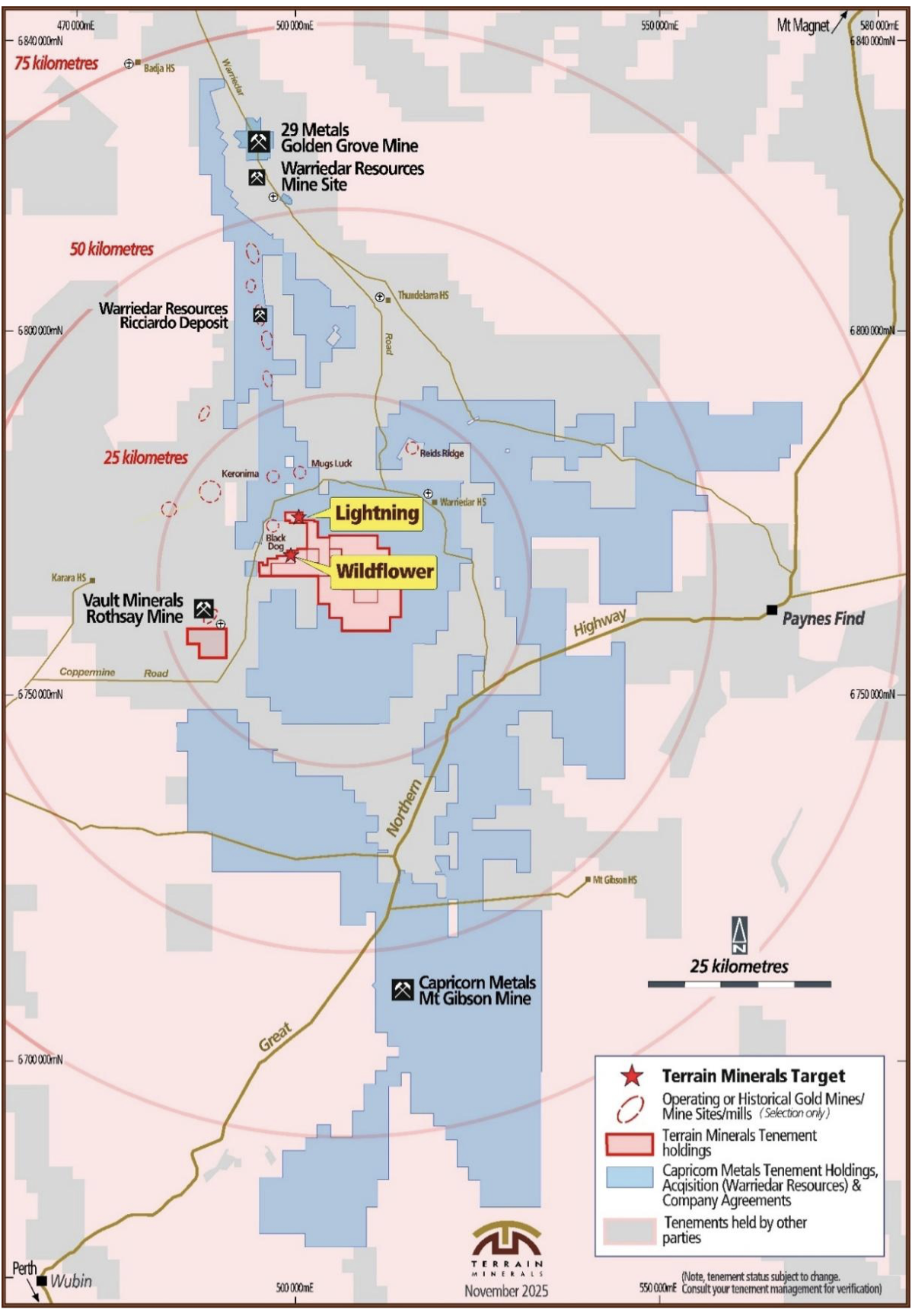
The Lightning Gold Prospect is located 15 kilometres from the operating Rothsay Gold Mine and within proximity to Capricorn Metals’ 4.5-million-ounce Mt Gibson Gold Deposit.
The transition from geophysics to the drill bit has been rapid, with the IP data delivering “clear” targets that can be tested along strike over the 800-metre-plus trends. The work positions Wildflower as a follow-up growth opportunity designed to expand Terrain’s gold footprint within Western Australia’s Murchison Gold Province.
Follow-up drilling will test whether the IP anomalies coincide with sulphide-associated gold mineralisation similar to that reported at Lightning.
"We are accelerating our exploration strategy at the Smokebush Project following this rapid and cost-effective survey at Wildflower. The IP results have exceeded our expectations, revealing multiple large-scale targets that share the same characteristics as our Lightning and Monza discoveries," TMX executive director Justin Virgin said.
"Our systematic approach — using geophysics to identify targets before drilling — is proving highly effective. These IP anomalies are not subtle; they're large, coherent structures that demand immediate drill testing.
"With drilling at Lightning currently planned to commence before the Wildflower drilling in January, we're building serious momentum into 2026. We're not just exploring one prospect — we're systematically unlocking the gold potential across the entire Smokebush Project. The next six months will be transformational for Terrain."
Target evolution
The IP survey follows several years of systematic work at Wildflower, including detailed mapping across historic and elevated gold-in-soil anomalies and a successful aircore program that outlined encouraging mineralised zones.
Subsequent RC drilling intersected sulphides, indicating that IP could be an effective and relatively low-cost method for prioritising targets beneath soil cover. Terrain has previously applied IP at the Lightning–Monza target to the north of Wildflower. Both areas sit at comparable distances from the Mt Mulgine granite intrusion and along interpreted structural corridors.
IP in context
Induced polarisation (IP) measures how subsurface rocks respond to electrical current. Sulphide-bearing rocks — often associated with gold systems — produce distinctive chargeability and resistivity responses, allowing geologists to map potential mineralised structures before drilling. Deployed at district scale, IP can rapidly screen covered terrain, refine drill targeting and reduce the risk of testing blind geology.
What the survey shows
1) Multiple large target zones
- Broad chargeability anomalies extend for more than 800 metres.
- Several parallel trends point to a potentially extensive mineralised system.
- Targets are coherent and positioned for near-term drill testing.
2) Alignment with existing discoveries
- Dominant east–west structures are consistent with controls mapped at Lightning and Monza.
- Similar magnetic rock packages to those hosting mineralisation at nearby prospects.
- The structural setting is considered favourable for higher-grade gold shoots.
3) Indicators of alteration
- Low resistivity corridors suggest zones of hydrothermal alteration.
- Alteration halos are commonly associated with gold deposits.
- Multiple alteration trends increase the probability of intercepting mineralisation.
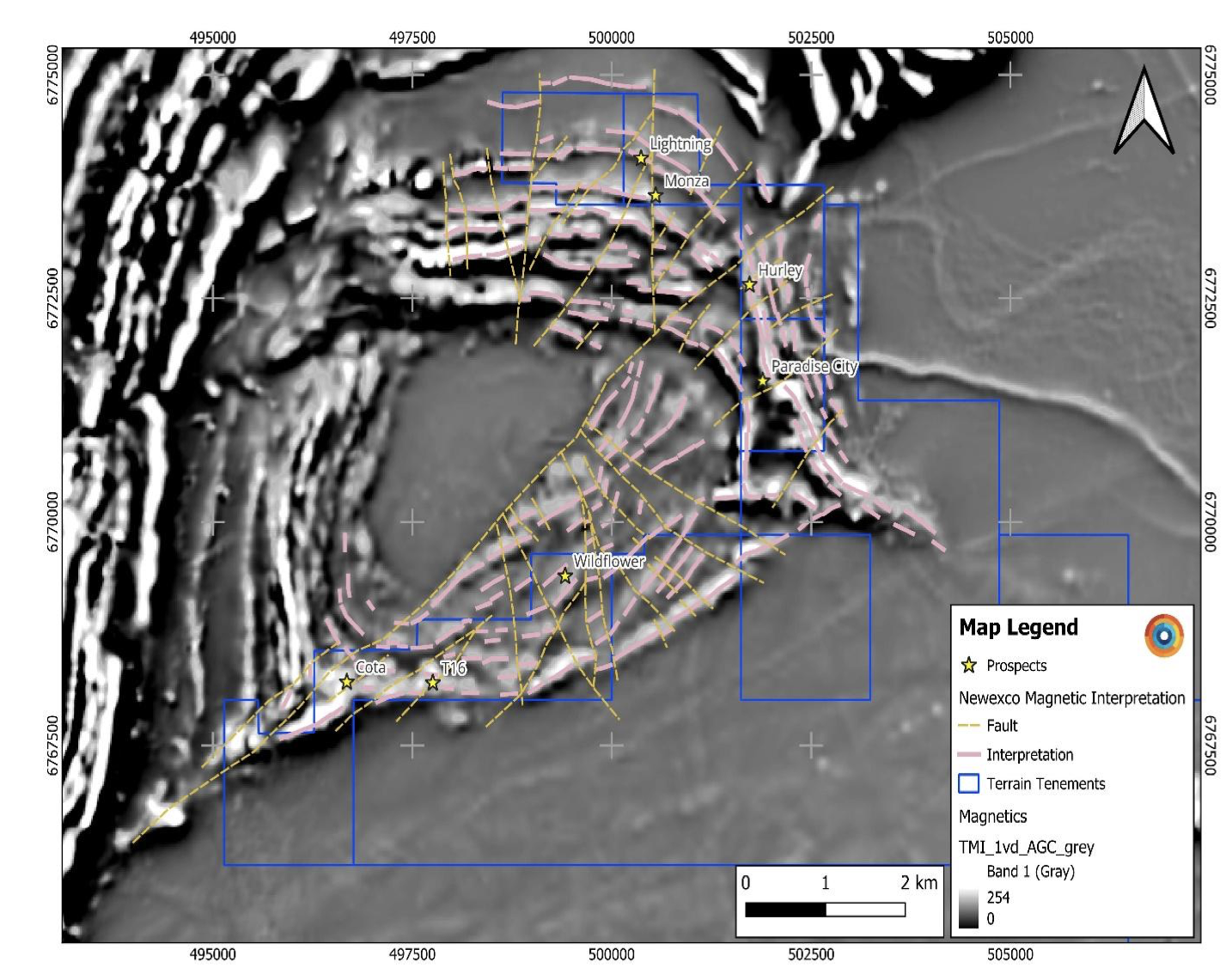
Interpretation of the magnetic stratigraphy is displayed in pink and the breaks in the magnetic stratigraphy has been interpreted to represent faults (shown as dashed orange lines). This interpretation is overlain on an image of the Total Magnetic Intensity (TMI) first vertical derivative in greyscale. Location of Terrain Minerals gold prospects across the project area are as marked.
What’s next
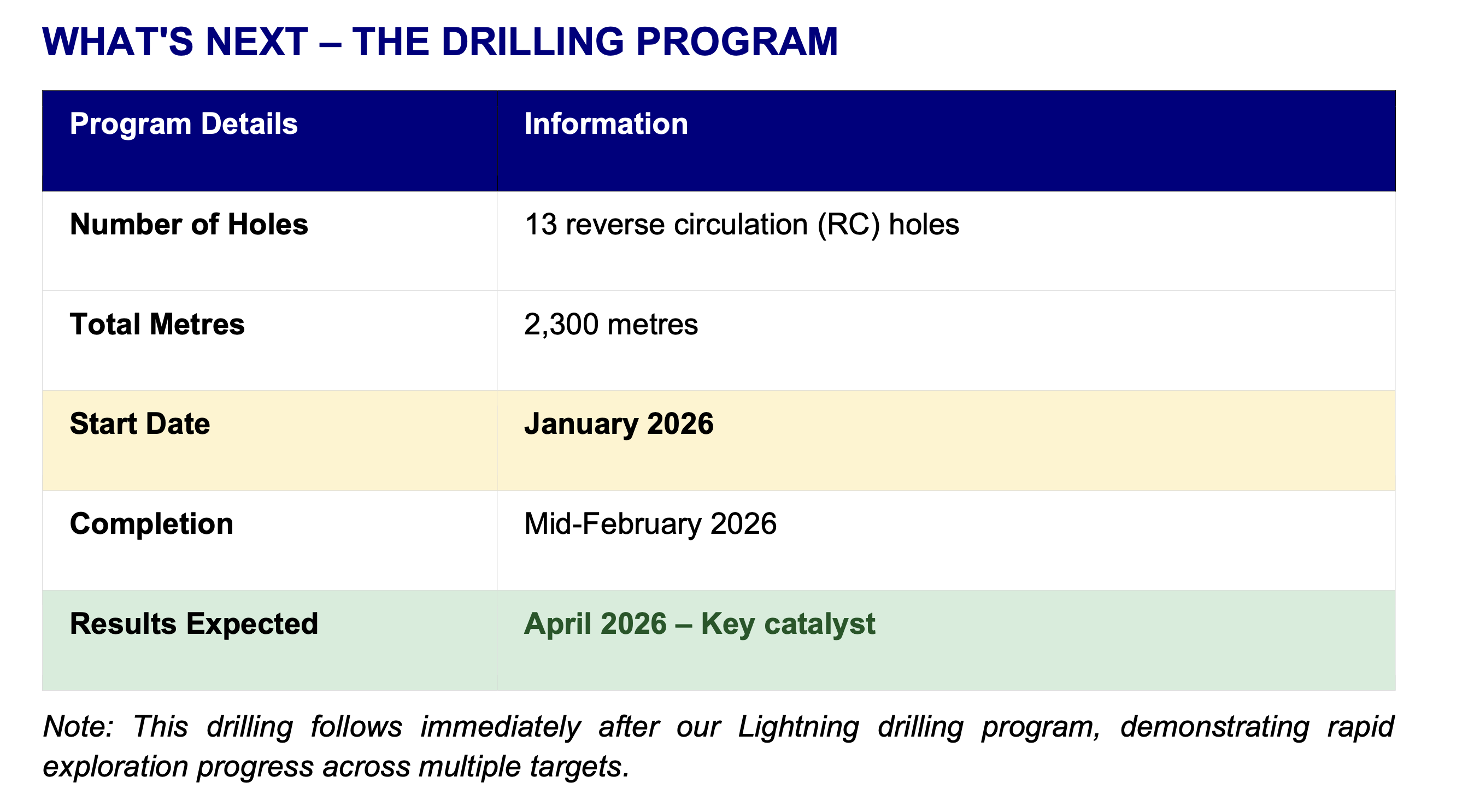
Terrain plans to sequence drilling at Wildflower behind its Lightning advancement program slated for the December quarter of 2025. Reverse-circulation drilling at Wildflower is scheduled to start in January 2026, comprising 13 holes for a total of about 2,300 metres. First assays are expected in April 2026, providing a defined timeline of near-term catalysts.
- Q4 2025: Advancement drilling at Lightning.
- January 2026: RC program at Wildflower — 13 holes, ~2,300 metres.
- April 2026: First assay results anticipated.
Investors will be watching for confirmation that the IP anomalies translate into gold mineralisation and for any indications that the Wildflower structures host similar grades or styles to Lightning. A successful program would add scale to Smokebush and refine Terrain’s understanding of granite-proximal mineral systems in the area.