
Gold exploration in Western Australia’s Eastern Goldfields has always been defined by scale. This is the terrain that delivered Jundee, Bronzewing and Thunderbox — mines that grew from open pits into long-lived underground operations and corporate cornerstones for Northern Star Resources.
For decades, the region rewarded explorers with gold systems that were shallow, continuous and easy to see — ore that sat close to surface, where geochemical anomalies lined up cleanly with the geology beneath.
Today, the easy discoveries are gone; many of the obvious targets have already been drilled by previous generations. What remains is still capable of producing large deposits — but hidden beneath layers of cover that require data, discipline and structural clarity before a drill bit can even be justified.
In that environment, discovery is not about luck; it’s about methodology.
Yandal Resources Ltd (ASX:YRL) has built its identity around this shift. Rather than focusing on near-term development or incremental resource additions, its aim is to become a repeat discoverer in a belt that continues to yield major orebodies — but now demands a more rigorous approach to uncover them.
A strategy matched to a mature belt
Yandal’s exploration footprint in the Eastern Goldfields covers more than 400 square kilometres of the Tier-1 Yandal Greenstone Belt across two core project hubs: Ironstone Well–Barwidgee and Mount McClure. Combined, these host more than 450,000 ounces of JORC gold resources — including 268,000 ounces at the Ironstone Well-Barwidgee Project’s Flushing Meadows deposit and 182,000 ounces at Mt McClure — all within realistic haulage distance of multiple existing processing facilities.
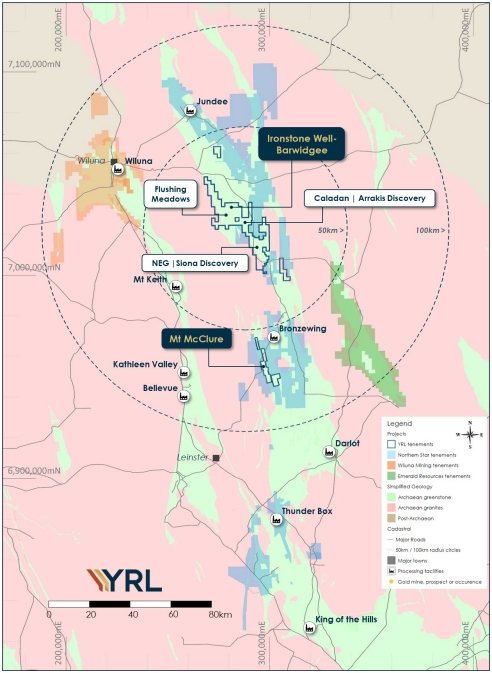
Two strategically located projects in the Tier-1 Yandal Greenstone Belt of Western Australia
Those ounces provide a valuation foundation and development flexibility, but discovery remains the central objective: identifying new systems capable of becoming future standalone deposits.
The exploration framework is anchored to three principles:
- Focus on belts that have already produced Tier-1 gold deposits.
- Reduce discovery risk using targeted geophysics and structural geology.
- Preserve development optionality by staying close to infrastructure.
Many juniors refer to systematic exploration; Yandal applies it in practice. Targets are advanced through a defined process — collect data, interpret the structural setting, and only then drill to validate the model.
In a belt where most outcropping mineralisation has already been tested, the differentiator is not the volume of drilling, but the quality of the decisions that lead to it.
Two discoveries in less than a year
Over the span of 11 months, Yandal progressed from target generation to announcing two distinct gold discoveries at Ironstone Well–Barwidgee: Arrakis and Siona.
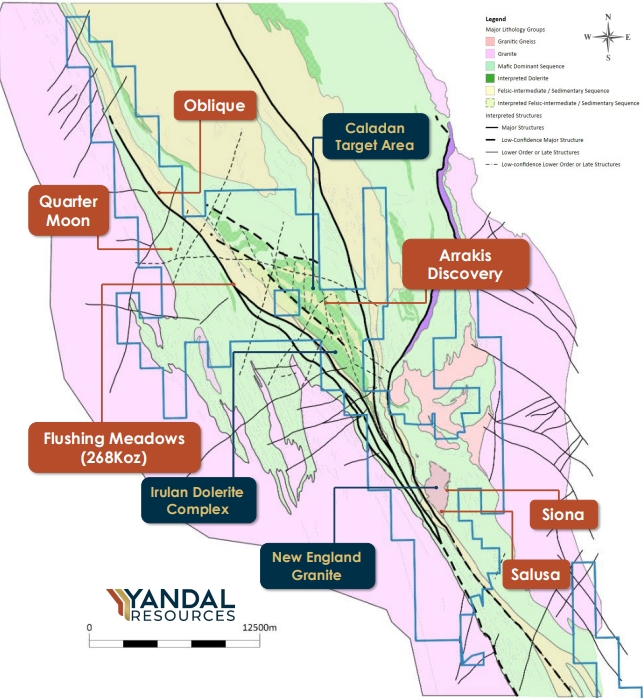
Ironstone Well & Barwidgee: Advancing Discoveries & Exploration
Securing even one modern discovery in the Eastern Goldfields is uncommon; securing two, each based on a separate geological model, points to a repeatable exploration process rather than a fortunate intercept.
Read more: Yandal quarterly: Arrakis drilling confirms second gold discovery within a year
Arrakis: a structural discovery delivering large mineralised widths
Discovered in September 2025, Arrakis lies within the Caladan structural area — a large, previously untested fold system with a major shear zone running through it. Earlier exploration in the 1990s relied on sparse, shallow drilling at wide spacing. Beneath transported cover, the geology remained hidden.
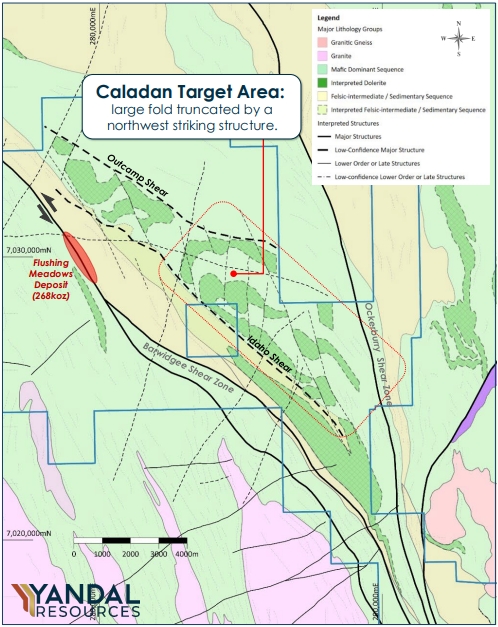
Arrakis Discovery: Caladan Target Area
Yandal began with a ground gravity program to refine structural interpretations. Only after those structures were understood did aircore drilling begin. In mid-2025, continuous gold mineralisation was identified over a strike length exceeding 2 kilometres.
Follow-up reverse circulation (RC) drilling returned wide, consistent intercepts from fresh rock, including:
- 54 metres at 1.2 g/t gold, including 24 metres at 2.1 g/t;
- 50 metres at 1.3 g/t gold, including 28 metres at 1.9 g/t; and
- 16 metres at 1.1 g/t gold.
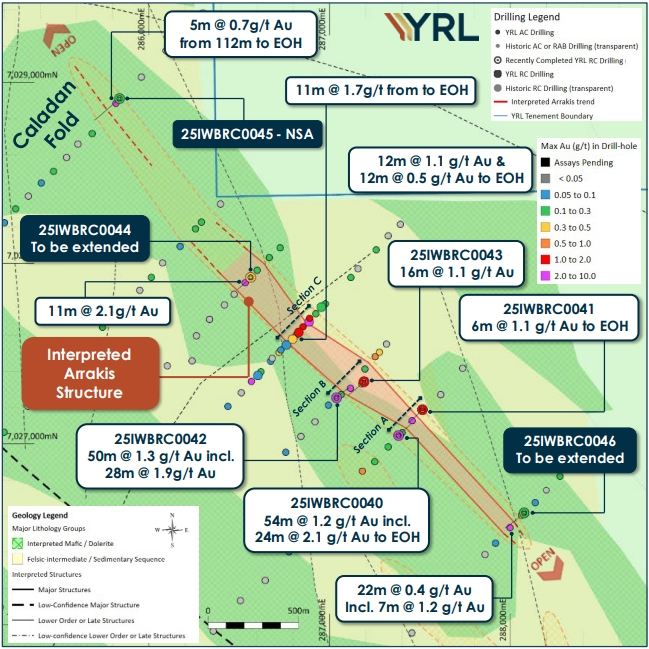
True widths appear to range from roughly 20 to 34 metres, indicating a robust structural zone rather than isolated shoots. The mineralised system remains open along strike, with parallel positions still untested.
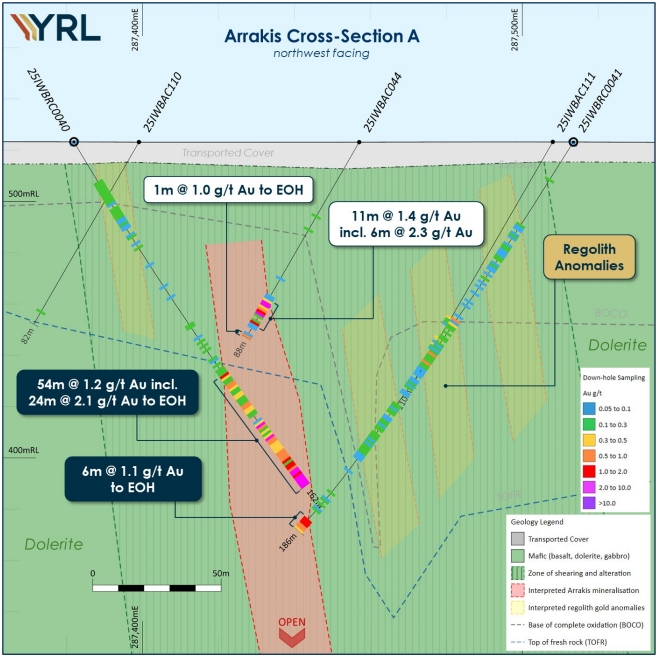
This is not typical “narrow-hit” greenfield success. The widths and continuity imply a mineralised system with scale.
Siona: a granitic-host discovery with room to grow
The New England Granite-hosted Siona discovery represents a completely different conceptual target. Instead of dolerite or basalt, Siona, discovered in late October 2024, sits on the margin of a large granitic intrusion that remains mostly untested due to cover.
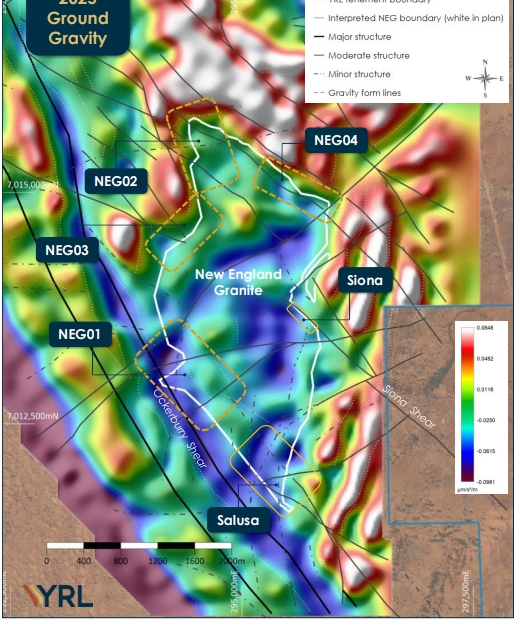
Yandal targeted it on geological theory — that intrusive margins can create favourable pressure and structural regimes for gold deposition, even without surface expression. Early drilling validated the concept, delivering true widths of 12–40 metres and continuity over more than 450 metres of strike. Multiple phases of mineralisation and emerging high-grade domains suggest a long-lived system.
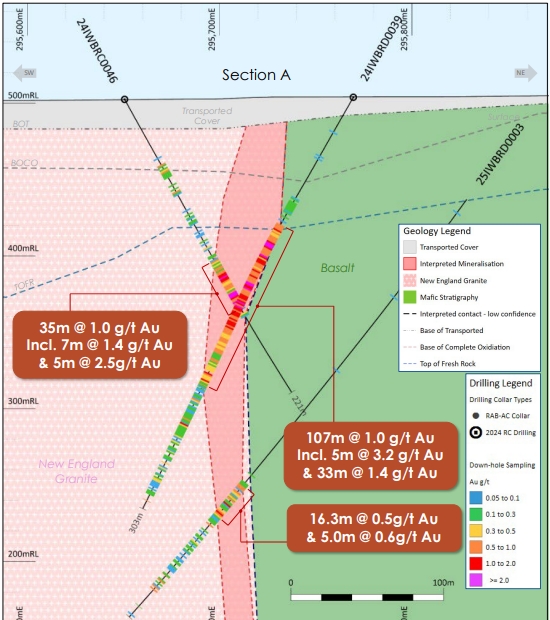
To date, only one side of the intrusive margin has been tested. Heritage clearances are expected to allow drilling on the western margin — effectively doubling the search space.
Siona is still in its early stages, but the continuity and geometry suggest another large-scale opportunity.
Existing ounces provide strategic flexibility — not distraction
Yandal also has an asset that many explorers would build an entire strategy around: the Flushing Meadows resource.
This deposit sits on a granted mining lease, with predominantly oxide mineralisation starting from surface. It lies within trucking distance of multiple mills operated by established producers. Beyond its existing 268,000-ounce inventory, new geophysics and soil work are revealing underexplored positions south and east of the current footprint.
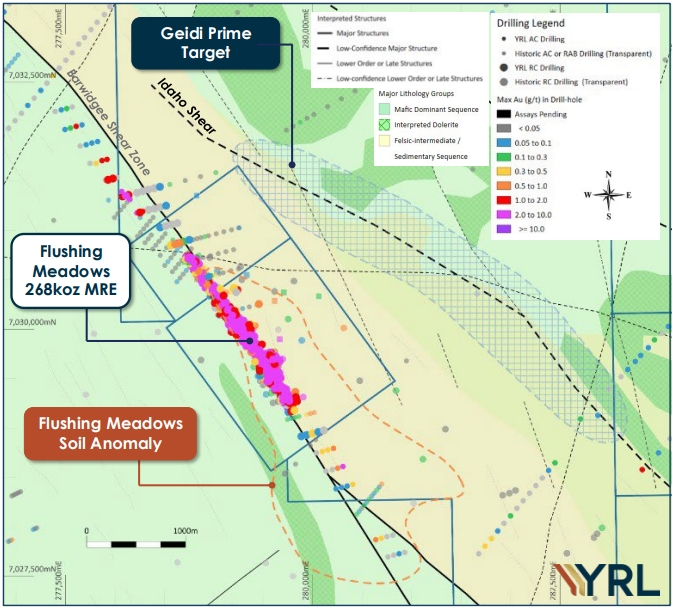
Largest Mineral Resource: Flushing Meadows
Flushing Meadows gives Yandal optionality. It can be advanced, monetised, partnered or divested — without shifting focus from the primary objective of discovery.
Mount McClure, the second project hub with a 182,000-ounce resource, is undergoing a strategic review, with KPMG Corporate Finance advising on a potential divestment to retain focus on the new discoveries.
A strong balance sheet, tight register and experienced leadership
Yandal is well-funded with a cash position sufficient to progress Arrakis and Siona through expanded drilling and initial diamond work. The register is concentrated among strategic investors and institutions — including Regal Funds (19.5%) and Gold Fields (15.9%) — supporting clear decision-making rather than reactive capital moves. Options maturing this year may also add non-dilutive funding.
The approach is reinforced by an experienced board and technical team. Chair Greg Evans brings more than two decades in mining-focused investment banking, and non-executive director Katina Law has held senior finance roles at major global miners. Managing director and CEO Chris Oorschot is an exploration geologist with extensive WA gold experience, supported by geology manager Owen Casey and strategic advisor Eduard Eshuys — well known for leading teams behind several major Australian gold discoveries.
Institutional backing, capital discipline and a proven exploration leadership team give Yandal the ability to allocate drilling where it counts — and move quickly when the geology supports it.
The next catalyst: drilling that answers scale, not just grade
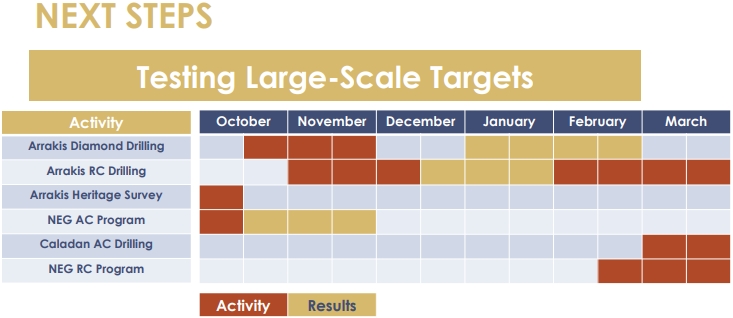
Yandal’s immediate work plan prioritises density and depth of information:
- Diamond drilling to test structural geometry at Arrakis
- RC drilling to step out along the two-plus-kilometre trend
- Broad aircore programs to track extensions along strike and into parallel structural domains
- Additional aircore and RC drilling across the intrusive margin at Siona
Each stage will increase geological resolution, progressively defining whether Arrakis and Siona have the size and continuity required to underpin development decisions.
Turning discovery into value
Exploration success is often measured by grade. In reality, scale is what drives value.
A company can drill high grades for years without defining a mine. Wide intercepts across kilometres of strike are what get the attention of majors — especially in a belt with mills seeking long-term feed.
Yandal offers a combination that is unusual among juniors:
- Multiple discoveries before resource drilling even begins
- Existing defined ounces to underpin valuation
- Strategic infrastructure within range if development becomes attractive
- A funded program focused on scale
In a region shaped by history, the next wave of success will belong to explorers who can see what the historical datasets missed.