
Novo Resources Corp (TSX:NVO, OTCQX:NSRPF, ASX:NVO) has outlined a string of high-grade rock chip results and fresh targets from reconnaissance work at its Tibooburra Gold Project in New South Wales, headlined by 39.9 g/t gold at Pioneer North and multiple standout assays at Pioneer South, where seven of 20 samples topped 4 g/t with a peak of 19.8 g/t. Recent mapping, down-hole televiewer and acoustic surveys at Clone, and core re-logging from Pioneer and New Bendigo point to shallow to moderate NNW-plunging high-grade shoots as the primary target style across the field.
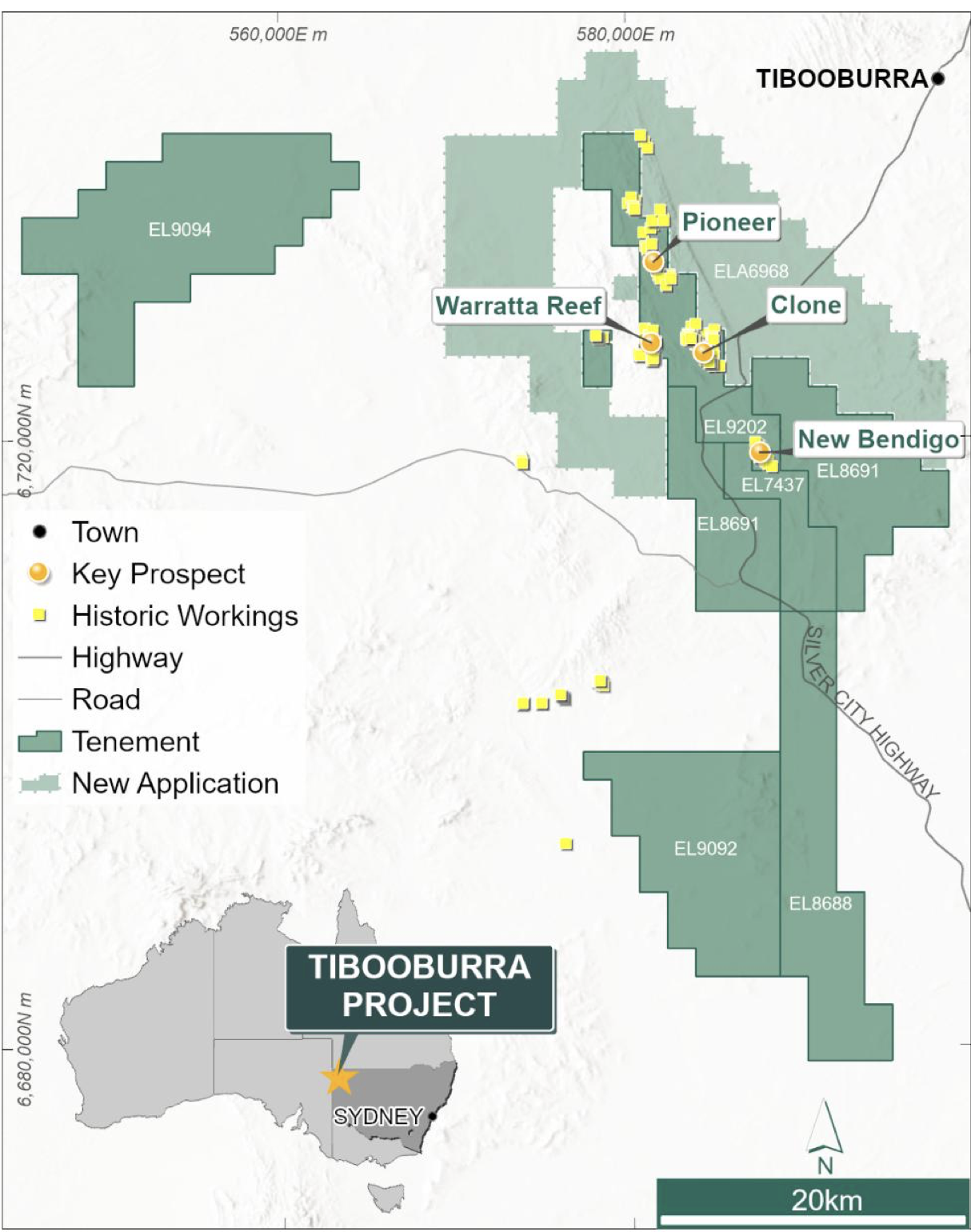
Location, tenure (including the new ELA6968) and key prospects at Tibooburra, NSW.
Assays are pending for 136 additional rock chip samples collected across priority prospects and 115 soil samples from Warratta Reef, while Novo has also staked an extra exploration licence covering ~350 sq km to consolidate the Tibooburra trend, including multiple zones of historic workings. Drilling targets are now being ranked to test down-plunge high-grade shoots at Clone and New Bendigo and the newly defined Pioneer South.
Beyond Tibooburra, Novo confirmed all regulatory approvals are in place to drill planned RC holes at the John Bull project near Grafton, NSW, with landholder access negotiations ongoing.
Tibooburra Gold Project (Farm-in with Manhattan Corporation (ASX: MHC)
Pioneer Prospect
The Pioneer Prospect is defined by a >2 km-long, +30 ppb gold-in-soil anomaly and multiple lines of historic workings, including shafts to ~76 m depth and a historic processing hub centrally located within the prospect area (Figure 2).
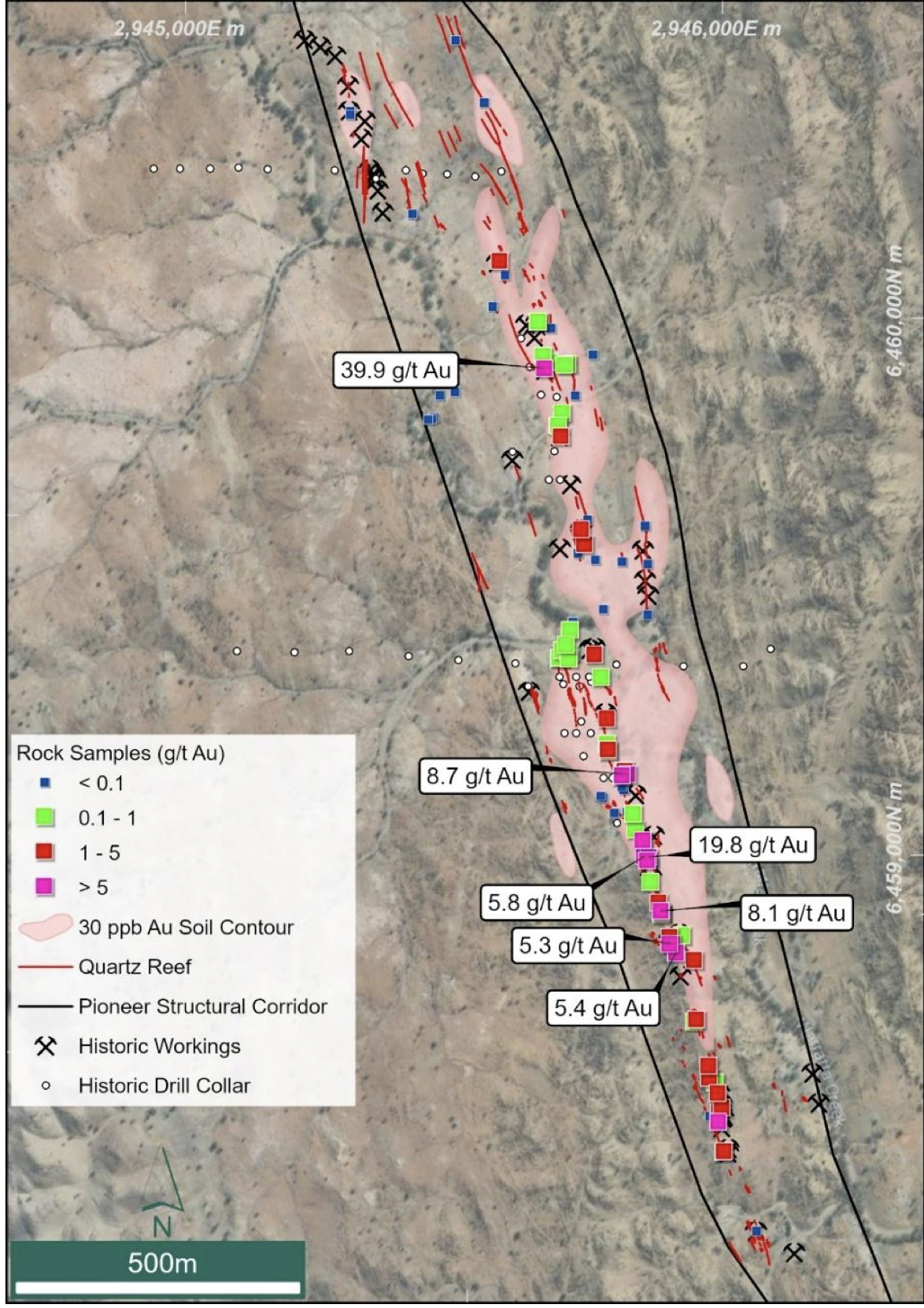
Plan view of quartz reefs with recently returned rock chip assays (Novo Resources sampling) at the Pioneer prospect and 30 ppb soil Au anomaly.
Recent mapping — integrated with historic datasets and diamond-core review — highlights multiple gold-bearing quartz reefs hosted in narrow but continuous, NNW-striking, steeply west-dipping oblique structures that cut regional foliation and isoclinally folded stratigraphy.
At Pioneer South, rock-chip sampling returned consistently high grades: 15 of 20 samples assayed >1 g/t Au, including 19.8 g/t Au, 8.12 g/t Au and 5.83 g/t Au, from outcropping high-grade reefs over ~600 metres coincident with numerous historic workings. The Pioneer South target has not been drill-tested.
Broad-spaced historic drilling in central and northern Pioneer returned previously reported peak intercepts (see appendices):
- 5 m @ 6.96 g/t Au from 199 m, including 1 m @ 33.90 g/t Au
- 2 m @ 14.74 g/t Au (TP003) from an original 4 m composite @ 4.39 g/t Au
- 3.8 m @ 1.90 g/t Au from 69 m
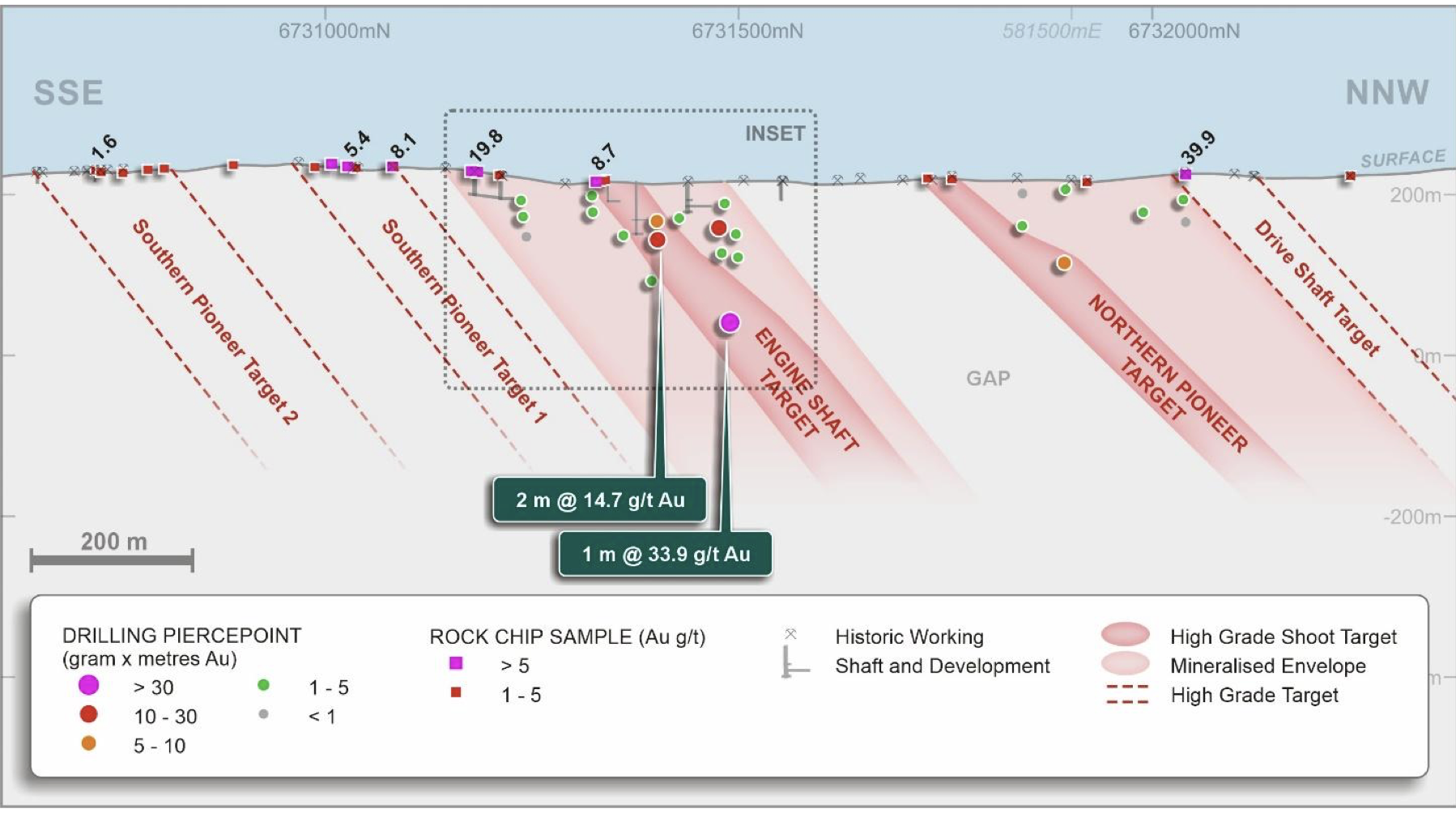
Long section interpretation showing the Southern Pioneer and Main Shaft targets, historic shafts, previous drilling pierce points 2, 3, 4, 7 from broad spaced drilling and recent rock chip results. Targets are high-grade NNW plunging shoots.
An additional 37 rock-chip samples from Pioneer are awaiting assay.
Gold-bearing quartz reefs are typically <1 metre wide and can be traced for tens to hundreds of metres. Adjacent footwall and/or hanging-wall mineralised zones locally thicken to 2–5 metres. Mineralisation is structurally controlled within a poly-deformed, tightly to isoclinally folded siltstone–shale sequence that is locally intensely sericite–carbonate altered, within a regional alteration corridor of multi-kilometre scale.
Structural data from mapping and oriented diamond core, together with 3D modelling of historic workings and drill data, indicate a moderate north to northwest plunge of high-grade shoots along the main mineralised structure. Drill testing across multiple sections at Pioneer South is being assessed to target these NNW-plunging high-grade shoots.
Clone Prospect
A downhole wireline geophysical program at Clone, completed by Borehole Wireline Pty Ltd, surveyed 12 existing RC holes (1,503 m) from campaigns by Novo Resources (2025) and Manhattan (2023). Optical and acoustic televiewer data were collected to generate “virtual digital diamond core” for structural interpretation (Figure 4). Additional tools (resistivity, induction-conductivity, natural gamma) were trialled but proved less useful for lithological or alteration discrimination.
Televiewer results have been incorporated into the evolving 3D gold model at Clone, which has previously returned results including:
- 12 m @ 5.90 g/t Au from 16 m, including 5 m @ 13.74 g/t Au from 23 m (TBR0001)
- 17 m @ 2.40 g/t Au from 59 m, including 9 m @ 4.14 g/t Au from 59 m (TBR0014)
The data support the interpretation of vein geometries and structural trends, indicating a shallow north plunge on the main shoot that remains open to the north and at depth (Figure 5). Planned drilling will focus on testing down-plunge extensions of the high-grade shoot and potential parallel mineralised trends.
New Bendigo
Mapping, surface sampling and relogging of seven diamond holes have been completed to identify additional mineralisation, assess potential extensions, and define the orientation and plunge of the main zone.
Wireframing of mineralised domains is ongoing, integrating new mapping and relogging. Pending surface assay results will be incorporated into updated models. Observed mineralisation styles include laminated to massive, narrow quartz veins; saddle-reef-style veining; and at least one occurrence of intrusive (felsic dyke)–hosted mineralisation in a parallel zone west of the main New Bendigo trend.
Warratta Reef Prospect
Mapping and rock-chip sampling (26 samples) were completed alongside 115 soil samples collected on a 40 m × 160 m grid. Multiple corridors of quartz veining exploited by historic workings have been mapped within a ~1.3 km × 400 m zone of altered sediments that trends undercover to the northwest.
The most significant working (~400 m long) targets a steeply west-dipping laminated quartz vein. Mineralisation styles include laminated to massive quartz veins, stacked/structurally thickened quartz zones, quartz–sulphide breccias, and saddle-reef-style mineralisation. Ongoing interpretation will be integrated with pending rock-chip and soil assays to refine drill targets. Of earlier reconnaissance samples, one returned 1.11 g/t Au (Table 1). All 26 new rock chips and all 115 soils are pending.
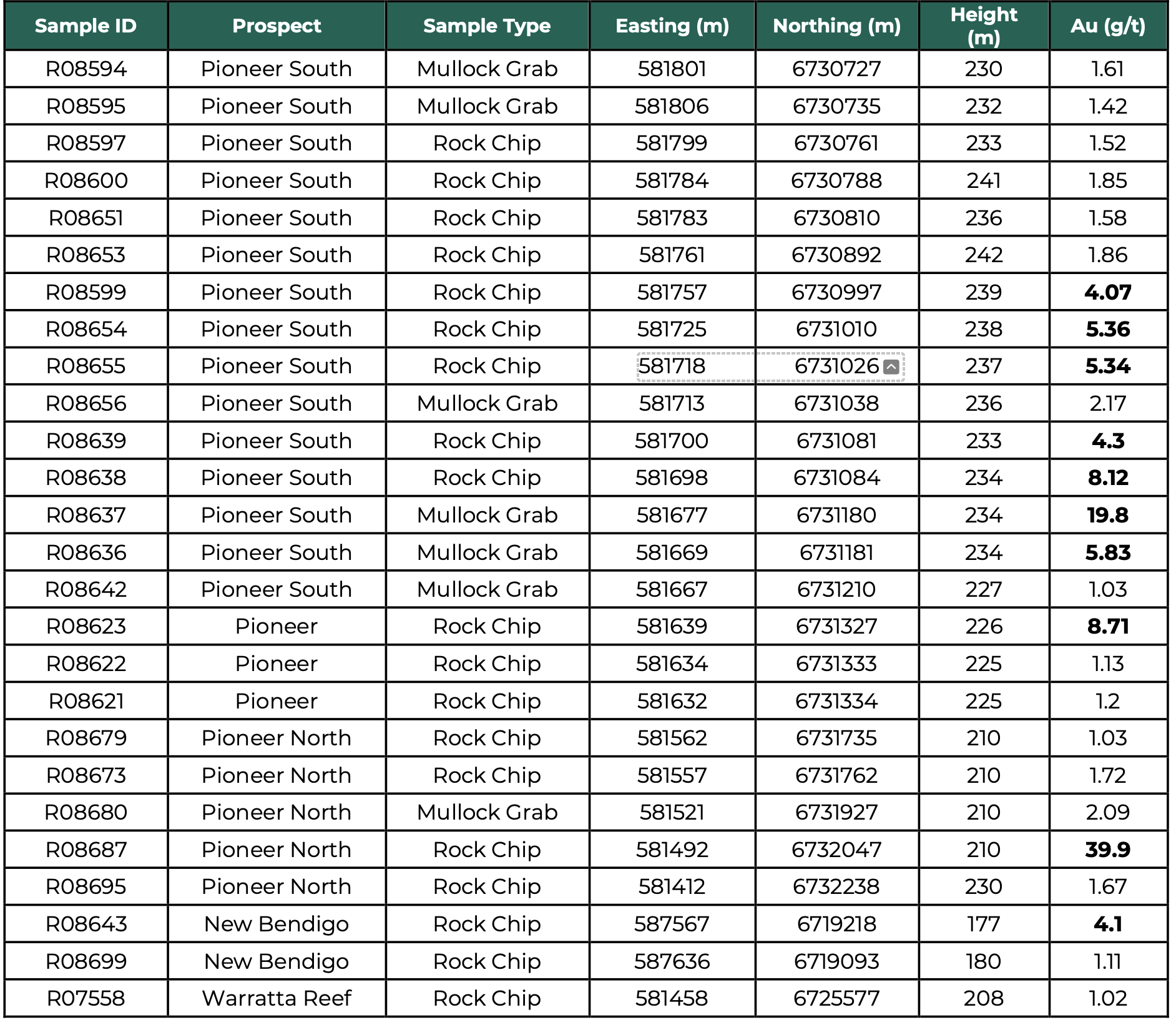
Significant (+1 g/t Au) rock chips returned from recent sampling at Tibooburra.
New Applications – Tibooburra
An application (ELA6968) has been lodged for ~118 units (~350 km²) ~20 km southwest of Tibooburra. The area is contiguous with current tenure and includes the northern extension of the Albert Goldfield and numerous historic workings.
John Bull Gold Project - Farm-in with TechGen Metals (ASX: TG1)
A ~1,750 m RC program is planned to test four high-priority targets: John Bull Main, John Bull South, Hills Creek West and Diggers North.
Drilling will start once all regulatory and land access requirements are met. Regulatory approvals are in place; landholder access negotiations are ongoing.