
Altech Batteries Ltd (ASX:ATC, OTC:ALTHF) says long-running field data from South Africa shows its partner AMPower’s sodium-nickel-chloride (SNC) units deliver standout reliability in telecom and industrial UPS applications, with failure rates of just 0.6–1.5%. That compares with typical failure ranges of 3–5% for lithium-ion, around 8–12% for lead-acid and more than 2–4% for nickel-cadmium systems, underscoring a clear lifetime and safety advantage.
The SNC fleet — deployed across South Africa’s telecom networks and UPS installations for more than 15 years and in some cases spanning over two decades — routinely achieves 15–20+ years of service life with minimal capacity fade and little maintenance. The chemistry’s inherent fault tolerance means packs continue operating even if an individual cell fails, helping ensure uninterrupted system performance in challenging environments.
Altech highlights a major cost advantage over conventional chemistries, driven by lower replacement frequency as well as the absence of ventilation or active cooling requirements — key levers that reduce total cost of ownership. Performance benchmarking against lithium-ion, lead-acid and nickel-cadmium further supports SNC’s long-life and safety credentials.
Given these attributes, the company says SNC is emerging as a highly reliable, largely maintenance-free option for explosive ATEX zones, remote operations and other critical industrial assets. The South African track record forms part of Altech’s expansion thesis as it targets opportunities in European pipeline and hydrogen control infrastructure.
“It’s great to see real service-life data confirming the reliability and consistency of SNC battery technology," Altech managing director Iggy Tan said. "These results back up our long-held understanding of how well the batteries perform under harsh conditions, including high temperatures and frequent power disruptions. The exceptionally low failure rate highlights the strength of the chemistry and design, while the high float life proves their long-term stability. This outstanding durability sets SNC batteries apart as one of the most dependable and low-maintenance energy storage solutions available today.”
Proven performance in extreme South African conditions
SNC batteries have been deployed across South Africa since the early 2010s to power telecom towers, utility substations and industrial controls. They run reliably in extreme settings — routinely facing temperatures above 50 °C and frequent grid outages — yet continue to deliver stable capacity and output.
Units installed as far back as the mid-2000s are still operating without maintenance or electrolyte replacement. Field data collected by AMPower reports an exceptionally low failure rate of just 0.6–1.5%, underscoring the chemistry’s reliability.
With no active cooling required and minimal servicing, real-world results show SNC batteries are ideal for remote sites and high-temperature environments.
Built to last: Solid-state design, sealed for life
Sodium-Nickel-Chloride (SNC) batteries achieve long life through a solid-state ceramic design and fully sealed architecture.
There are no flammable electrolytes, vented gases, or corrosion pathways. The internal molten sodium / nickel-chloride reaction is contained within a β-alumina (BASE) ceramic electrolyte, enabling stable operation over thousands of cycles.
Unlike lead-acid and lithium-ion, SNC chemistry does not form dendrites and its electrolyte does not degrade. It is immune to over-discharge damage and can sit idle for months without capacity loss. This chemical stability and mechanical robustness translate to service lives exceeding 15–20 years in both float and cycling applications.
Head-to-head: SNC vs. conventional chemistries
Industry experience typically shows failure rates around 3–5% for lithium-ion, 8–12% for lead-acid, and 2–4% for nickel-cadmium (see Table 1).
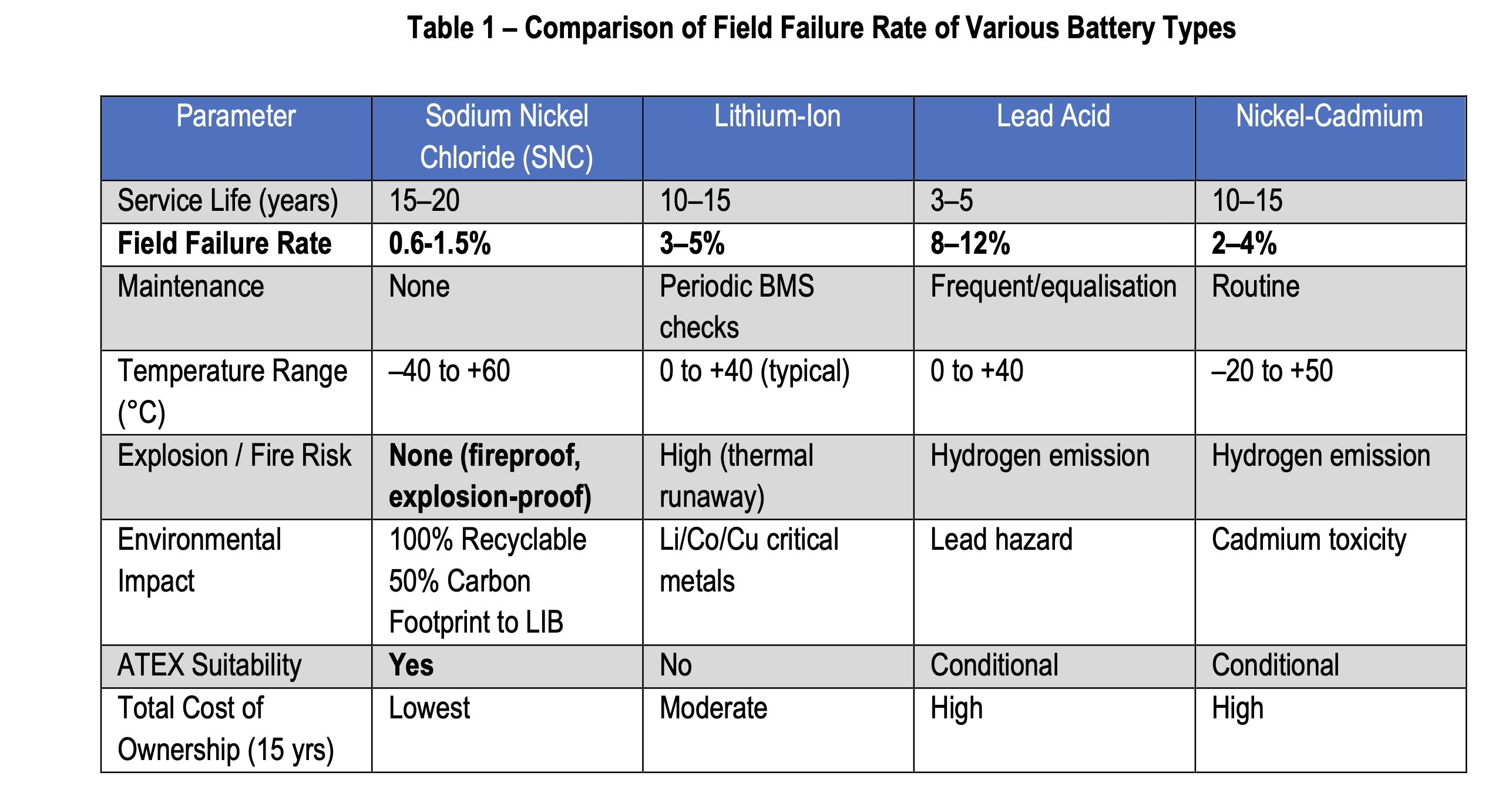
Failures often arise from chemical aging, heat stress, or mechanical damage. Lithium-ion cells may suffer dendrite growth, electrolyte breakdown, and thermal runaway; lead-acid systems commonly face sulfation and plate corrosion; nickel-cadmium can exhibit memory effect and electrolyte leakage.
SNC batteries avoid these issues: their solid ceramic electrolyte contains no liquid to corrode or gas to evolve, and they operate in a controlled, stable thermal regime.
Built-in fault tolerance at the cell level
Each SNC cell resides within a β-alumina solid electrolyte tube that conducts Na⁺ ions while blocking electrons. If a micro-crack forms, the battery does not necessarily fail.
At the approximately 270 °C operating temperature, molten sodium can wick into the fracture and create a thin ionic bridge, preserving ion transport and conductivity.
Modules contain many cells in series and/or parallel, so if one cell’s resistance rises, the others share the load — maintaining steady voltage and dependable overall performance.