
Constellation Resources Ltd (ASX:CR1)'s September 2025 quarter was defined by steady technical progress on its Western Australian natural hydrogen portfolio and the emergence of a priority gold–copper drill target at Ularring.
The company now controls nine Special Prospecting Authorities with Acreage Options (SPA-AOs) spanning 87,602 square kilometres across the Edmund-Collier, Yerrida and Ashburton basins — ground cut by the Goldfields Gas Pipeline and near large industrial energy users.
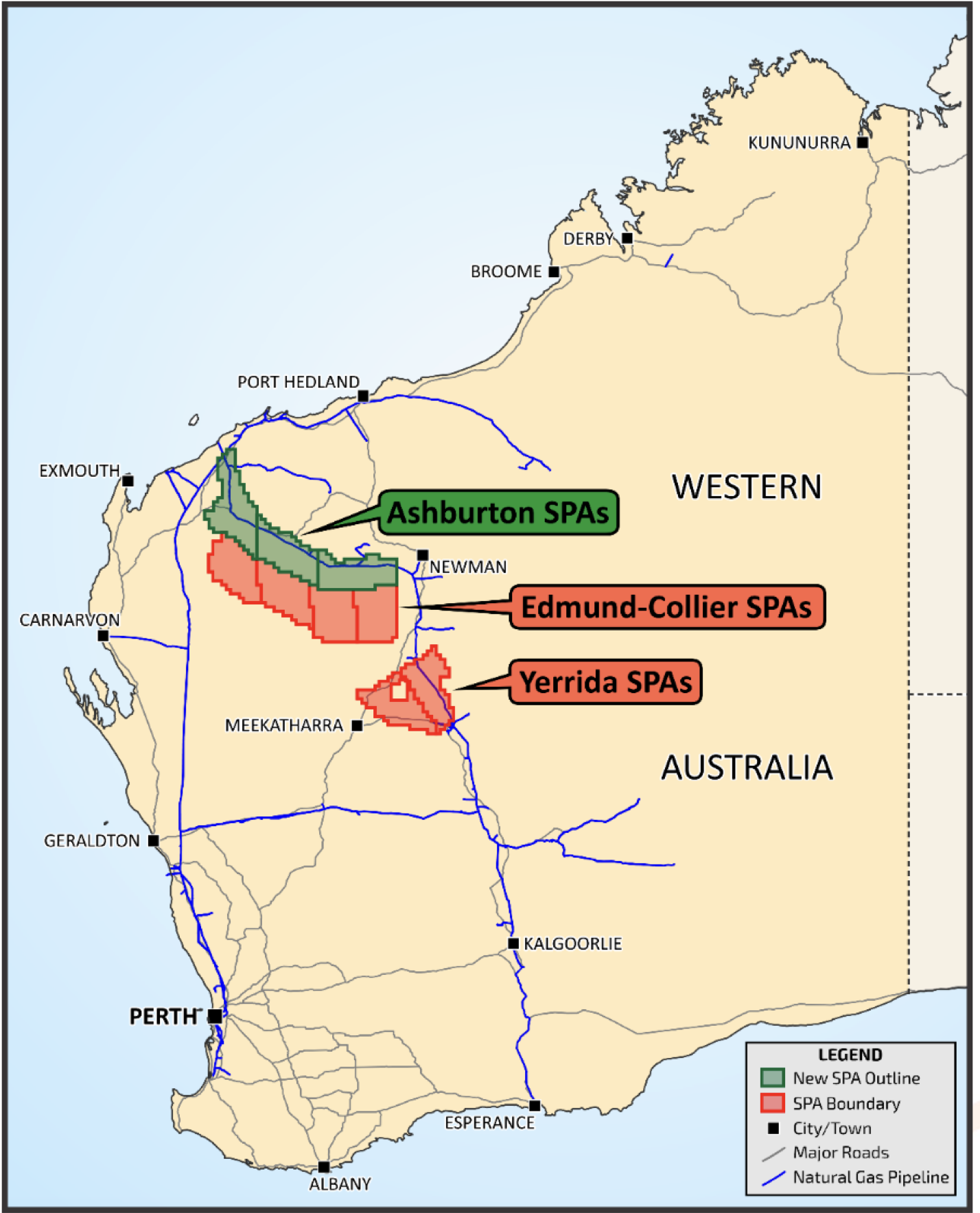
Constellation SPA-AO application locations.
Edmund-Collier, a 300 km x 40 km under-explored basin with no prior deep drilling, is positioned as a first-of-its-kind opportunity for natural hydrogen in the state, and with WA’s 2024 legislative change allowing hydrogen to be blended into existing gas pipelines, there is strategic relevance here for CR1 should a discovery be made.
The company raised $2.1 million gross via a non-renounceable entitlement and shortfall offer, ending the quarter with $1.53 million cash (up from $0.33 million), after $631,000 operating outflows and $1.83 million net financing inflows.
Strengthening the case for natural hydrogen
Technical work through and after the quarter strengthened Constellation’s geoscientific case across its hydrogen assets.
CSIRO crushed-rock and fluid-inclusion analyses from legacy diamond core revealed hydrogen, helium and natural gases (methane/ethane) in nearly all samples tested, with costs partially offset by a $50,000 Co-Funded Energy Analysis Grant.
Constellation interprets these results as evidence of both generation and migration of gases within Edmund-Collier, potentially linked to the thermal maturation of organic-rich shales in the Blue Billy and Discovery formations.
Complementary reprocessing of Geoscience Australia seismic line 10GA-CP2 indicates the basin deepens to ~4.2 km within the Wanna Syncline and that the Blue Billy and Discovery formations thicken and extend across the basin — key ingredients, together with regional faults (Godfrey and Talga), for a viable hydrogen system with potential antiformal traps along the Talga corridor.
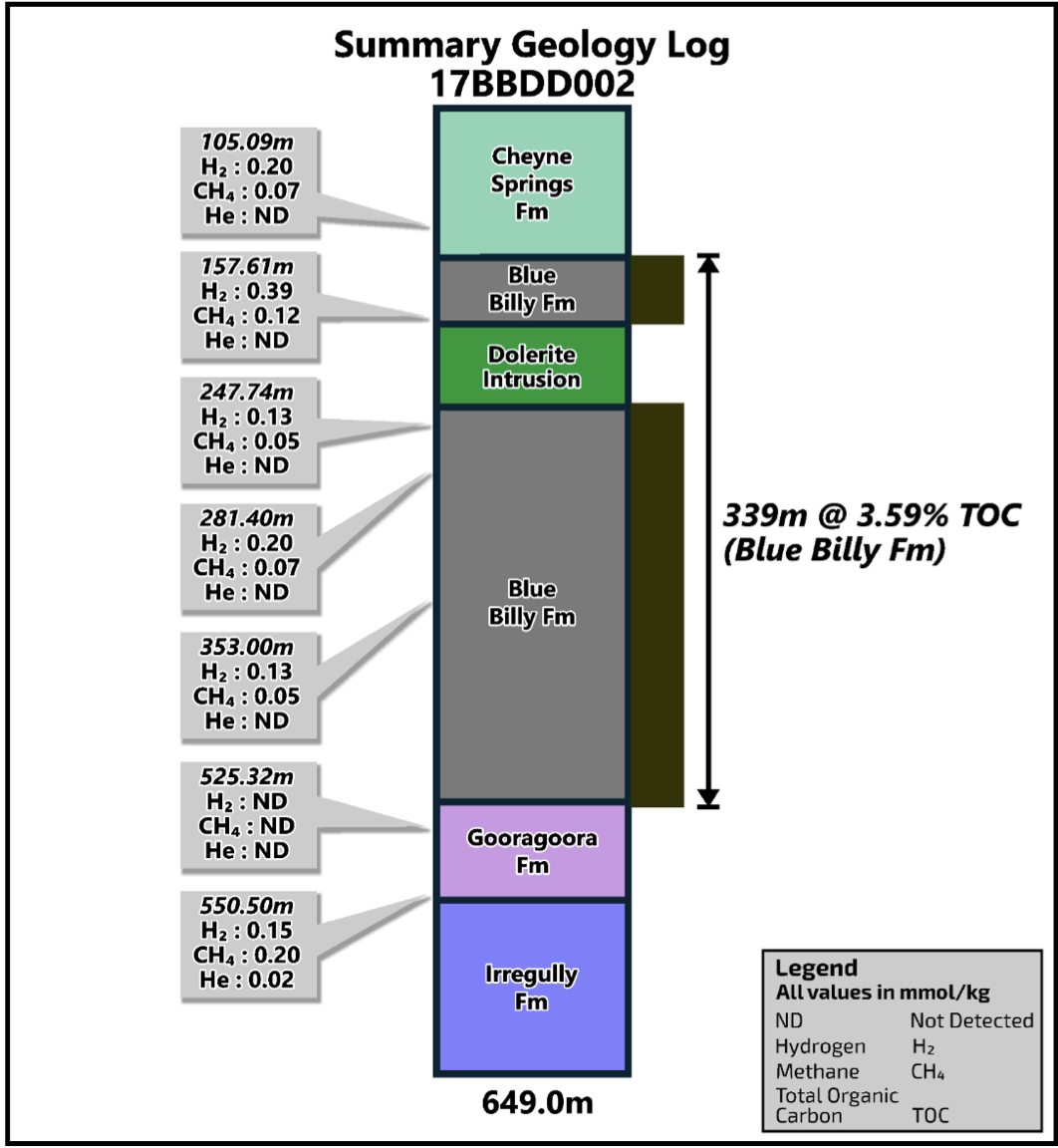
Results of CSIRO molecular gas composition bulk rock crushing over multiple intervals throughout 17BBDD002, implying migration of gases
throughout the stratigraphic column.
A parallel thermogenic hydrogen assessment delivered strong Total Organic Carbon (TOC) values from 10 historic diamond holes across Edmund-Collier and Yerrida. Multiple intervals returned averages above the 2% threshold typically considered “good to excellent” for potential natural hydrogen generation, with highlights including 5.24% average TOC in DDH2 and 5.2% in THD1 over broad down-hole lengths.
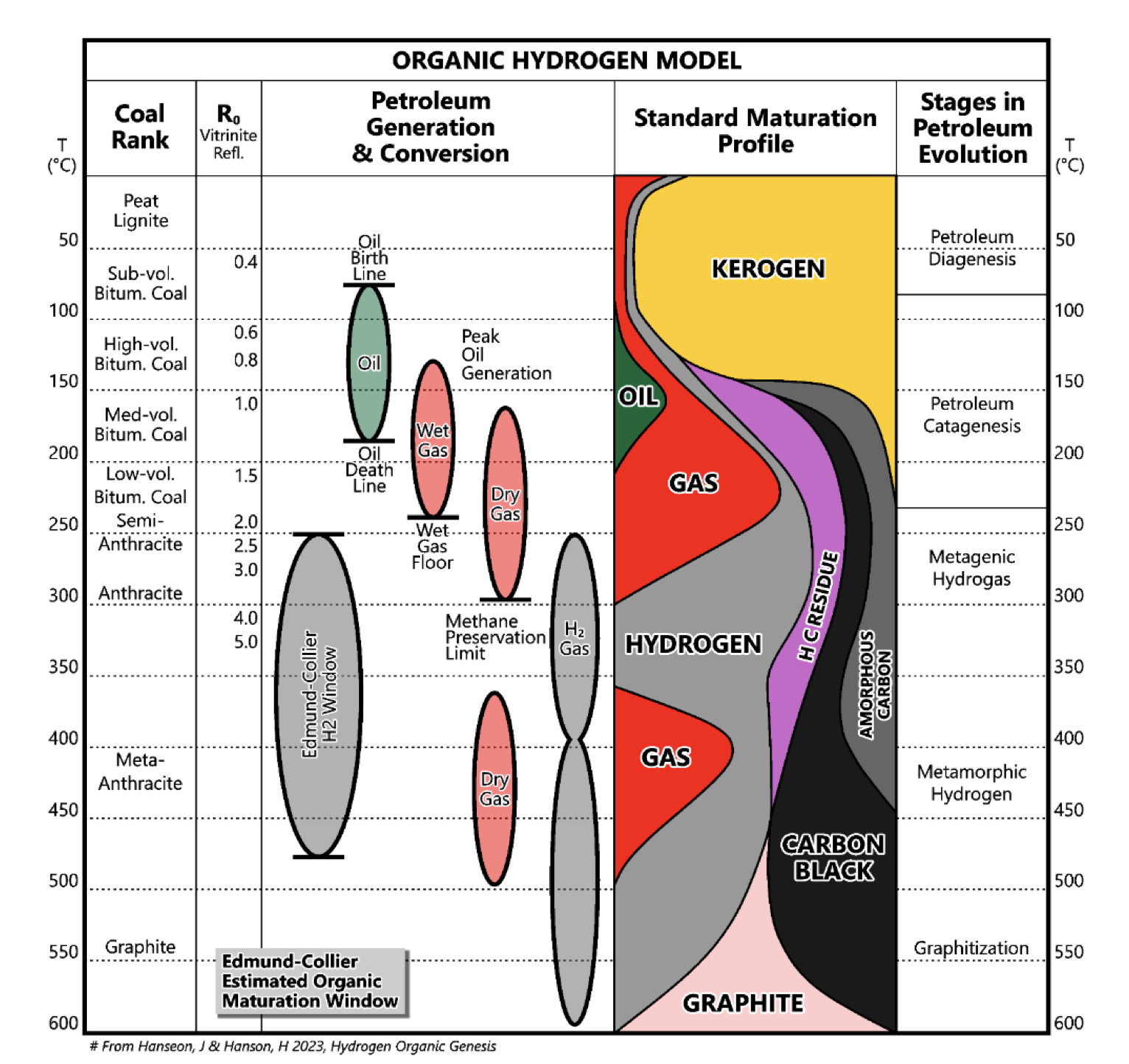
Hydrogen generation model (Hanson & Hanson, 2023) with interpreted Edmund-Collier Maturation Window Plotted.
With these datasets in hand, Constellation advanced stakeholder engagement and submitted its Environmental Plan to the Department of Mines, Petroleum and Energy, targeting staged commencement of regional soil-gas surveys. Handheld instruments will screen for near-surface seepage — an efficient way to home in on “invisible gossans” that could signal leakage from larger subsurface accumulations.
Consolidation at Ullaring
At the Ularring Copper-Gold Project (222 km²), the company consolidated a 24 km strike along the prospective Meenar Shear within the Yilgarn Craton — an intrusion-related metallogenic setting analogous to Boddington and Caravel.
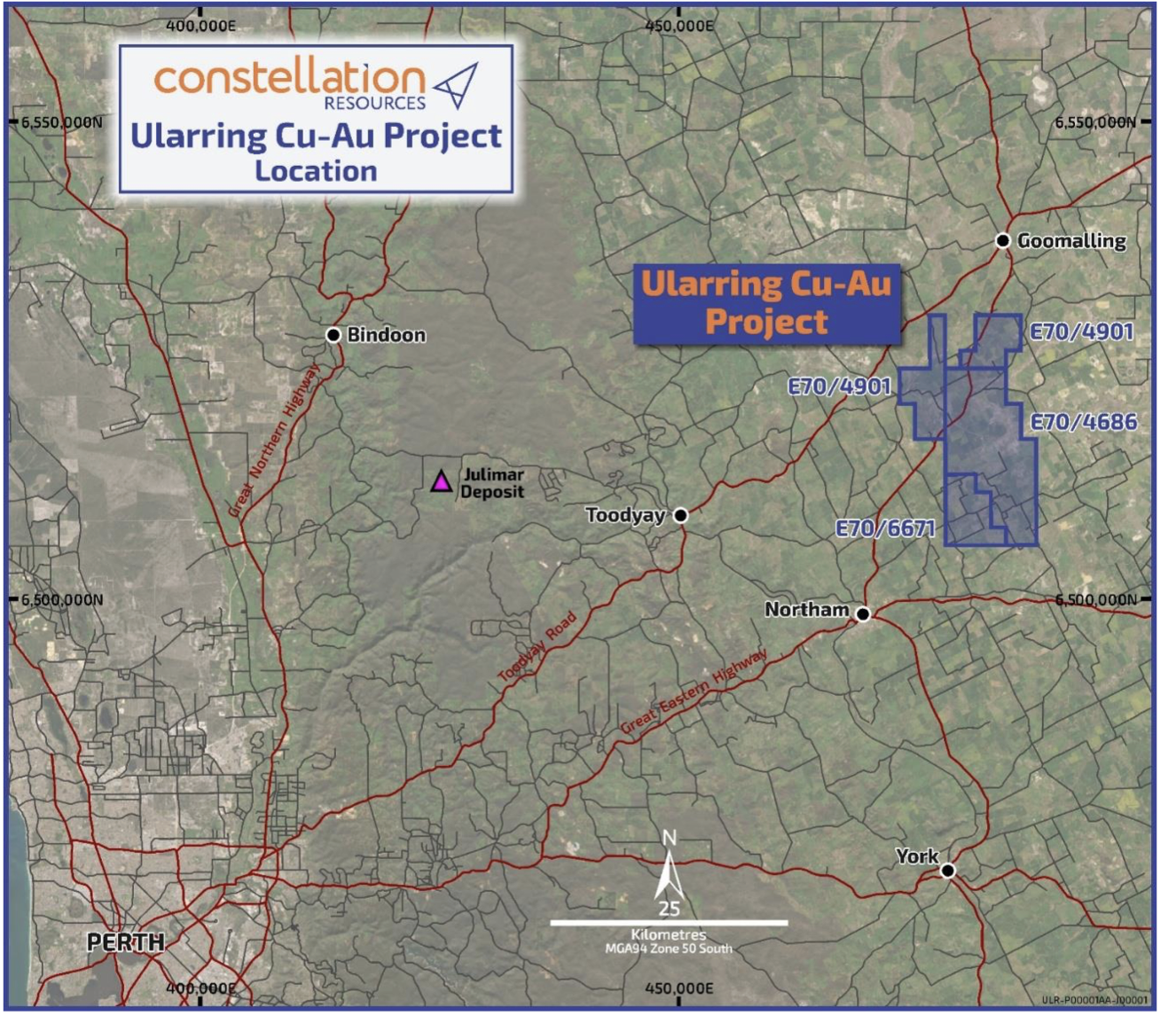
Ularring Project location.
Its maiden Ultrafine+™ soil program defined “Chatham,” a 1.3 km x 0.45 km Au-Cu anomaly (peak 78 ppb Au, 1,126 ppm Cu) coincident with a bullseye late-time VTEM conductor and favourable structural geology — now funded for drilling via a $57,500 Exploration Incentive Scheme grant, with first holes expected in the March 2026 quarter.