
Eco Buildings Group PLC (AIM:ECOB) founder Dr Etrur Albani spoke to Proactive about the company's innovative housing technology, its expansion into global markets, and how it’s tackling affordable housing shortages with fast, green, and durable building solutions.
Here we take a closer look at the conversation.
Proactive: Etrur, very good to meet you. You are out with news of another landmark deal this morning. Before we get into the details, for investors who may be new to the company, can you start by explaining what you do and how your construction technology is changing the way housing is delivered worldwide?
Dr Etrur Albani: Hi. Good morning Stephen, very nice meeting you and very nice talking to investors. What we have tried to do with Eco is basically create a revolution. We try to keep the exterior of housing familiar while transforming the internal industry to adopt to 2025 standards.
The beauty of Eco is that we take stone, grind it into gypsum powder, and then combine it with additives, silicone oil, fiberglass, retardants, and our secret formula. We mold this mix, effectively marrying the liquid and fibres back into a form of stone. That process brings speed, durability, quality, and visual appeal.
When you see our homes, they appear traditional. But we are building homes, not just houses. A key focus is quality — especially in affordable housing, which often suffers. Traditional industry homes are not breathable; they trap air and moisture, causing mold, which leads to issues like asthma, especially among young people.
Our houses are mold and damp free for life and also waterproof. We’re transforming the construction industry and we are the only ones who can keep up with the pace currently needed.
Proactive: Eco Buildings has just secured a landmark €420 million agreement to supply 20,000 homes in Chile under the government's social housing program. How significant is this contract for the company, and what does it say about the scalability of your technology and your entry into Latin America?
Dr Etrur Albani: I urge people to look at how President Boric is addressing social housing. Chile is like the Switzerland of Latin America — once certified there, most other countries accept that certification. So we moved into Chile to speed up entry into other Latin American markets.
Chile has a shortage of 400,000 houses. President Boric has promised to build 300,000. This is where we come in — with speed. In Dubai, 16 or 17 people were needed to produce one wall. Now, with just four people, we produce six houses a day. Everything is modular — like Lego — and we can install six homes in a week with a team of three or four people. Latin America is a key market for us.
Proactive: And you're also rolling out operations in countries like Albania, Kosovo — you mentioned Africa, including Senegal and Sudan — often through joint ventures and local partnerships. How does your model support your goal of deploying at least two production lines per country and scaling efficiency in each market?
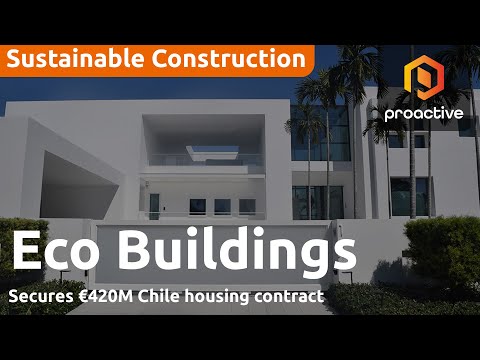
Dr Etrur Albani: Before I answer that, I’ll touch on Albania. We're not doing social housing there. Because of the image around modular housing, we entered the high-end market instead. Right now, we are constructing apartment blocks — low-rise, five-floor buildings — in the Mayfair of Tirana.
This shows our technology is versatile. The difference between affordable and high-end is only in the finishes — like marble floors or cladding. That’s why we have broader potential.
Our production lines are very cheap to build and we’re incorporating more electronic systems and even machine learning. That allows us to predict factory issues and cut costs further. A full production line can be built for under €10 million and is self-sustaining after six months.
People buy cars, boats, yachts — imagine spending that to solve a fundamental problem. Over 1.6 billion people worldwide live without proper housing. That’s where we come in. Africa is crucial to us — for sustainability and for preserving the environment. We are fully green, fully recyclable. Every unused wall is reground and reused. And our homes are permanent, not portable.