
Lightning Minerals Ltd (ASX:L1M) has intersected high-grade gold and silver mineralisation in the first results from its inaugural drilling campaign at the Mt Turner Gold Project in north-west Queensland, confirming the project’s strong near-surface potential.
The company reported standout intercepts such as 20.4 metres at 2.4 grams per tonne (g/t) gold and 14.3 g/t silver from 63 metres, including 1.8 metres at 10.6 g/t gold and 27.1 g/t silver from 77 metres, in hole 25L1MP3DD001 at Pit 3 (Drummer West).
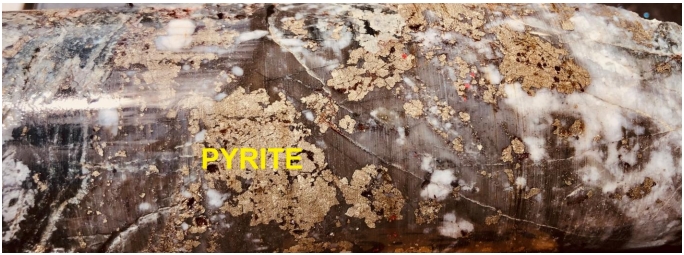
Epithermal style breccia hosted mineralisation (78.1m, Drill Hole 25L1MP3DD001).
“Excellent results from the first round of assays at the Mt Turner project have demonstrated to us the grade and scale potential that this project represents to the company,” Lightning Minerals managing director Alex Biggs said. “Results demonstrate continuation of the gold-bearing ore zone down dip, and we are still only at shallow depths, with mineralisation open at depth and along strike.
“It should be noted that this is only one target area, and with 14 kilometres of strike along the Drummer Fault to explore, we have many other drill targets for execution,” Biggs added. “To have intersected epithermal-style mineralisation is also a big positive as we understand that typically this represents potential for higher gold grades.”
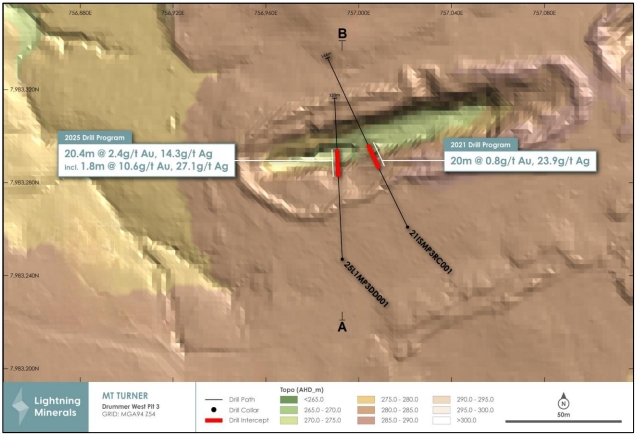
Plan view of Hole 25L1MP3DD001 and historic hole 21ISMP3RC001 (Drummer West - Pit 3).
Near-surface mineralisation confirmed
Eight of nine planned holes have now been completed in the fully funded diamond drill program, designed to test extensions of shallow mineralisation beneath historical oxide workings along the 14-kilometre Drummer Fault.
The initial three holes have confirmed breccia-hosted epithermal gold and silver mineralisation at shallow depths, with assays demonstrating both high grades and broad intercepts.
At Pit 5 (Drummer Girl), drilling from Hole 25L1MP5DD001 returned:
- 8 metres at 1.4 g/t gold and 4.8 g/t silver from 77.8 metres;
- 2 metres at 1.3 g/t gold and 1.6 g/t silver from 117 metres; and
- 1.9 metres at 0.9 g/t gold and 7.1 g/t silver from 127 metres.
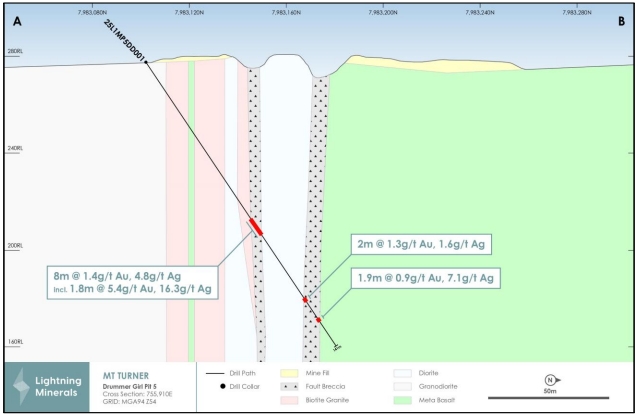
Cross-section and plan view of Hole 25L1MP5DD001 (Drummer Girl - Pit 5).
Mineralisation remains open both along strike and down dip, with results pending for four holes drilled across Pits 5 and 6 and the Cobar Line prospect.
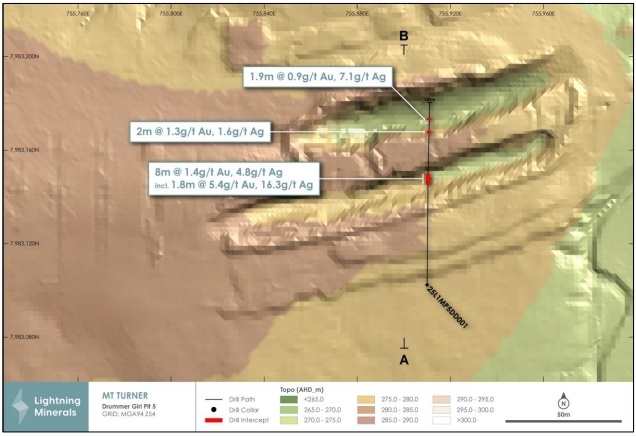
Plan view of Hole 25L1MP5DD001 (Drummer Girl - Pit 5).
Building momentum across a fertile system
Lightning says the wide intersection at Pit 3 — 20.4 metres at 2.4 g/t gold and 14.3 g/t silver — aligns closely with the geometry of the historical pit and confirms continuity of mineralisation beneath the oxide zone mined in the 1990s.
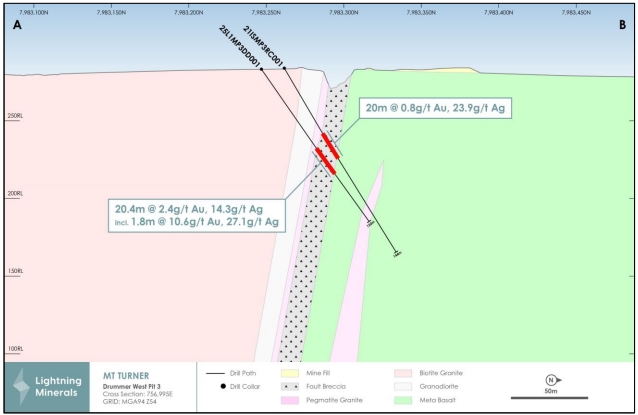
Cross-section of Hole 25L1MP3DD001 and historic hole 21ISMP3RC001 (Drummer West - Pit 3).
The company believes this early success validates its targeting model focused on epithermal gold mineralisation associated with the Mt Turner porphyry system, where multiple felsic intrusions and structural intersections create favourable conditions for gold deposition.
Soil and rock chip sampling along the Drummer Fault and adjacent structures has also been completed, with assays expected within four to six weeks. These datasets will support broader target generation for 2026 drilling.
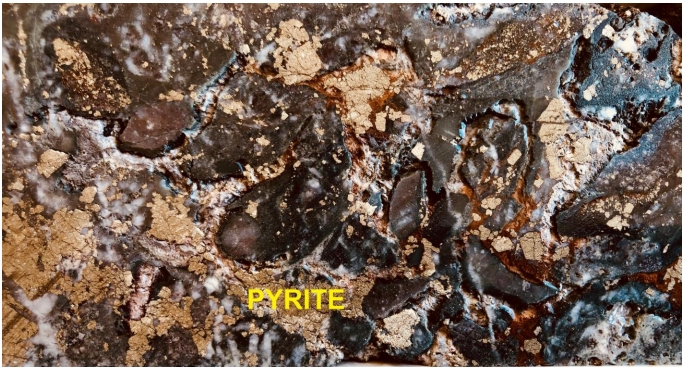
Epithermal breccia mineralisation (79.4m, Drill Hole 25L1MP3DD001).
Next steps
The current program is nearing completion, with follow-up drilling already being planned to test down-dip and along-strike extensions of the new intercepts.
Lightning expects to release further assay results over the coming weeks and said the findings will help refine its exploration model across Mt Turner’s multiple gold and silver targets.
The company also holds a portfolio of gold, lithium and critical minerals assets across Australia, Brazil and Canada, including the Boree Creek copper-gold project in New South Wales and the Dundas and Mailman Hill projects in Western Australia.