
The world is running short on copper — and time.
To meet net-zero targets by 2050, nearly twice the amount of copper mined in all of human history will need to be produced again in just 27 years. That’s the finding of multiple industry analyses, which warn that dwindling grades, slower discovery rates and ever-deeper deposits are squeezing the supply pipeline at the very moment electrification is accelerating.
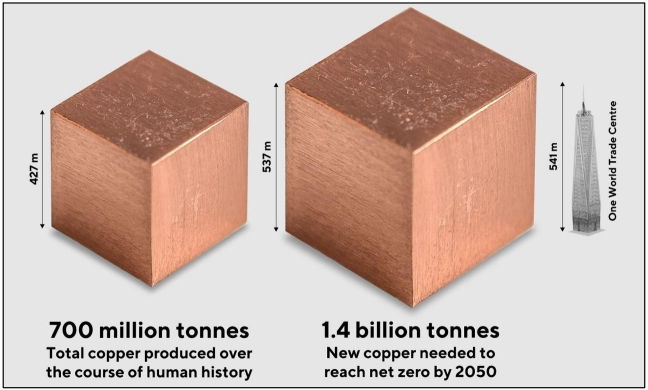
It’s a structural challenge with a simple implication: whoever can bring new, high-grade copper supply online quickly — in politically stable jurisdictions — will command investor attention.
That’s the backdrop against which FireFly Metals Ltd (ASX:FFM, TSX:FFM, OTC:MNXMF) is shaping its next growth chapter in Canada’s Newfoundland and Labrador province.
From discovery to development momentum
FireFly’s Green Bay Copper-Gold Project has emerged as one of the few advanced, high-grade copper opportunities left in a Tier 1 mining jurisdiction. With 1.2 million tonnes of contained metal at 2% copper equivalent (CuEq) already defined and drilling still expanding the resource, Green Bay sits on a rare foundation: scale, grade and existing infrastructure.
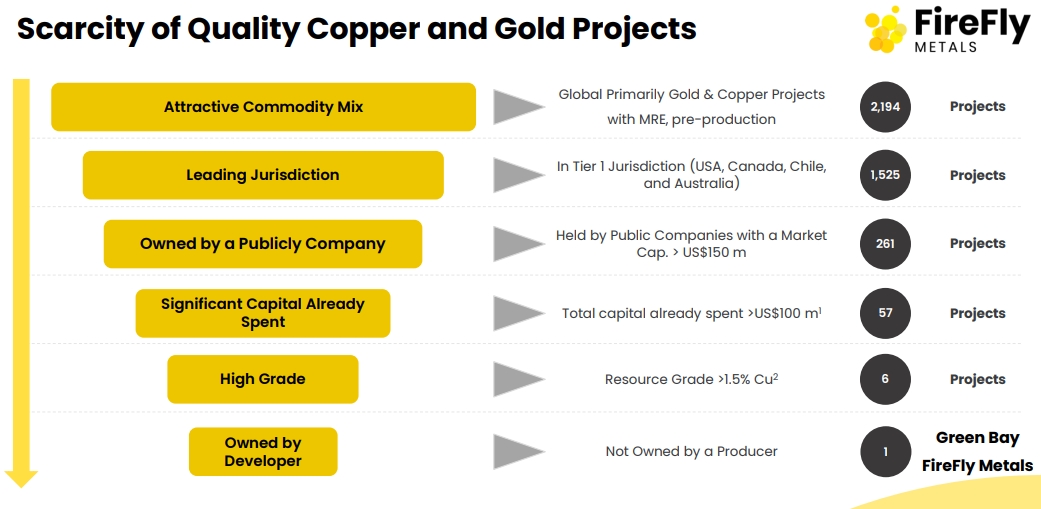
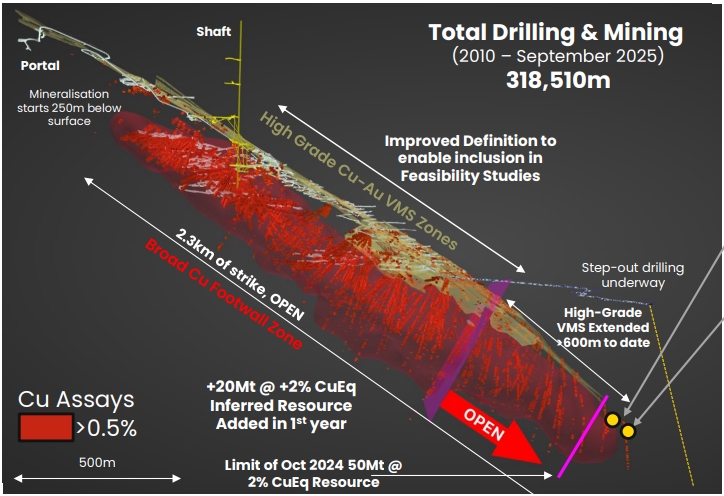
The project centres on the historic Ming Mine, a past-producing operation near the town of Baie Verte that has yielded copper-rich volcanogenic massive sulphide (VMS) ore for decades. Green Bay now incorporates and extends this system, combining both the high-grade Ming-style VMS lenses and the broader copper-rich footwall zone — a dual structure that gives the deposit unusual continuity and scale.
The mine site — complete with underground access, a 950-metre shaft, processing facilities, workshops and a deep-water port only 6 kilometres away — gives FireFly a head start that few explorers enjoy. It also means lower capital intensity and faster start-up potential once studies are complete.
Environmental approvals are already in place for an upscaled restart, with plans for a 1.8-million-tonne-per-annum processing plant and new tailings facility. Economic studies are now under way, targeting delivery in early 2026.
Well-funded and moving fast
FireFly enters this phase with a balance sheet that gives it unusual flexibility for a mid-cap explorer. As of September 2025, the company held roughly A$145 million in cash, receivables and liquid investments and carried no debt, streams or offtake commitments.
Its market capitalisation has surged from about A$70 million in August 2023 to roughly A$820 million as of September 2025 — a more than tenfold increase since acquiring Green Bay. In less than two years, FireFly has transformed from a junior with no rigs to an ASX 300-listed copper-gold developer running eight drill rigs across its Canadian portfolio.
At Green Bay alone, more than 130,000 metres of drilling is planned for 2025, with six rigs underground and two targeting regional prospects. The company has already completed more than 100,000 metres, with results continuing to expand both the high-grade volcanogenic massive sulphide (VMS) lenses and the broader copper-rich footwall zone.
A transformational acquisition for FireFly
High-grade results define a rare system
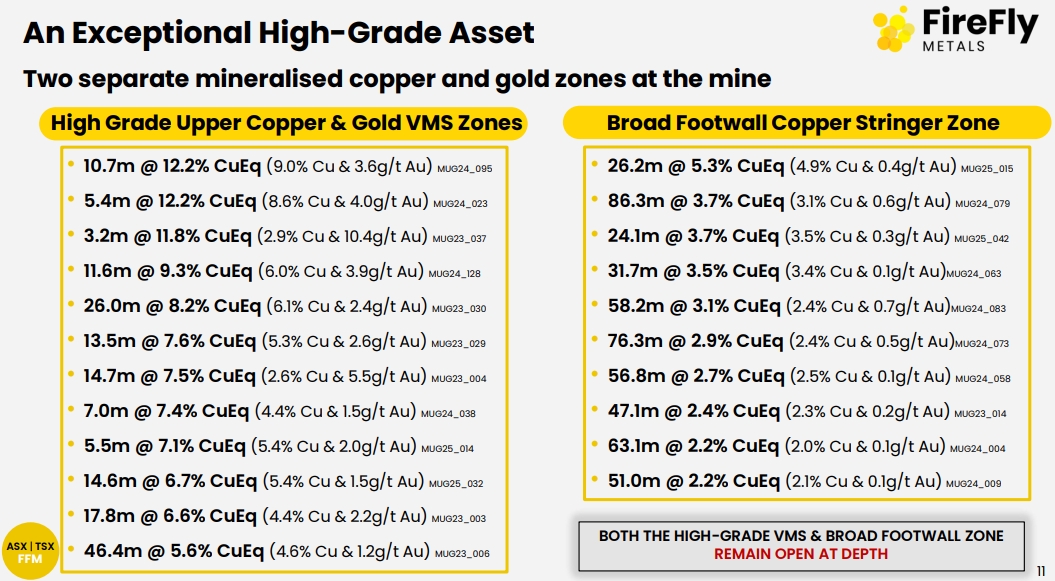
Few deposits can deliver both grade and width, yet FireFly’s latest drilling shows exactly that dual character. Highlights include:
- 10.7 metres at 12.2% CuEq (9.0% Cu & 3.6 g/t Au) from hole MUG24_095.
- 26.0 metres at 8.2% CuEq (6.1% Cu & 2.4 g/t Au) from MUG23_030.
- 86.3 metres at 3.7% CuEq (3.1% Cu & 0.6 g/t Au) from MUG24_079.
Both the upper high-grade copper-gold VMS zone and the broad footwall stringer zone remain open at depth, pointing to significant expansion potential.
These results reinforce what FireFly describes as a “world-class VMS system” — the kind of mineral architecture that historically underpinned long-life Canadian copper mines such as Kidd Creek (now under Glencore) and Flin Flon’s 777 system (Hudbay Minerals’ former flagship asset, which concluded 18 years’ production in 2022).
Regional upside: More than one Ming
Within the broader Green Bay property, step-out drilling at the Rambler Main and East Mine areas — just a few kilometres from the Ming Mine — is returning strong early hits, including 10 metres at 6.4% CuEq and 12.9 metres at 4.3% CuEq, from shallow depths of about 200 metres.
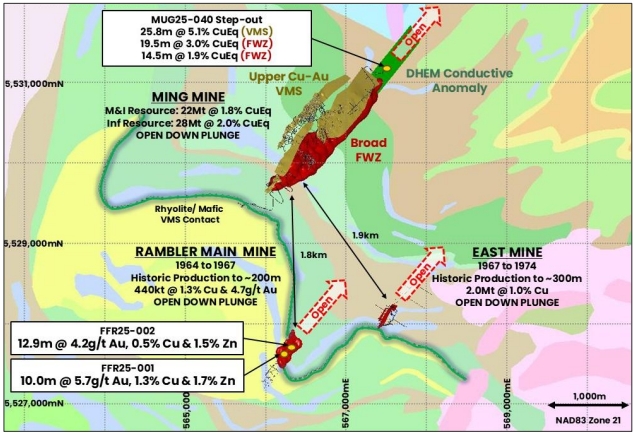
Multiple Targets Adjacent to Copper & Gold Ming Mine
Geophysics and mapping have outlined more than 300 untested targets across the broader district — many sharing the same structural and magnetic signatures as the Ming Mine itself.
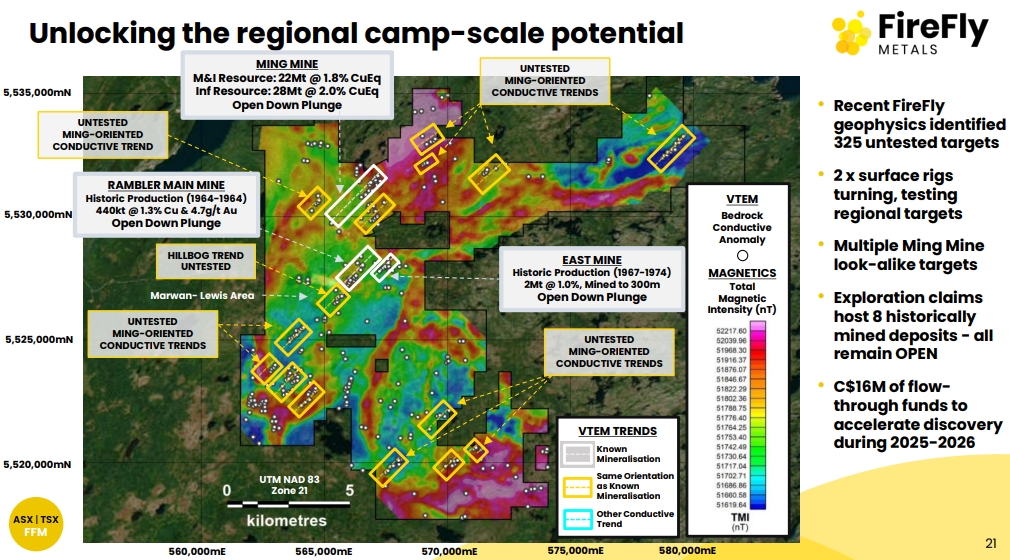
With C$16 million in flow-through funding earmarked for exploration through 2025–26, FireFly aims to prove the project could be the nucleus of a much larger copper camp.
Beyond Green Bay, FireFly continues to advance its Pickle Crow Gold Project in Ontario — a high-grade, shallow resource of 2.8 million ounces at 7.2 g/t gold with district-scale upside. The project has produced more than 1.5 million ounces historically and remains one of Canada’s highest-grade undeveloped gold deposits.
A copper-gold equation that adds up
The project’s 2% CuEq grade blends a copper-dominant resource with meaningful gold credits, a combination that adds resilience to shifting commodity cycles. Metallurgical testing shows recoveries of more than 98% copper and 85% gold, producing a high-quality concentrate with grades between 27% and 29% copper and no deleterious elements — a key advantage in tightening global concentrate markets.
That metallurgical simplicity matters. As major miners grapple with complex, lower-grade orebodies, Green Bay’s conventional processing flow sheet — crush, grind, float — and established port access stand out as differentiators that shorten the path to production.
De-risked jurisdictional advantage
Newfoundland and Labrador has become one of the most mining-friendly regions in the world, ranking in the global top six for policy perception in the 2024 Fraser Institute survey. The province contributes more than 30% of local GDP through mining and offers abundant low-cost hydroelectric power — a structural advantage as energy costs rise elsewhere.
For FireFly, that means lower operating costs, year-round road and port access, and strong community and government support. It also places the company within reach of North America’s rapidly expanding clean-energy supply chain — from electric-vehicle manufacturing to grid infrastructure.
Studies point to scale
The company’s engineering and economic work, already well advanced, is exploring multiple development pathways. The baseline case — an initial upscaled restart using existing underground workings and new surface facilities — has cleared environmental assessment.
Further options for a larger, long-life mine are being tested through ongoing geotechnical and paste-fill studies, hydro power assessments and process-flow design. FireFly expects preliminary results in the first quarter of 2026, paving the way for a formal scoping or feasibility study thereafter.
Five levers for 2025
FireFly frames its strategy around what it calls its “5 in 2025” value drivers:
- Resource growth — extending both the high-grade VMS and the copper-rich footwall zones.
- New discoveries — testing near-mine and regional targets.
- Upgrades — converting Inferred to Measured & Indicated tonnes for mine planning.
- Global scale — positioning Green Bay as a large, long-life operation.
- Tier-1 location — leveraging Canada’s stable regulatory and investment environment.
Each lever feeds into a simple goal: to transform Green Bay from an undervalued restart into a mid-tier copper-gold producer with clear line-of-sight to construction.
A timely position in the copper cycle
With copper demand accelerating and major new discoveries scarce, FireFly’s timing could hardly be better, with forecasts showing supply deficits will widen sharply through the early 2030s unless new projects come online soon.
Against that backdrop, FireFly’s combination of grade, scale and infrastructure positions it as one of the few advanced projects capable of near-term development — particularly within a jurisdiction aligned with North American critical-minerals policy.
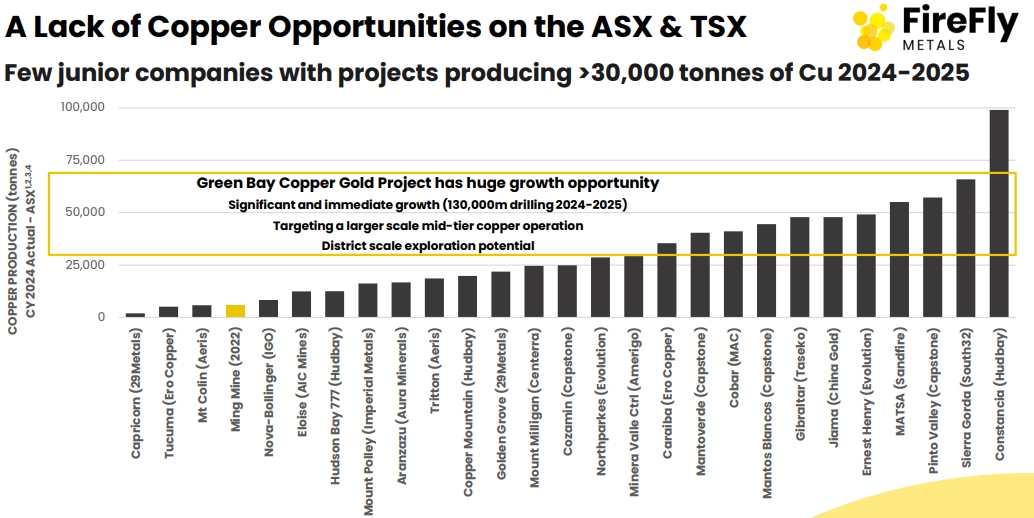
With eight rigs turning, environmental approvals secured and economic studies on the horizon, FireFly is now squarely in the growth-execution phase. The company’s 2025 drilling program aims to expand resources, convert categories and test fresh regional targets — all while maintaining the financial strength to move swiftly once development decisions are made.
For investors watching the copper squeeze unfold, FireFly’s Green Bay project offers a tangible example of how new, high-grade supply can still emerge — not from frontier exploration, but from revitalising proven ground in the world’s safest mining districts.