
Standard Uranium Ltd (TSX-V:STND, OTCQB:STTDF) VP exploration Sean Hillacre talked with Proactive about early exploration success at the company’s Rocas project in Saskatchewan.
Hillacre explained this was the company’s first on-the-ground program at the site, conducted under an option agreement with Collective Metals.
Located just southwest of the Key Lake Mine and Mill, the 4,000-hectare property lies along Highway 914, making it highly accessible.
The goal was to verify historic uranium showings and gather new geological insights.
Proactive: Welcome back inside our Proactive newsroom. And joining me now is Sean Hillacre. He is the Vice President of Exploration for Standard Uranium. Sean, it's great to see you again. How are you?
Sean Hillacre: Doing well, thanks.
So, the company is out with news about your Rocas project. You've been completing some exploration there under an option agreement with Collective Metals. Tell me a bit about the work that was done and what you're seeing.
Yes, absolutely. It's an interesting project. We just talked about it in our last interview, I believe. It's just southwest of the Key Lake Mine and Mill, right along Highway 914 — nice and accessible. It's about 4,000 hectares, and we got out there with boots on the ground for the first time.
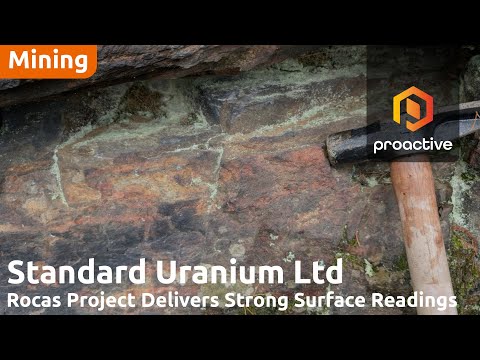
This was the first time we've been on the project. The goal was to check out the rocks and confirm historical uranium showings right at surface — one of them showed almost half a percent in an outcrop. We checked that out and explored the 7.5-kilometre strike length.
Really good results came back. Some strong radioactivity right at the surface. I think our peak was about 33,000 counts per second, which is really good. And there were lots of favorable rock types. We took some samples, and we'll get those analysed in the lab to ground truth those numbers.
The news release mentions a diamond drill program in 2026 and the 7.5km strike length. How do you pinpoint the areas you want to drill?
That's a great question. We completed a ground gravity survey on the project last year. It helps identify areas of potential alteration from uranium fluids. The conductors act as plumbing systems, focusing those hydrothermal fluids that carry uranium, which alter the rocks around them. These altered zones often turn into clay, which is less dense than the surrounding rock — creating density anomalies.
We’ll layer those results with the radioactive showings. We know there's uranium fertility along this corridor, and it's never been drilled before. These geophysical layers, along with the field data, make for strong drill targets. This will be the first time it’s drilled in history. It’ll be funded by our partners at Collective Metals and operated by us. We’re looking at about 2,000 to 3,000 metres of drilling.
This is another example of how your model works — bringing in partners and keeping your team active.
That's right. It's a great way to move our projects forward, retain exploration upside, and keep our geologists busy. It gives us more shots on goal, so to speak. We’re looking forward to it, and there will be lots of news coming out from our JV projects and our flagship.
Quotes have been lightly edited for clarity and style