
Provaris Energy Ltd (ASX:PV1, OTC:GBBLF) has established a new Innovation Centre in Fiskå, Norway, to advance fabrication and testing of its proprietary hydrogen (H₂) and liquid carbon dioxide (LCO₂) storage tanks using robotic laser-welding technology.
The facility, which has now completed commissioning of its robotic laser welding and handling systems, will recommence fabrication of the company’s hydrogen prototype tank this month — a key step towards final Class approvals for Provaris’ H₂Neo™ carrier design.
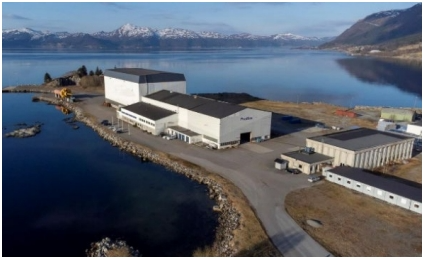
Innovation Centre located in Fiskå, Norway.
Strategic innovation hub
The Norwegian Innovation Centre will serve as both a research and demonstration hub, showcasing cost and production efficiencies for large-scale tank manufacturing. The robotic cell includes industrial-scale robotic arms, controllers, scalable jigs and laser-welding equipment designed for high-precision, automated fabrication.
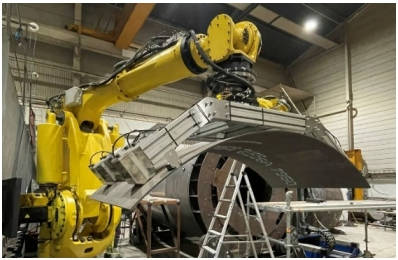
Installed Robotic Arms for Production of Prototype and Pilot tanks.
Provaris said the investment represents a “significant strategic asset” that will demonstrate the feasibility of constructing its layered tank designs and validate production cost advantages using laser and hybrid-laser welding techniques. The company expects the technology to underpin future commercial fabrication and licensing opportunities.
Managing director and CEO Martin Carolan said the new facility marked a milestone in the company’s pathway to commercialisation.
“We are excited to have the robotic cell commissioned and in control of a strategic facility in Norway to demonstrate the material cost and production efficiency benefits of manufacturing large-scale steel tanks, including the completion of the hydrogen prototype tank,” Carolan said.
“This Innovation Centre will showcase the feasibility of constructing our proprietary tank designs for both H₂ and LCO₂ using robotics and laser-welding and play an integral role in advancing R&D, marine classification and commercialisation for Provaris.”
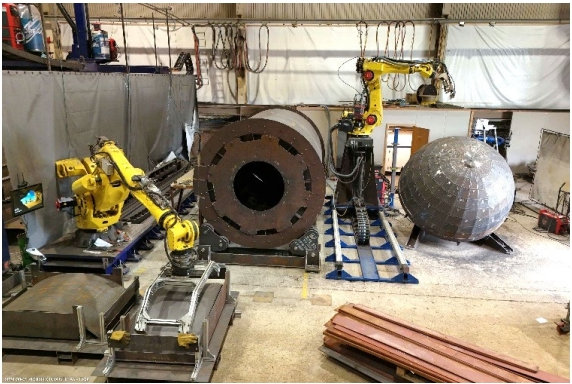
Image of Robotic Arms for Material Handling and Laser welding, including jigs, partially complete cylinder section and end cap.
Hydrogen prototype fabrication restarts
Fabrication of the hydrogen prototype tank will restart in October, with completion and testing targeted for the first quarter of 2026. The prototype — measuring 11 metres long and 2.5 metres in diameter with a total steel weight of around 40 tonnes — will be assembled in four sections, including two cylinders and two end-caps.
Site visits are planned over the next two quarters, including from K Line, Provaris’ shipping partner for hydrogen carriers, whose technical and commercial teams will attend in December.
Supporting LCO₂ development with Yinson
The Innovation Centre will also support front-end engineering design (FEED) work on Provaris’ LCO₂ storage solution, part of its collaboration with Yinson Production to develop a Floating Storage and Injection Unit (FSIU). Design and testing protocols are ongoing, with plans to fabricate test sections at the new facility using the same robotic laser-welding systems.
Read more: Provaris and Yinson advance LCO₂ growth strategy
That project follows recent milestones in Provaris’ broader LCO₂ growth strategy and its strategic collaboration with Baker Hughes announced in September, aimed at advancing large-scale compressed hydrogen transport technologies.
Provaris said further updates on both hydrogen and LCO₂ tank programs would be provided in upcoming quarterly reports, with additional operational staff to join the Norwegian team later this year.