
Far East Gold Ltd (ASX:FEG) has signed a Conduct and Compensation Agreement (CCA) with property owners to enable drilling at the Mount Clark West copper-gold project in Queensland. Eagle Drilling NQ has been contracted for a minimum three-hole, 1,800-metre program combining reverse circulation (RC) and diamond drilling, scheduled to begin in early November 2025.
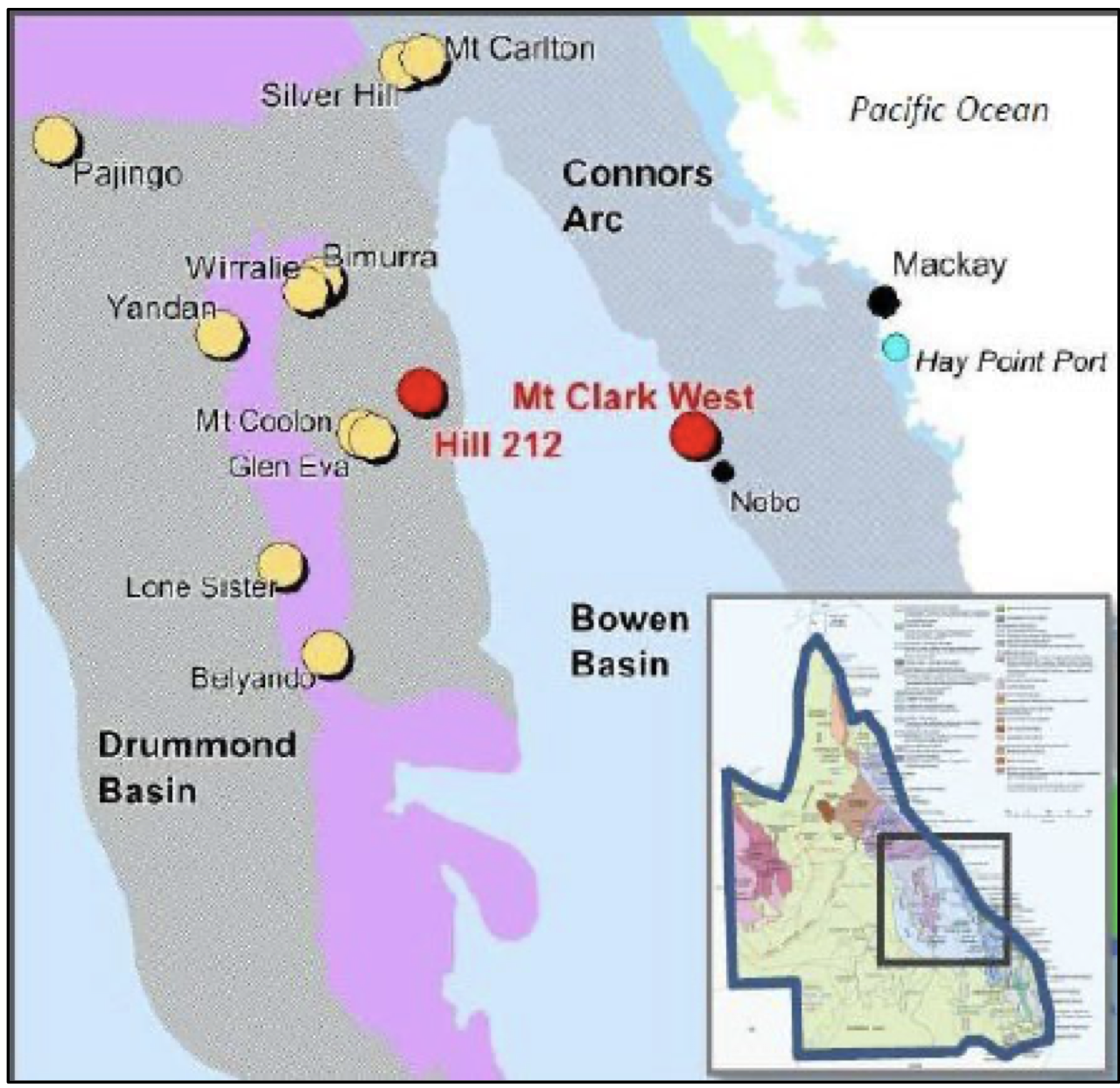
Image shows the location of the Mt. Clarke West (MCW) and Hill 212 tenements held by FEG. MCW is situated within Carboniferous volcanic rocks of the Connors Arc. Overlying Bowen Basin Permo-Triassic sediments occur to the west. The occurrence of significant epithermal Au-Ag deposits further west within the Drummond Basin are also shown.
The campaign will test three geophysical targets defined by Far East Gold’s interpretation of historical exploration, geophysical and geochemical datasets. Each target is characterised by a distinct circular low-magnetic zone, approximately 500 metres in diameter, encircled by high chargeability and magnetic anomalies, and coincident in parts with copper-molybdenum-in-soil geochemical anomalies — features consistent with potential porphyry systems.
Historical drilling at Mount Clark West intersected low-grade copper mineralisation within altered volcanics, including 0.1% copper over 104 metres from 114 metres, with a higher-grade interval of 0.23% copper over 14 metres from 180 metres in hole MCDD002. These results indicate possible proximity to a mineralised porphyry centre.
The initial 1,800 metre program is designed to directly test the three priority targets and refine geological vectors for follow-up work.
“The historical drilling at Mount Clark West gave us the first clear signs of copper mineralisation in the district while being surrounded by other Tier 1 global mining companies also exploring,” FEG CEO Shane Menere said.
“By applying modern geophysics and geochemistry, we now believe those results were not isolated, but rather potential evidence of being on the shoulder of a much larger porphyry system. This upcoming program will be the first real test of those targets, and we are excited by the scale of the opportunity and potential to make a discovery.”
Mount Clark West drill program
FEG will launch a targeted drill program at the Mount Clark West Copper-Gold Project in central Queensland, aiming to test priority geophysical and geochemical anomalies indicative of a porphyry copper-gold (molybdenum) system.
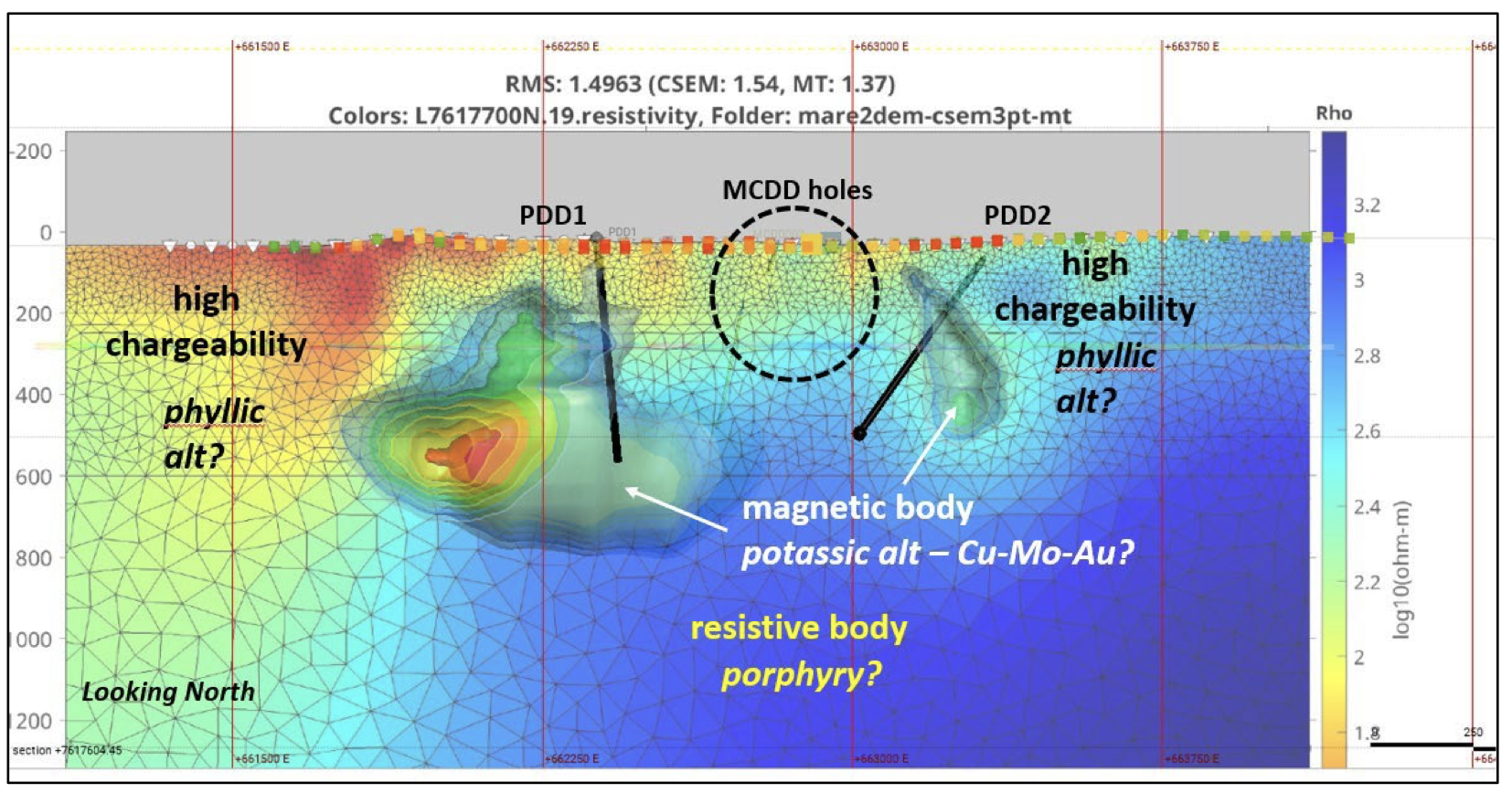
Southern Geoscience Consultants Pty.Ltd. interpreted resistivity image for MIMDAS survey line 7616900N. The image shows a envelope of low resistivity & high chargeability surrounding a central zone of high resistivity. The occurrence of high magnetic bodies immediately adjacent to the resistive zone are considered to be priority drill targets to test for porphyry type mineralisation. The east-most area coincides with a broad (1km) zone of high Cu in soil.
The project comprises one tenement, EPM26008, covering 1,912 hectares (ha), about 24 kilometres (km) north of Nebo. It sits on the boundary between Connors Arc Carboniferous volcanics to the east and Permo–Triassic sediments of the Bowen Basin to the west. The Connors Arc hosts large, more than 1 million ounce, epithermal gold–silver deposits, including the high-sulphidation Mount Carlton to the north and the low-sulphidation Cracow to the south, yet the district remains underexplored for associated porphyry-style copper-gold mineralisation.
At Horseshoe Hill, coincident copper and molybdenum soil anomalies lie adjacent to a low magnetic body. Historical drilling near this feature cut low-grade copper within sericitic mafic volcanics with stockwork quartz veins. Notably, hole MCDD002 returned 104 metres (m) at 0.1% copper from 114 m downhole, including 14 m at 0.23% copper from 180 m, with pyrite at about 5% and minor, less than 1%, chalcopyrite.
New holes will directly test coincident chargeability–resistivity responses flanking low magnetic cores interpreted as intrusive porphyries. Three discrete circular low-magnetic zones, each ringed by high chargeability and adjacent magnetic highs, define high-priority targets. The company interprets this pattern as pyrite-bearing, phyllic alteration enveloping potential mineralisation, with the magnetic highs representing magnetite-bearing potassic alteration commonly associated with better-mineralised parts of porphyry systems.