
Lithium Universe Ltd (ASX:LU7, OTC:LUVSF) has unveiled plans for a second lithium carbonate refinery in Brownsville, Texas — a move that expands its North American refining footprint and complements its flagship Bécancour project in Québec.
The new US strategy positions the company to build a twin-plant refining platform spanning Canada and the United States, targeting the “lithium conversion gap” — the growing mismatch between regional battery-grade lithium demand and limited refining capacity.
“Brownsville represents an extraordinary opportunity to extend our lithium refinery strategy beyond Québec,” executive chairman Iggy Tan said. “With the Inflation Reduction Act, Department of Energy programs, and clear national ambitions for critical mineral independence, the timing is ideal to establish a foothold in Texas.”
Building on Bécancour success
Lithium Universe emphasised that Bécancour remains its first priority, with the definitive feasibility study (DFS) completed and offtake talks under way.
The Brownsville initiative is designed as a parallel growth pathway rather than a diversion of focus:
- Québec will serve as a Trans-Atlantic hub powered by Hydro-Québec’s renewable energy, supplying Canadian and European markets.
- Texas will act as the US hub, integrated with Gulf Coast logistics and closer to American gigafactories.
Together, the two refineries are intended to form a binational platform that de-risks supply, broadens geographic exposure and aligns with incentive regimes across both Canada and the US.
Strategic Gulf Coast location
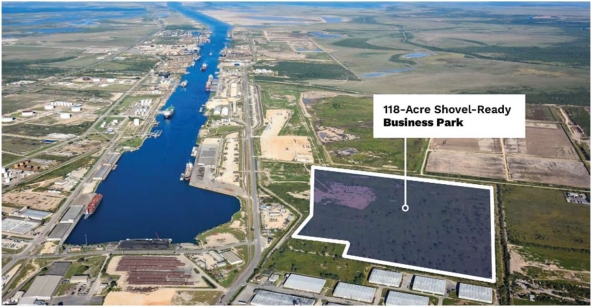
The proposed refinery will be located in the Port of Brownsville Business Park, where Lithium Universe is already evaluating land for its photovoltaic (PV) recycling venture.
Read more: Lithium Universe recruits mechatronics specialist to accelerate PV recycling program
The company said the site is large enough to host two lithium carbonate refinery trains alongside recycling operations, creating a multi-commodity clean-energy hub.
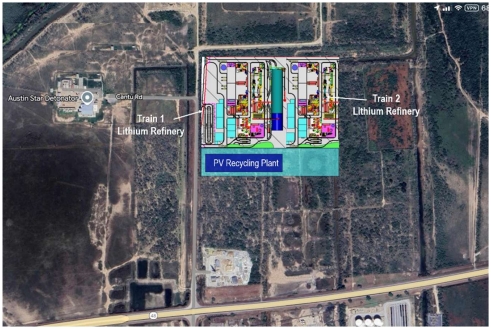
Location of LU7 Proposed Second Lithium Refinery Site with Two Trains and PV Recycling Project Under Evaluation
Deep-water port access offers direct maritime transport for spodumene concentrate from the United States, Brazil and Africa.
The flat, industrial-zoned site lies adjacent to major highways, rail links and utilities — a combination that Lithium Universe says minimises permitting delays and capital costs.
Copy-and-paste design for rapid rollout
Lithium Universe plans to replicate its proven Bécancour refinery design in Texas, removing cold-weather modifications and adding Gulf-specific hurricane safeguards. The Bécancour DFS delivered a net present value of US$718 million, an internal rate of return of 21% and a payback of less than four years.
Copying the Bécancour design, each refinery train would produce about 18,270 tonnes per annum (tpa) of battery-grade lithium carbonate, scalable to 36,000+ tpa with a dual-train configuration.
Using the established Jiangsu continuous-process flow allows immediate adoption of tested purification systems and supplier networks, reducing engineering time and cost.
US policy and cost advantages
Brownsville’s low labour and land costs, streamlined permitting and pro-industry environment add to the project’s appeal.
The site sits roughly 230 kilometres south of Tesla’s lithium hydroxide refinery at Corpus Christi and near SpaceX’s Boca Chica Starbase facility — both contributing to local infrastructure and workforce skills.
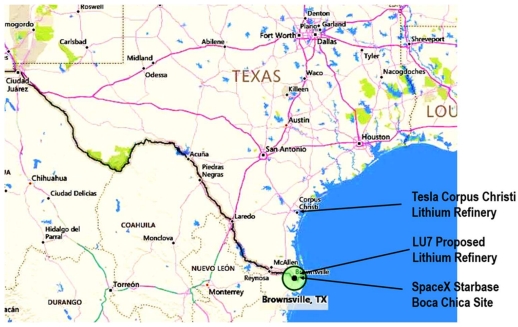
Location of LU7 proposed second lithium refinery site.
US policy tailwinds further strengthen the case. Lithium carbonate refined domestically would qualify for Inflation Reduction Act tax credits, while 25% tariffs on Chinese lithium compounds heighten demand for US supply.
Lithium Universe also intends to pursue support through the Department of Energy’s loan programs for critical-minerals infrastructure.
“Our vision is to create a trans-Atlantic refining platform — two projects, one in Québec and one in Texas — serving North America’s rapidly growing demand,” Tan said. “Together, these facilities will cement LU7 as a leader in bridging the lithium conversion gap, supporting electric vehicles, stationary energy storage and the global clean-energy transition.”