
Hydrogen has been detected at Constellation Resources Ltd (ASX:CR1)’s Edmund-Collier Natural Hydrogen (NatH2) Project in Western Australia, with Commonwealth Scientific and Industrial Research Organisation (CSIRO)’s preliminary tests also indicating helium and other gases.
Edmund-Collier represents a first-of-its-kind opportunity in Western Australia to explore for natural hydrogen and helium across a large, underexplored basin with no prior deep drilling.
The CSIRO program analysed crushed rock and fluid inclusions from historic mineral exploration diamond drillholes. Results establish evidence for the generation and migration of hydrogen, helium and associated gases across the project area. Constellation’s broader Western Australian NatH2 portfolio covers 87,602 square kilometres (km²) across three sedimentary basins, positioned near gas pipelines and major mining operations.
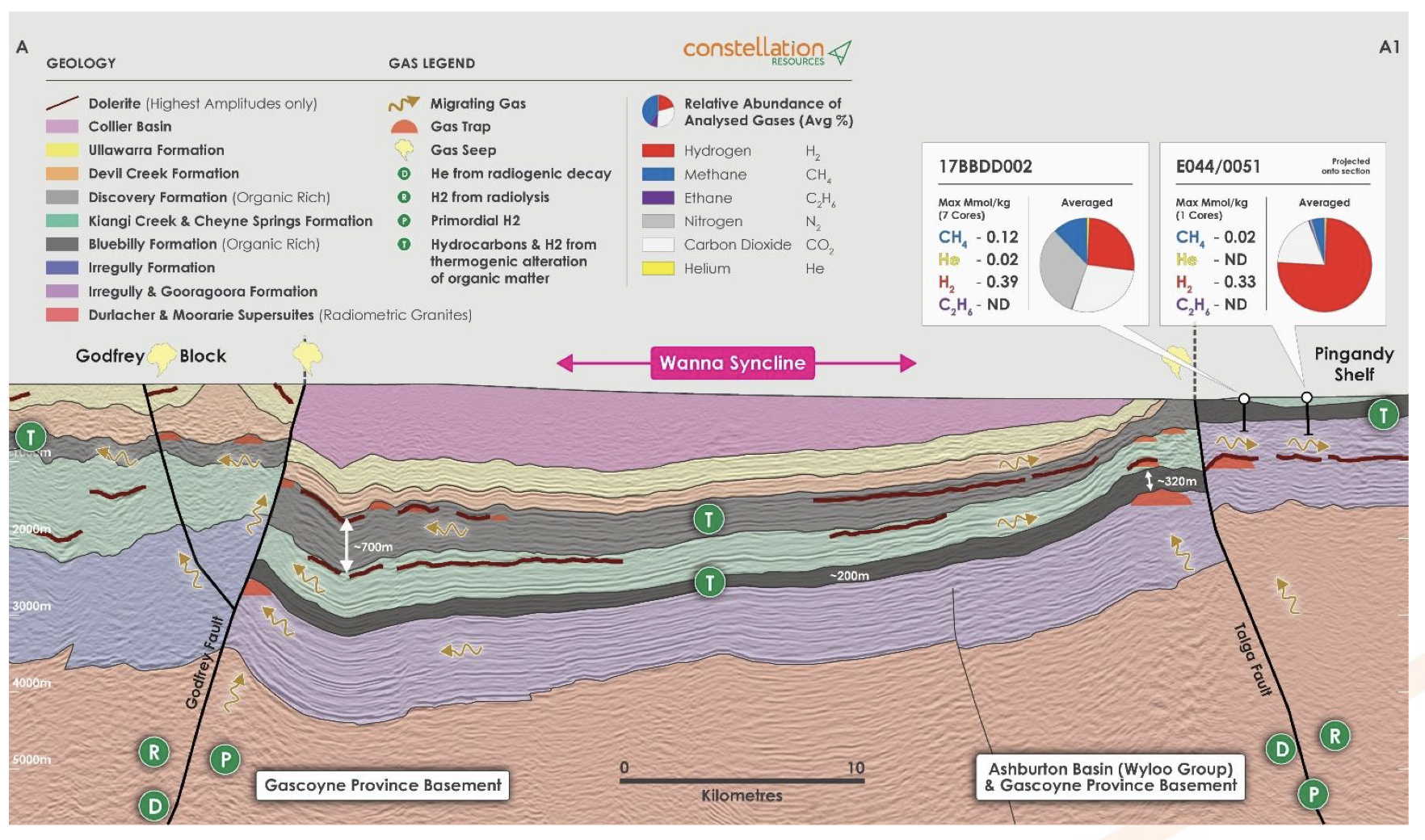
Edmund-Collier conceptual hydrogen system and reprocessed seismic line displaying anomalous crushed rock analyses from drillholes containing hydrogen, helium and natural gas (methane).
All sampled drillholes detected either hydrogen, helium or hydrocarbon gases (methane and/or ethane). Notably, helium was identified in a sandstone sample near the Talga Fault, one of two basement-tapping faults that run along the north and south boundaries of the Wanna Syncline.
Constellation interprets the Wanna Syncline to host preserved traps and source rocks buried to sufficient depths, with overlying seals, enabling hydrogen and associated gases to be retained within shales or stored in overlying reservoirs.
Reinforcing hydrogen–helium potential
Constellation’s review of historic deep diamond core from the Edmund-Collier basin has identified trapped gases in nearly all samples analysed by the CSIRO, including hydrogen, helium and natural gases such as methane and ethane. The results support the company’s thesis that Edmund-Collier offers a first-of-its-kind opportunity in Western Australia to explore for natural hydrogen and helium across a large, underexplored basin with no prior deep drilling.
CSIRO’s work indicates gases have likely been generated and migrated from the basement and within the basin. The coexistence of hydrogen, helium, methane, carbon dioxide and ethane suggests a possible common genetic origin linked to the thermal maturation of organic-rich shales, potentially within the Blue Billy and Discovery formations, which have extensive footprints across Edmund-Collier. Helium may also derive from radiometric decay and/or deep primordial sources, broadening the exploration case.

Summary of CSIRO bulk rock crushing analysis within the Edmund-Collier.
Notably, all selected samples came from drillholes targeting base metals on the shallow outer edges of the Wanna Syncline, yet still delivered encouraging evidence of gas generation. The Wanna Syncline — about 300 kilometres by 40 kilometres by 4.5 kilometres — presents targets for both basement-derived hydrogen and helium and basin-derived thermogenic gases. Depth, potential overpressure, and widespread dolerite sills could provide effective seals, making the area a priority for further seismic acquisition and drilling near basement-tapping faults and within synclinal traps.

Results of CSIRO molecular gas composition bulk rock crushing over multiple intervals throughout 17BBDD002, implying migration of gases throughout the stratigraphic column.
Methodology: CSIRO conducted bulk-rock crushing on 23 core samples from seven holes using a gas-tight stainless-steel crusher with blanks, and in-situ Raman spectroscopy on 14 samples (hydrogen, oxygen, carbon dioxide, methane and nitrogen; helium and ethane excluded by technique limits).
Advancing towards drill-ready targets
CR1 is progressing low-cost, high-value programs across its Western Australian natural hydrogen (NatH2) portfolio to confirm prospectivity and define drill targets.
It has been awarded preferred candidate status for nine Special Prospecting Authority – Acreage Option (SPA-AO) permits by the Department of Mines, Petroleum and Exploration. Current activities include reprocessing a historic seismic line, reviewing Geological Survey of Western Australia (GSWA) mapping and open-file WAMEX reports, sampling publicly available diamond core for thermal maturity and total organic carbon, and conducting studies with the Commonwealth Scientific and Industrial Research Organisation (CSIRO).
These work streams continue to support basin-scale prospectivity for natural hydrogen and associated gases and are developing emerging drill targets across Edmund-Collier.
The company is also well advanced in planning surface-gas sampling from old drill collars and soils to further refine prospective areas.
Emerging drill targets
At the Wanna Syncline, traps and sufficiently buried source rocks with overlying seals are interpreted to retain hydrogen and associated gases within shales or overlying reservoirs; method selection to best define targets is ongoing.
On the western Pingandy Shelf (SPA-STP-116), a folded, breached antiformal sequence with bituminous sandstones up to 60 metres (m) thick in the Blue Billy Formation was intersected in 1990s Rio Tinto drillholes (WAMEX A54569) and mapped by GSWA, indicating possible hydrocarbon migration from underlying organic-rich shales or source rocks within the adjoining Wanna Syncline.
Maturity analysis suggests the Blue Billy Formation is overmature and has been within the hydrogen generation window. Approximately 40 kilometres west of seismic line GA 10-CP2, a possible unbreached antiformal equivalent is interpreted along the Talga Fault corridor. Combined with hydrogen, methane and helium indications in drillholes E44/0051 and 17BBDD002 near the section, this shallow feature is a priority target to test Edmund-Collier’s broader potential.
Significant potential
Edmund–Collier offers basin-scale potential for natural hydrogen with helium upside. Four contiguous Special Prospecting Authority – Acreage Option permits (37,288 km²) sit adjacent to gas transmission pipelines that could support future commercialisation.
The largely outcropping Edmund Fold Belt provides the essential elements of a working system — reservoirs, seals, migration pathways and traps — within a 4- to 5-kilometre Proterozoic package over a radiogenic basement.
Multiple hydrogen sources increase prospectivity: thermogenic generation from organic-rich shales, hydrolysis of groundwater in heat-producing Palaeoproterozoic granites (Durlacher and Moorarie supersuites), and primordial degassing. Helium derives from long-lived radiogenic decay of uranium and thorium in granites and some sediments, supporting a potential co-product stream.
Trap diversity (anticlinal/structural, stratigraphic pinch-outs, diagenetic and density-driven hydrologic traps) and widespread anticline development since about 1,171 million years ago suggest numerous, long-lived accumulation sites. Voluminous dolerite intrusions enhance trapping architecture, while surface fold closures extrapolated via geophysics expand subsurface target inventory. Together, system ingredients, multiple charge mechanisms and proximity to pipelines underpin strong exploration and development potential.