
NextSource Materials Inc. (TSX:NEXT, OTCQB:NSRCF) president and CEO Hanré Rossouw talked with Proactive about the company’s definitive feasibility study for its active anode material project in Abu Dhabi.
Rossouw said the development marks a “pivotal moment” for NextSource as it positions itself as one of the largest non-Chinese producers of battery anode material for electric vehicles and grid-scale storage.
Proactive: Hello, you’re watching Proactive. I’m joined by NextSource Materials President and CEO Hanré Rossouw. Hanré, very good to speak with you. This study marks a major milestone for NextSource. Could you walk us through the key takeaways, especially the economics and what they mean for shareholders?
Hanré Rossouw: Thanks. It’s a pivotal moment for the company. We’re establishing ourselves as one of the leading, if not the biggest, non-Chinese producers of active anode material — the key component used in electric vehicles and grid-scale energy storage. Following our offtake agreement with Mitsubishi, announced in August, we have now secured a site in Abu Dhabi to build this project. It has very positive economics, underpinned by that Mitsubishi contract.
The total capital expenditure is around US$291 million. For the first phase, it’s just over US $150 million. We expect an IRR of 24% and a payback of about 4.6 years, with an NPV of over US$400 million. That gives us confidence to proceed and deliver on our commitments to Mitsubishi and other OEMs.
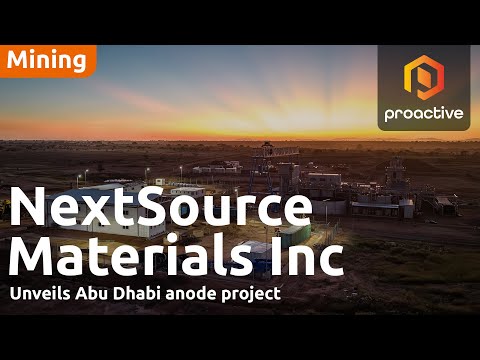
How does the location in Abu Dhabi’s Industrial City give NextSource an edge in terms of cost, speed to market, and access to global EV supply chains?
In choosing the location, cost advantage was a key factor. We initially looked at Mauritius, which was close to our Madagascan operations, but it faced challenges with environmental requirements and timelines. Abu Dhabi, on the other hand, offers speed to market, an established industrial ecosystem, reagent suppliers, and low-cost power. We also found an existing building suitable for a plug-and-play setup, which will help us start production by 2026.
The study shows a strong IRR and NPV with a phased build approach. How do you plan to finance phase one, and what role might strategic or offtake partners play in that funding?
We’re working on the right capital structure for phase one, which totals around US$150 million. Société Générale is facilitating a process for us to secure both debt and equity funding at the asset level. There’s strong interest from local banks and partners, given the backing of the Mitsubishi offtake agreement. We’re optimizing funding both at the project and group levels.
The project is part of a bigger vision to build vertically integrated anode capacity outside Asia. How close are you to achieving that goal?
We’re very close. We already operate the Molo mine in southern Madagascar, one of the world’s largest and highest-quality graphite resources. The phase one plant there was used to qualify our product. Graphite is a complex material — not a simple commodity — and the qualification process is essential. With this resource and growing production capacity, we’re building a full portfolio of battery anode facilities, while also evaluating alternative feedstock options to reduce supply chain risk.
What are the next milestones investors should be watching for?
Now that the study is complete, our focus is to reach the final investment decision (FID). Engineering work is underway, and we’re testing the building structure and surrounding infrastructure. We’ve already ordered about half of the equipment, which is stored in Mauritius and China. Over the next three months, we aim to reach FID and announce further progress on this exciting project.
Quotes have been lightly edited for clarity and style