
Dekiln CEO Dr Aled Roberts talked with Proactive about the company’s first commercial installation of its sustainable bio-based product, Eralith, marking a key step from laboratory innovation to real-world deployment. The tiles are being installed at Sustainable Ventures spaces in Manchester, part of the £1.70 billion innovation district hub known as Sister.
Dr Roberts described the installation as “a quite significant milestone for us,” emphasising how it validates Dekiln’s technology under commercial conditions. He added that the project demonstrates the company’s transition “from the lab to commercial scale commercial deployment.”
Alongside this, Dekiln has moved into new premises in the heart of Manchester — a facility three times larger than its previous location. The expanded space will allow the company to increase production capacity by about twentyfold, supported by larger-scale equipment to meet growing demand.
Dr Roberts also highlighted support from the Henry Royce Institute and collaboration with the Centre for Process Innovation (CPI) as part of a successful grant project aimed at scaling up production.
Delkin is a portofio company of Frontier IP Group, PLC (LSE:FIPP).
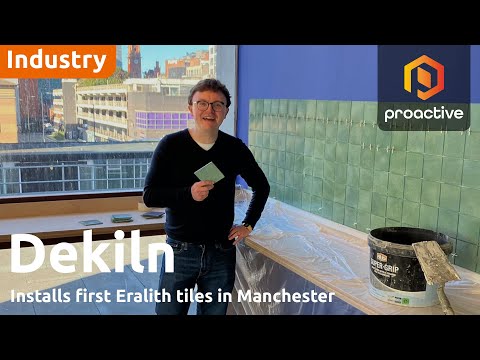
Proactive: I’m joined by Dr Aled Roberts, CEO of Dekiln, a Frontier IP Group PLC portfolio company. Aled, it’s very good to speak with you again. Can you tell us what you’re announcing?
Dr Aled Roberts: We are announcing a quite significant milestone for us, which is the first commercial installation of our first product, Eralith — a sustainable bio-based alternative to ceramic tiles. The tiles are going to be installed in Sustainable Ventures spaces in Manchester, which is part of Sister, a £1.70 billion innovation district hub. This is great because it validates our technology for the first time in real-world conditions, taking us from the lab to commercial-scale deployment.
Proactive: Aled, what else is happening?
Dr Aled Roberts: We’ve also just moved into our new premises in the heart of Manchester. It’s three times larger in floor area than our previous location, and here we aim to increase our production capacity by about twentyfold. Again, we’re going from lab-scale to the first steps of commercial-scale production, which is really important for us in terms of scaling up.
We are also investing in larger equipment to move from small-batch, lab-scale production to larger-scale production capacity.
Proactive: And anything else you’d like to add?
Dr Aled Roberts: Yes. We are doing this with the support of the Henry Royce Institute. We secured a successful grant that is ongoing, and we’re working with the Centre for Process Innovation (CPI). We also have support from various production partners through this grant, which is helping us transition from our lab-scale facility to our new, large-scale production facility.
Proactive: Aled, I hope you’ll continue to keep us updated with your progress. Thank you very much for speaking with us today.