
Nova Minerals Ltd (ASX:NVA, NASDAQ:NVA, OTC:NVAAF) has secured a land-use permit over 42.81 acres of commercial industrial-zoned land near Port MacKenzie, which will help it advance its plan to develop a downstream antimony refinery that could supply the United States military and consumer markets.
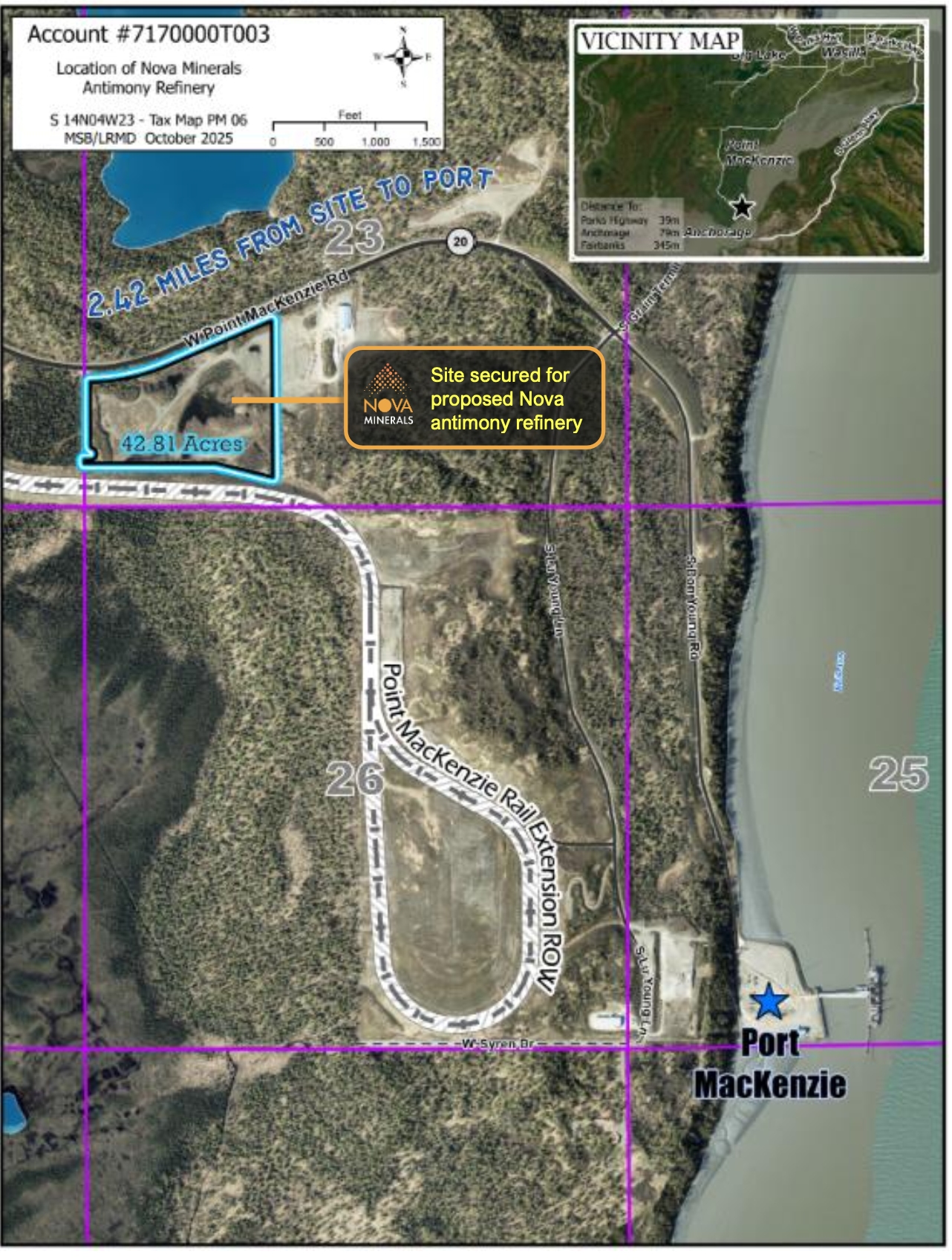
Aerial view of Port MacKenzie highlighting the site for Nova’s proposed antimony refinery. Source: Port MacKenzie Operations.
Nova is uniquely positioned to lead the US antimony market as the sole emerging producer with a first-mover advantage, capitalising on secured land in a key commercial industrial zone, robust government support, and established infrastructure at Port MacKenzie for its planned antimony processing and refining operations. Aligned strategically with peers like Perpetua Resources (A$3.9 billion market cap) and US Antimony (A$2 billion market cap), Nova is set to become a vital supplier in this high-demand sector, driving significant share price growth.
After receiving a US$43.4 million award from the United States Department of War (DoW), Nova has initiated its plan to onshore antimony production in Alaska, aiming for initial output within 24 months.
Following phase one of its refinery plan, which is to provide military-spec antimony to the DoW, Nova intends to scale up mining and establish a full-scale refinery in Alaska to create a fully integrated, mining-to-refining domestic antimony hub.
The proposed Port Mac facility would initially produce military-spec antimony output targeted in 2026/27, as supported by a US$43.4 million award from the United States Department of War (DoW). The full scale refinery would produce a range of antimony products for both the military and industrial base including, antimony trisulphide (Sb₂S₃), antimony trioxide (Sb₂O₃) and antimony metal.
“On behalf of Nova Minerals, I extend our heartfelt gratitude to Governor Dunleavy and his administration for ongoing steadfast support, as well as to the Port MacKenzie Authority, the Mat-Su Borough Assembly, and Mayor Edna DeVries for their ongoing commitment to support the mineral development industry, including Nova Minerals,” Nova CEO Christopher Gerteisen said.
“This is a defining moment for Nova Minerals and for US critical mineral independence. With the land use permit secured and the Department of War award, we are rapidly advancing our vision to become the leading US miner and producer of refined antimony products — strategic, secure, and proudly made in the USA. We are fast-tracking phase 1 production of military-spec antimony, targeting delivery of our first product to the Department of War within 24 months, underscoring our commitment to supporting critical national defense needs.
“The planned refinery development in the Port MacKenzie industrial district is a cornerstone of a vertically integrated domestic antimony supply chain. The Port Mac site has immediate access to key infrastructure and utilities. Our active engagement with federal agencies such as the DoW, Exim Bank, DoE, DLA and state departments highlights Nova’s growing role in strengthening US defence and energy security. Backed by strong government support, strategic partnerships, a highly capable leadership team, and land secured to commence construction of a downstream refinery, Nova holds a commanding first-mover advantage as the sole emerging fully integrated antimony producer and supplier to the US military and domestic markets.”
Nova reports strong inbound interest for offtake beyond Estelle stockpiles and is working with partners in the US and Australia, including a strategic pathway to future supply from Adelong Gold Ltd (ASX:ADG), located about 50 kilometres south of the Costerfield gold-antimony operation owned by Alkane Resources Ltd (ASX:ALK, OTC:ALKEF).
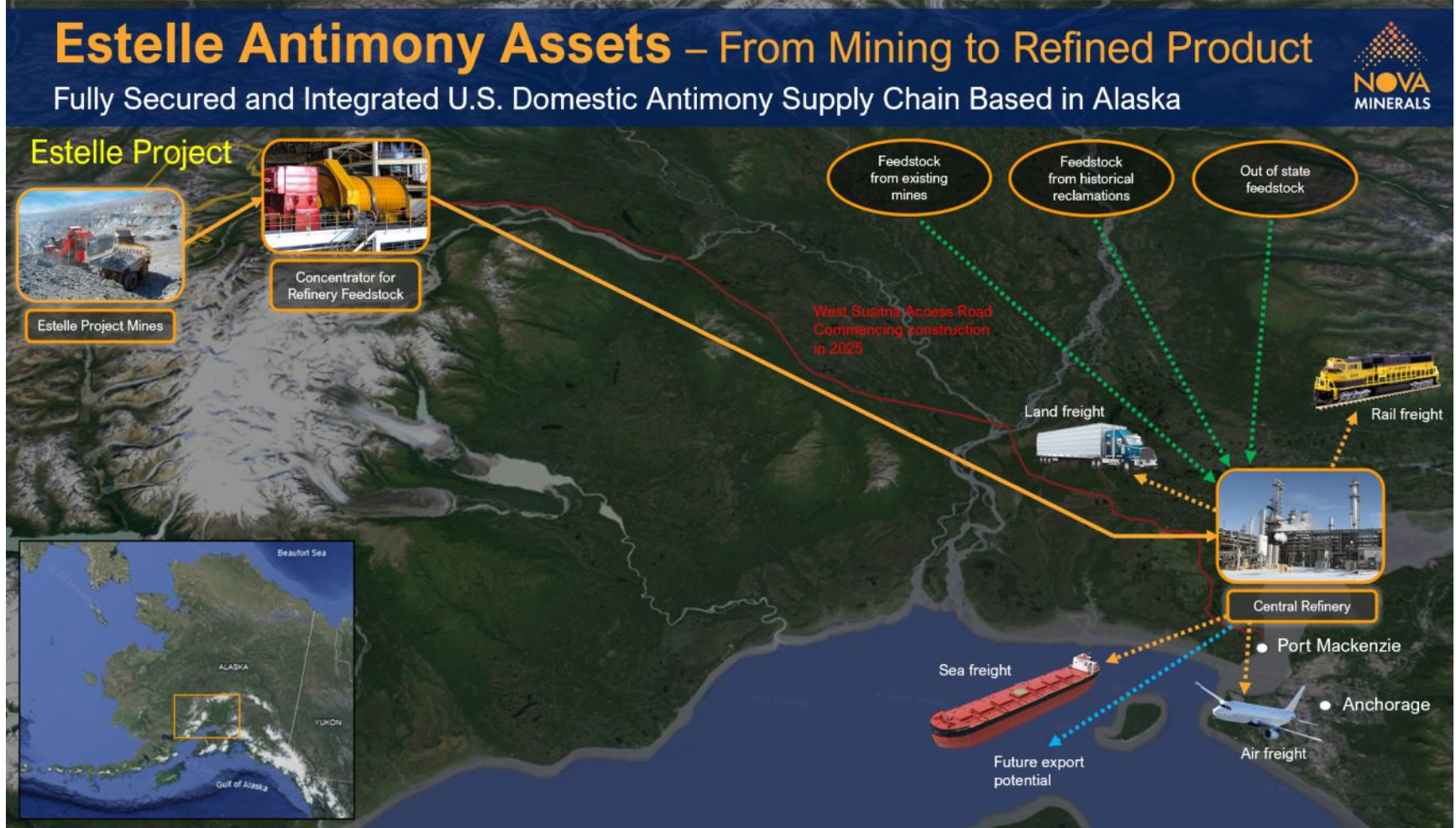
Nova’s proposed fully secured and integrated U.S. domestic antimony supply chain plan.
Port MacKenzie positions Nova’s refinery plans at Alaska’s industrial gateway
Port MacKenzie (Port Mac), on the Upper Cook Inlet, offers immediate road access to the Matanuska–Susitna (Mat-Su) Valley, Fairbanks and Anchorage, underpinning Nova’s newly secured refinery land use permit within a large, growth-ready industrial estate.
“As Director of Port MacKenzie, I strongly support Nova Minerals' Antimony refinery project. It aligns with our goals of economic growth, job creation, and sustainable resource development,” David Griffin, MPE, Director, Port MacKenzie, Matanuska-Susitna Borough said. “The refinery will enhance regional supply chains, boost our export portfolio with a critical mineral, and solidify Port MacKenzie’s role in supporting innovative industries that benefit the Matanuska-Susitna Borough. This project promises significant community value through employment and responsible operations and national security.”
Mike Brown, Borough Manager, Matanuska-Susitna Borough said, “The signing of this land use agreement with Alaska Range Resources marks a significant step forward for Port MacKenzie. This initiative positions our region for critical mineral development and strengthens our role in supporting national security. We look forward to working collaboratively with Alaska Range Resources as they evaluate the potential for a long-term antimony processing facility that could bring lasting economic and strategic benefits to Alaska and our nation.”
The port is the only site in Alaska with more than 9,000 acres (about 3,640 hectares) — roughly 14 square miles (about 36 square kilometres) — zoned for commercial and industrial development, including Nova’s permitted area. Existing facilities comprise a 15-acre (about 6-hectare) gravel-surface barge dock and the Upper Cook Inlet’s deepest-draft capability, engineered to efficiently handle diverse import and export cargoes, including natural resources.
Configured as a bulk-commodity export hub serving sectors such as mining and timber, Port Mac features a 1,200-foot (about 366-metre) deep-draft dock capable of accommodating Panamax and Cape-class vessels in deep water, alongside a separate 500-foot (about 152-metre) gravel-surface barge dock for shallow-water and river barges.
Future connectivity includes a proposed 32-mile (about 52-kilometre) rail spur and proximity to the advancing West Susitna Access Road project, together expected to provide a faster, lower-cost export corridor for Interior resources.