
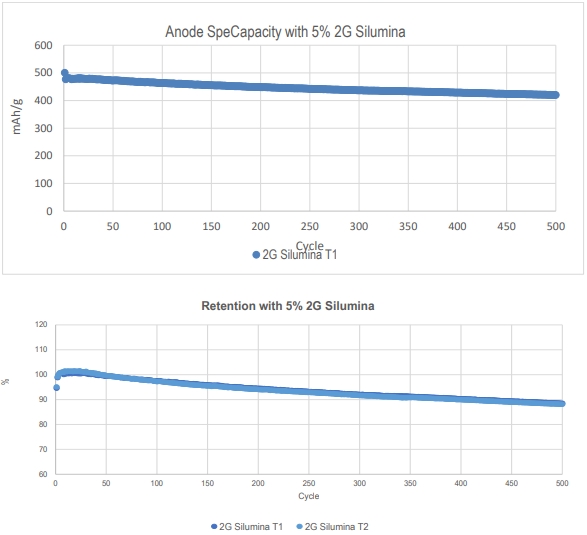
Altech Batteries Ltd (ASX:ATC, OTC:ALTHF) has reported a major performance milestone for its proprietary Silumina Anodes™ technology, recording 88.5% capacity retention after 500 charge–discharge cycles using a 5% addition of its spherical alumina-coated silicon material.
Repeated testing confirmed more than 88% retention, validating both the reproducibility and stability of the process — the strongest cycling performance achieved so far for Altech’s advanced anode material.
The result represents a breakthrough in the evolution of lithium-ion batteries, which have long relied on graphite as their anode material. While graphite is reliable and low-cost, its limited energy density constrains further gains in range and efficiency. Silicon, by contrast, can store nearly 10 times more lithium — but its tendency to swell and crack during cycling has hindered its commercial use.
Altech’s process aims to address that problem by stabilising silicon’s expansion and preserving performance over hundreds of cycles. The company says the advance could pave the way for lighter, longer-range electric-vehicle batteries and higher-efficiency energy-storage systems.
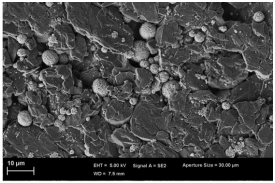
SEM Image, Silicon Sphere Distributed in Graphite Voids.
Silicon advantage, without the drawbacks
Silicon’s exceptional lithium-storage capacity offers a clear pathway towards higher-energy batteries and longer operating life. But its tendency to swell by up to 300% during charging has historically caused structural damage and rapid performance loss.
Altech says its patented alumina-coated spherical silicon particles overcome this barrier by buffering the expansion and maintaining electrical integrity across repeated cycles. The result combines higher capacity with exceptional long-term stability — a significant step in the global race to commercialise silicon-rich lithium-ion anodes.
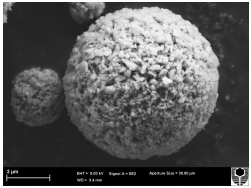
SEM Image, An Alumina Treated Silicon Sphere.
In testing, cells containing just 5% of Altech’s coated silicon achieved an initial specific capacity of 500 milliampere-hours per gram (mAh/g) — around 40% higher than a conventional graphite anode. After 500 cycles, the capacity remained at 420 mAh/g, compared with only 230–250 mAh/g for standard graphite-only cells.
Greater range and efficiency
Higher-capacity anodes translate directly to longer range and improved efficiency for electric vehicles. For the same battery size, the Silumina blend could deliver up to 20–25% more total cell energy, enabling longer-range EVs, lighter packs and reduced production costs.
The benefits also extend to compact or weight-sensitive systems such as drones, portable electronics and aerospace applications, where enhanced volumetric energy density can reduce size and improve performance.
Proven performance at Saxony pilot plant
Altech’s pilot facility in Saxony, Germany — located beside the proposed commercial site — is now producing multiple batches of the alumina-coated silicon material. The plant is confirming consistent high-quality output in line with results from Altech’s Perth laboratory, demonstrating readiness for full-scale production.
Several silicon feedstocks are under evaluation to optimise cost, performance and supply-chain resilience ahead of commercial rollout.
Scaling innovation
Managing director Iggy Tan said the results mark a turning point for silicon-based batteries.
“These latest results mark a genuine breakthrough for the battery industry. Achieving 88.5% retention at 500 cycles with a 5% silicon addition confirms the stability of our Silumina Anodes™ process,” Tan said.
“Our team in Saxony continues to deliver highly consistent results, validating the technology and scaling methods. Altech’s breakthrough positions us at the forefront of next-generation anode materials, unlocking longer-lasting, higher-capacity lithium-ion batteries.”
Altech is developing multiple advanced-materials projects alongside its Silumina Anodes™ program in Germany. These include a joint venture with Fraunhofer IKTS to commercialise CERENERGY® sodium-chloride solid-state batteries, and a strategic distribution partnership with AMPower, a subsidiary of China’s Chilwee Group, to supply sodium-nickel-chloride batteries across Australia, Europe and the US.