
Australia’s east coast is staring down the barrel of a fresh energy crisis. With domestic demand rising, coal retirements accelerating and liquefied natural gas (LNG) exports competing for supply, policymakers and industry alike are grappling with the prospect of shortages and higher prices. The Australian Energy Market Operator (AEMO) has repeatedly warned of potential deficits as soon as 2026, particularly in southern states.
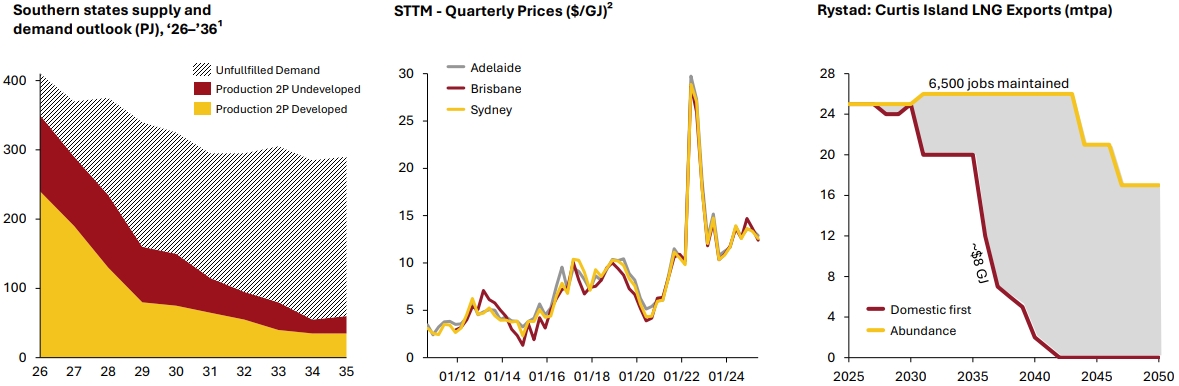
East Coast Gas & Energy Market – 3 Charts: A new multi-TCF east coast gas resource must be unlocked to prevent an unfolding energy crisis or collapse of the export industry
For explorers and producers, this supply squeeze represents both risk and opportunity. Among those positioning for a pivotal role is Elixir Energy Ltd (ASX:EXR, OTC:ELXPF), which has staked out the largest acreage holding in Queensland’s Taroom Trough — a basin-centred gas (BCG) play the company argues could prove the east coast’s equivalent of North America’s famed Montney shale.
A Montney-scale opportunity
Like Taroom, the Montney BCG play in western Canada is a three-phase system spanning light oil, gas-condensate and dry gas.
When development began in earnest, Montney production rocketed from less than 1 billion cubic feet per day (BCF/d) in the mid-2000s to more than 8 BCF/d within a decade. Since 2014, it has yielded more than 17 trillion cubic feet (TCF) of gas and 115 million barrels of oil. Today, Montney remains a cornerstone supply source for Canadian and US markets, dominated by major operators including Shell PLC (LSE:SHEL, NYSE:SHEL) (US$213 billion market cap), ConocoPhillips (NYSE:COP, ETR:YCP) (US$119 billion) and Petronas (~US$35 billion) — all of which also hold major LNG infrastructure interests in Queensland.
Elixir argues the Taroom Trough could follow a similar trajectory to the Montney shale if the concept proves up. New Montney wells now commonly feature 2–3-kilometre laterals, producing initial rates of 5 million–15 million cubic feet per day (mmscfd) and ultimately recovering 5–15 BCF per well. For an east coast market that pays roughly three times the Henry Hub price — the US benchmark spot price for natural gas — that kind of scale and productivity could be transformative.
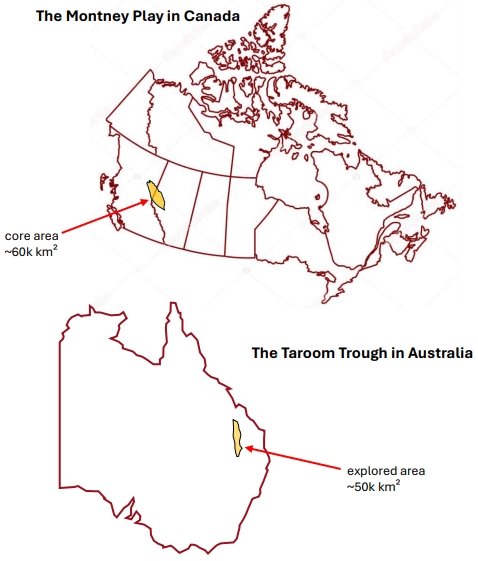
The Taroom Trough: a Montney-scale opportunity
The Taroom Trough’s strategic location
The Taroom Trough lies on the doorstep of the Wallumbilla Gas Hub, the key pricing point for east coast gas. It is also directly connected by pipeline to 25 million tonnes per annum of LNG capacity at Gladstone, providing an outlet to global markets.
Closer to home, the basin’s proximity to Queensland’s oil refineries means any condensate or liquids production has a ready domestic market. Crucially, the region already hosts a prolific coal seam gas (CSG) industry, ensuring infrastructure and oilfield services are well established.
For Elixir, that adds up to a low-cost development profile: independently certified multi-TCF resources, gas quality already tested as better than pipeline spec, and infrastructure nearby.
Read more: Elixir Energy builds on strategic plan as it prepares for key drilling campaign in Taroom Trough
Largest acreage holder in the play
Elixir has quietly consolidated a dominant position. Across more than 2,000 square kilometres (roughly 500,000 acres), the company holds the largest acreage package in the Taroom Trough BCG play — even bigger than supermajor Shell’s footprint.
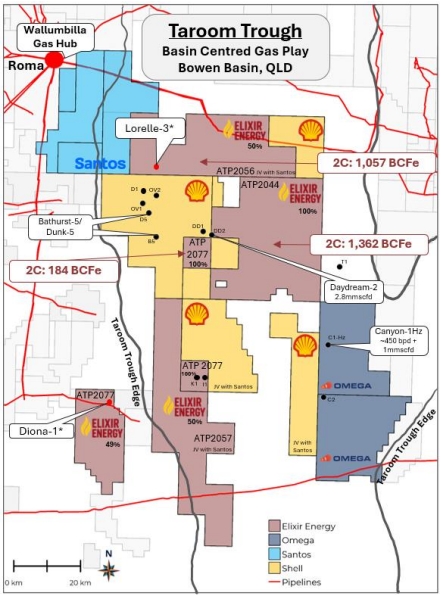
Elixir has the largest position in the Taroom Trough
Its resource base already includes 2.6 TCF equivalent (TCFe) of independently certified 2C contingent resources across its northern permits, plus additional contingent resources from deep dry coal testing.
To put that in context, Elixir’s 503,000 net acres compares with Shell’s 407,000, Omega’s 259,000 and Santos Ltd (ASX:STO)’s 207,000. The acreage spans geologically diversified zones — dry gas, condensate-rich gas and light oil — providing multiple avenues for commercialisation.
Riding on Shell’s coattails
The other crucial dynamic is Elixir’s leverage to Shell’s activity. The global major has drilled multiple Taroom appraisal wells targeting the Tinowon ‘Dunk’ sands, reporting strong gas and condensate flows from laterals such as Dunk-5 and Bathurst-5.
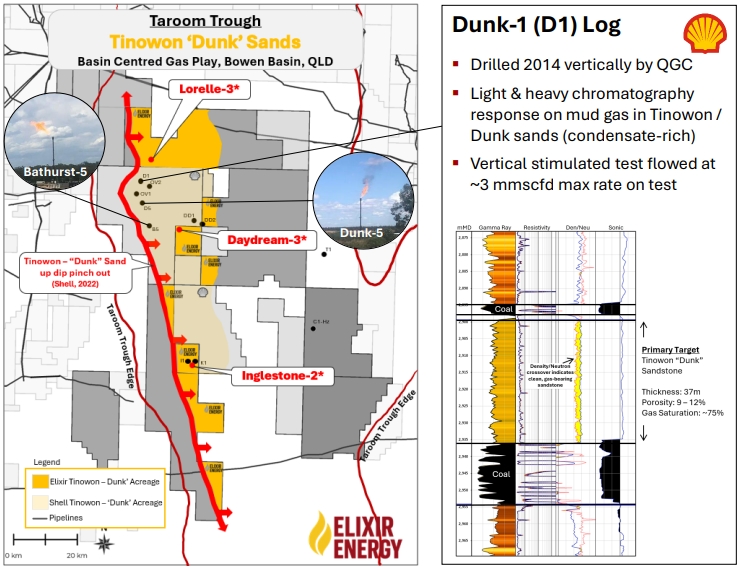
Highly leveraged to Shell’s success
Shell’s high-resolution Overston 3D seismic survey has provided rare insights into the basin’s geology, including amplitude anomalies that appear to correlate with better reservoir quality. Elixir’s mapping shows nearly 100 kilometres of exposure to the same Tinowon formation along strike.
This creates a “nearology” story investors know well: Elixir’s planned wells at Lorelle-3 and Daydream-3 sit directly on trend from Shell’s proven Dunk and Bathurst results.
Lorelle-3: searching for a sweet spot
The Lorelle-3 well (ATP 2056) is Elixir’s next flagship test. Planned to drill to 3,600 metres, it will target the Tinowon Dunk sands as primary, with Overston and Lorelle sands as secondary objectives.
Seismic mapping suggests Lorelle-3 lies within a high-amplitude zone — a potential “sweet spot” analogous to Shell’s best intersections. If drilling validates that correlation, Elixir could replicate some of the strongest Taroom results to date.
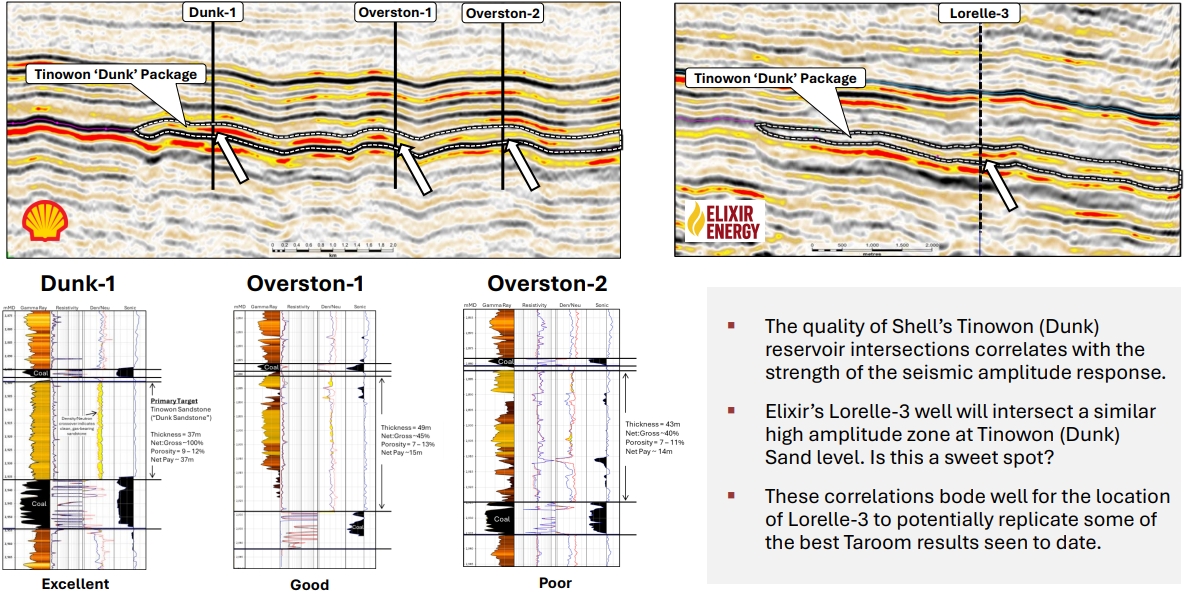
Lorelle-3 - a positive geophysical response
Beyond proving productivity, Lorelle-3 also underpins a multi-year R&D program designed to characterise the basin-centred play, optimise stimulation design and de-risk development across Elixir’s broader acreage. Data from whole core, sidewall core and NMR logs will feed into laboratory work over three financial years.
Diona-1: A second near-term catalyst
Meanwhile, Elixir is also drilling Diona-1 (ATP 2077D), spudded in late September. Importantly, this well is being fully carried by JV partner Xstate Resources Limited (ASX:XST), leaving Elixir with exposure at minimal cost.
Read more: Elixir Energy’s JV partner Xstate Resources advances Diona-1 well in Queensland
Diona-1 targets a four-way dip closed anticlinal structure at multiple sandstone levels, with stratigraphic upside from pinching units. It sits directly beneath the Waggamba Gas Export Pipeline, offering straightforward development options if successful.
.jpeg)
ATP 2077 D: Diona-1
The company estimates a 55% chance of success, with prospective resources of about 1.03 km² at the Diona prospect and 5.5 km² across running room leads. Success here could bring Elixir into production faster than its broader strategic timelines anticipate.
Well-funded for growth
Exploration requires capital, and Elixir ended the June quarter with $10.4 million in cash and receivables, a solid buffer as it advances two high-impact wells. The Xstate carry at Diona-1 further preserves its balance sheet.
These near-term programs are pivotal. If Lorelle-3 confirms productivity and Diona-1 delivers commercial hydrocarbons, Elixir will be able to demonstrate commercial potential across its acreage and materially de-risk its Taroom position.
Why the timing matters
For the broader market, the stakes are clear. East coast manufacturers have long complained of high gas costs, and policymakers are under pressure to ensure affordable domestic supply even as LNG exports expand.
Should Taroom Trough deliver Montney-style scale, it could inject new volumes into both domestic and export channels. That prospect is particularly relevant for majors like Shell, ConocoPhillips and Petronas, which already dominate both Montney and Queensland LNG.
For juniors like Elixir, proximity to those majors provides both validation and potential exit or farm-down opportunities. In a capital-intensive, infrastructure-heavy play, being next door to Shell is more than a geological coincidence — it’s a strategic hedge.
A ‘catalytic’ period ahead
In a recent investor presentation, Elixir bills the coming period as a “catalytic six months”. With Diona-1 already drilling and Lorelle-3 to follow, the company is positioned for a stream of newsflow into early 2026.
Success on either front could not only re-rate Elixir but also shine a spotlight on the Taroom Trough as a new frontier gas province. Against the backdrop of tightening east coast supply, that could make Elixir’s 500,000 acres a highly strategic asset.