
St George Mining Ltd (ASX:SGQ) has secured government-supported collaboration with The Federal Center for Technological Education of Minas Gerais (CEFET) to establish the St George Technological Centre in Araxá, Brazil, including construction of a large-scale pilot plant to advance downstream studies for rare earths and niobium from its 100%-owned Araxá Project.
The facility, to be housed at CEFET’s campus, will leverage concessions expected to cut equipment costs by 50%, process 200–300 kilograms per hour, and produce sample ferroniobium and rare earth products — including concentrate, mixed rare earth carbonate (MREC) and rare earth oxides.
A prior nine-month pilot operation (2012/13) at Araxá produced rare earth oxalate at more than 99% purity with 86% total rare earth oxides (TREO) recoveries and successfully removed radionuclides.
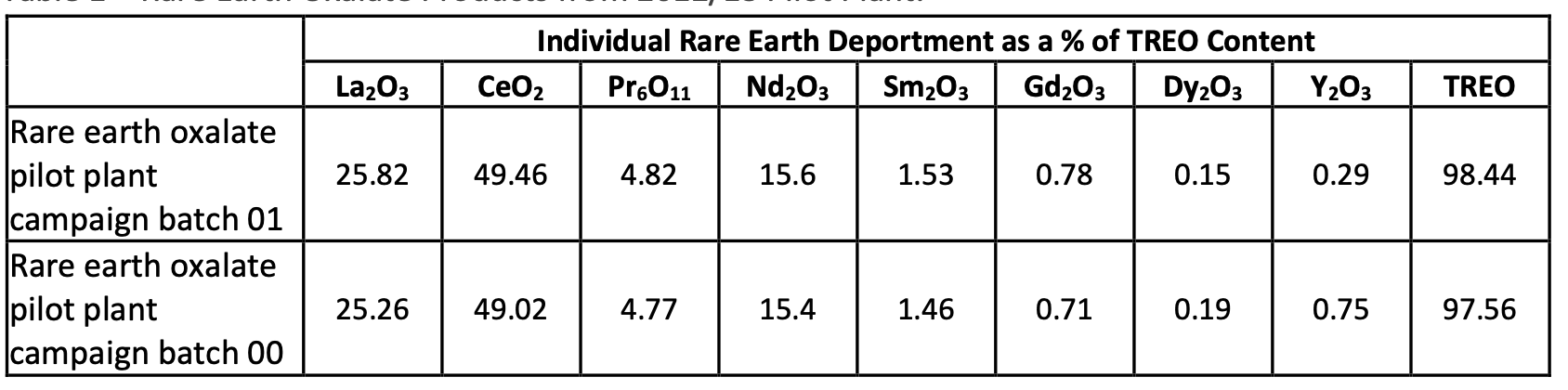
Rare Earth Oxalate Products from 2012/13 Pilot Plant.
“The downstream collaboration with CEFET, which will include the commissioning of a new pilot plant, marks an important milestone in executing our strategy of an integrated mine-to-market operation,” executive chair John Prineas said.
“We are delighted with the strong government support for the St George Technological Centre and are proud to also be contributing to the community through the Centre being available for educational and industry research.”
Research and downstream collaboration
The binding memorandum of understanding (MOU) with CEFET, a government-funded technological institution in Minas Gerais, Brazil, will establish the St George Technological Centre at CEFET’s Araxá campus. The collaboration will focus on research, development, and innovation to support sustainable mining and processing, including downstream studies for the Araxá Project.
Under the MOU, CEFET will provide rent-free workspace for a large-scale pilot plant, designed jointly with St George. St George will contribute equipment from a 2013 hydrometallurgical pilot campaign at Araxá. The plant will cover mineral processing and hydrometallurgical refinement with an input capacity of 200 to 300 kilograms per hour, producing sample ferroniobium and rare earth products such as concentrate, mixed rare earth carbonate (MREC) and rare earth oxides.
St George will procure all plant equipment to the final design, with expected government concessions on sales and import taxes reducing total costs by 50%. The Centre will be available for St George’s metallurgical testwork within a broader educational and strategic-minerals mandate. St George will have exclusivity to commercialise any intellectual property (IP) it develops at the Centre for five years from commissioning and may co-own other IP based on relative contributions.
Funding and implementation will be staged: three years of pilot-scale operations by St George, a two-year joint operating transition to ensure knowledge transfer and process optimisation, and full operational handover to CEFET at the end of year five.
A prior 2012/13 pilot produced rare earth oxalate at 99% purity. Retained oxalate samples (about 15 kilograms each) have been supplied to MagBras for magnet-making testwork (ASX: 29 July 2025), while REAlloys is conducting additional downstream studies under a United States strategic alliance (ASX: 10 September 2025). The products contain more than 20% of total rare earth oxides (TREO) as neodymium-praseodymium (NdPr) and around 5% heavy rare earths, including elevated samarium and dysprosium.
Team strengthened
St George has strengthened its delivery team with metallurgical appointments, including in-country consultant Alaercio Viera and Australian-based experts Gavin Beer and Peter Adamini.
- Alaercio Viera — St George’s in-country metallurgical consultant; formerly metallurgy manager at Serra Verde, Brazil’s only producing rare earths mine, and process expert at the two largest niobium operations, CBMM in Araxá and CMOC in Catalão, Brazil.
- Gavin Beer — metallurgical consultant to St George and the competent person for testwork results.
- Peter Adamini — technical manager at Independent Metallurgical Operations (IMO), leading the IMO team and also a competent person for testwork results.
The Araxá Project hosts a JORC-compliant mineral resource of 40.6 million tonnes at 4.13% TREO and 41.2 million tonnes at 0.68% niobium pentoxide (Nb₂O₅), with drilling underway to expand and upgrade the inventory.