
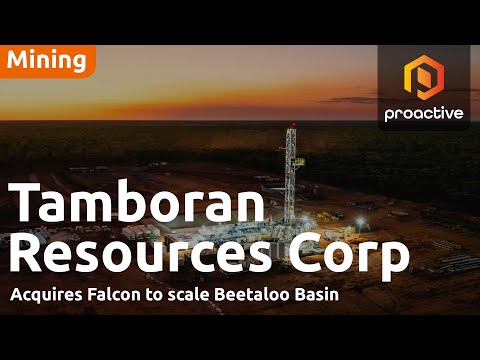
Tamboran Resources Corporation (ASX:TBN, NYSE:TBN, OTC:TBNRL) Chair and CEO Dick Stoneburner spoke with Proactive about the company's definitive agreement to acquire Falcon Oil and Gas in a strategic move to consolidate its position in the Beetaloo Basin.
Stoneburner explained that the Beetaloo Basin is “the largest, scalable, drill ready basin in the world to develop a large scale shale gas resource,” covering around 5 million acres.
Tamboran, following the merger, will hold 3 million net acres, giving it a controlling position across the majority of the basin.
The acquisition consolidates Tamboran’s operating interest and is expected to streamline future capital expenditure.
“Falcon would have had a hard time keeping up with that capital expenditure to develop the basin,” Stoneburner said, noting that the transaction arose naturally from shared interests.
Tamboran plans to supply gas initially to Darwin starting next year, followed by deliveries to southeast Australian markets and eventually the broader Asia-Pacific LNG market.
Stoneburner noted the long-term scope of the project, referencing “approximately 44,000 drilling locations under the acreage that we have an interest in.”
Looking ahead, he projected that production from the basin could reach up to 12 billion cubic feet (bcf) per day by the mid-2030s, positioning it as a major supplier for energy security needs in the region.
Due diligence is ongoing across multiple jurisdictions including the US, Australia, Canada, and the UK, with the merger expected to close in the first quarter of 2026.
Proactive: All right, welcome back inside our Proactive newsroom. And joining me now is Dick Stoneburner. He is the interim CEO of Tamboran Resources Corp. Significant news out from the company today talking about the acquisition of Falcon Oil and Gas — a really strategic acquisition for sure. Dick, we’ll get into the reasons why in a second, but just off the top of your head, talk to me a bit about the move forward on this.
Dick Stoneburner: Yeah, it's a natural consolidation between Falcon and Tamboran. They’re a non-operated interest partner with us, with a 22.5% working interest. There are hundreds of millions of dollars to spend in the future in this basin, and quite honestly, Falcon would have had a hard time keeping up with that capital expenditure to develop the basin.
So Philip Quigley and I began discussions, which led to a merger discussion. I think it’s going to be good for both companies. It’ll allow us both to move forward and develop this basin.
Yeah. As you mentioned, the capital that’s going to be needed — combined with both companies — makes it a way easier road ahead. Talk to me a little bit about the Beetaloo Basin and what you see there, and the opportunity now with the two companies combined.
Well, I've said this many times publicly and internally — I truly believe the Beetaloo Basin is the largest, scalable, drill-ready basin in the world to develop a large-scale shale gas resource.
It’s about 5 million acres in size. We have an interest under virtually every acre in the basin. By virtue of the merger with Falcon, we have 3 million net acres out of the 5 million acres. So it’s a huge basin.
It’s going to deliver gas not only to Australia — we’re going to begin sales in Darwin next year to help their need for energy security.
Our next phase would be to develop gas to deliver to the southeast markets of Australia, which will have a significant undersupply situation toward the latter part of the decade. And then lastly, we’ll put gas on LNG facilities and deliver that throughout the Asia-Pacific region. So it’s actually a huge resource that’s going to deliver gas to an area that, through the course of the next decade and more, needs it desperately.
Maybe you could talk a bit about the scale of it. Because as you mentioned, there’s a long-term plan here that will take you out many, many years. This isn't just one, two or five wells. There's potential for much more than that.
Well, it's funny you should ask that. I have a number off the top of my head — there are approximately 44,000 drilling locations under the acreage that we have an interest in. And we have a controlling interest, meaning we’re the operator, in about half of that. So it’s a huge resource.
We believe that by the mid-2030s, this resource could deliver as much as 12 billion cubic feet a day to the various markets I just described. For comparison, the Marcellus Shale in the northeast US delivers 35 billion cubic feet per day. Some of that is external to the LNG market, but most of it is to the domestic market in the US.
And lastly, how does this move forward now? Obviously, you’ve got some due diligence to do. The deal is definitive, but it’ll be closing in 2026. Is there work to happen before that?
Yeah. Like any merger, there’s work to be done. There are SEC requirements. There are other exchanges that Falcon is traded on. So we have a lot of international diligence — Australia, US, London, Canada. These are all areas where we have obligatory diligence to get us to the point of closing, which we think is sometime in mid–first quarter of 2026.