
The global medical technology (MedTech) sector has shown it is far from fragile. According to EY’s latest Pulse of the MedTech Industry Report 2025, the industry notched its seventh straight year of revenue growth, reaching US$584 billion, even as tariff uncertainty and macroeconomic jitters loomed large.
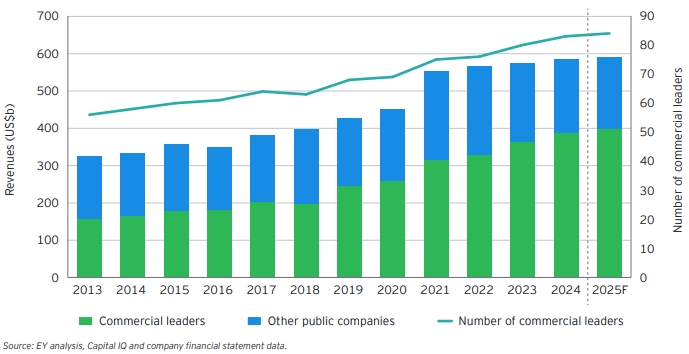
MedTech industry (US and Europe) revenue growth, i.e., 2013–25
Far from retreating, the report shows the sector is leaning into innovation and scale. Venture capital (VC) investment surged, deal sizes climbed, and commercial leaders are forecast to grow revenues by another 6–7% this year. For investors and companies alike, the message is clear: MedTech is proving to be one of healthcare’s most resilient and dynamic subsectors.
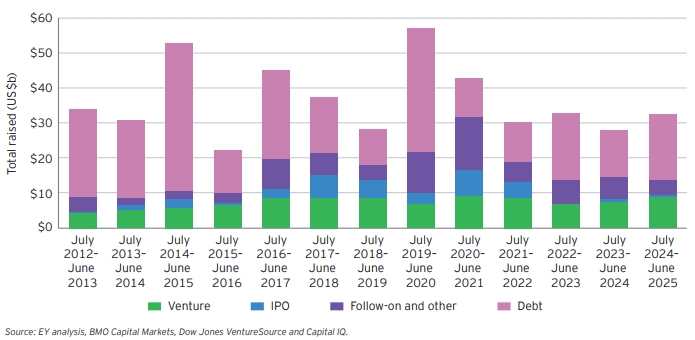
MedTech capital raised, July 2012–June 2025
Growth resilience and market confidence
EY highlights that the industry has emerged as a relative “safe harbour” compared with other parts of healthcare. Orthopaedics recorded 16% revenue growth, ophthalmics surged 28%, and cardiovascular companies delivered a 76% increase in net income. By contrast, research and laboratory equipment contracted for the second year running.
“The sector is proving to be a safe harbor within the relatively underperforming broader health care industry, generating stronger results and building confidence for the quarters ahead,” said John Babitt, EY global medical technology leader.
This outperformance is reflected in valuations, according to the report. High-growth leaders, often focused on differentiated innovation and high-potential therapeutic areas such as pulse field ablation, structural heart, robotics and diabetes, now command an enterprise value-to-revenue ratio of 10.82x, compared with 6.64x for the overall sector and just 3.59x across the S&P 500.
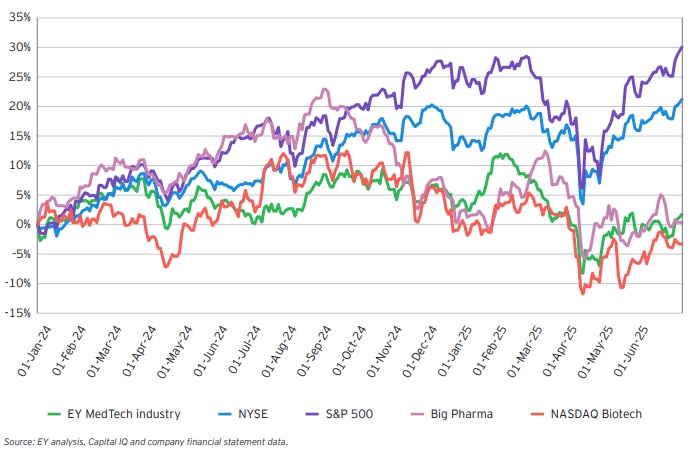
MedTech valuations compared to other indices, January 1, 2024–June 30, 2025
Bigger bets in venture and M&A
Venture funding has rebounded sharply. Total VC investment climbed 20% year-on-year to US$8.7 billion, just shy of record pandemic-era highs, according to the report.
Yet the number of rounds dropped 47% from last year, underscoring a trend toward fewer, larger deals. The average round swelled to US$37 million — a 221% jump on the five-year mean.
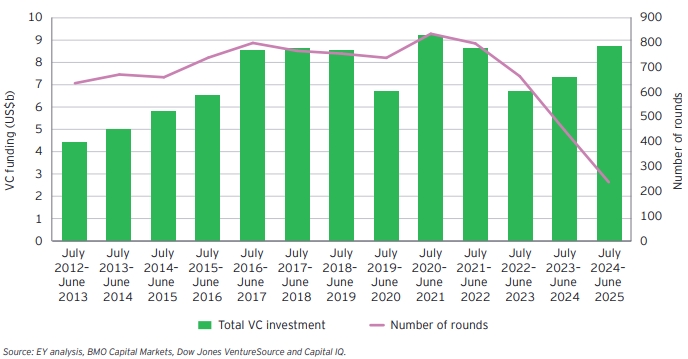
VC investment and number of financing rounds, July 2012–June 2025
That capital concentration is flowing into hot spots. Robotics and cardiovascular devices attracted a lion’s share, with companies such as Neuralink raising US$650 million and ophthalmology specialist BVI Medical securing US$1 billion, EY noted.
The same pattern is visible in M&A. While total disclosed spending of US$38.8 billion was below historical norms, the average deal size leapt to US$636 million — more than double the decade-long average. Stryker’s US$4.9 billion acquisition of Inari Medical and Johnson & Johnson’s US$1.7 billion purchase of V-Wave highlight the appetite for high-growth assets in cardiovascular technologies.
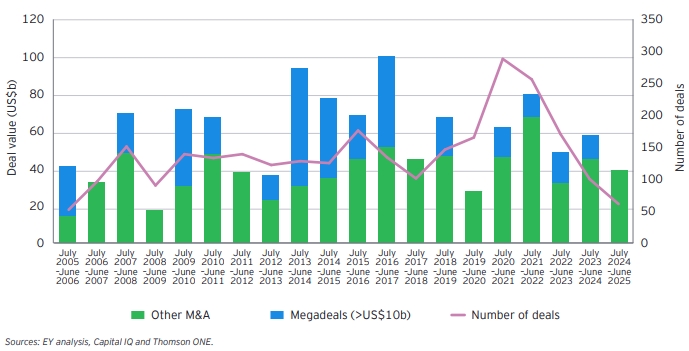
M&A investment and deal volume, July 2005–June 2025
Arda Ural, PhD, EY Americas life sciences leader, summed up the dynamic: “Encouraging fundamentals, along with strong balance sheets, are creating new opportunities for MedTech to continue to thrive. Organisations who prioritize differentiated innovation, strategic M&A and advanced operating models will be best positioned to deliver long-term growth and shareholder value.”
Tariffs and trade: adapting to disruption
Despite resilience, trade friction is forcing strategic adjustments. The Trump administration’s 2025 tariff regime — including a baseline 10% on most imports — has compelled companies to build tariff task forces, reconfigure supply chains and consider local-for-local manufacturing.
As EY noted, GE HealthCare CFO James Saccaro said on a recent earnings call: “As we’ve seen these trade deals shape up, we’re now in a position to begin to execute on some of these [supply chain shifts], which we’ll do in the second half of the year, and then those will benefit 2026.”
EY observed that the firms best positioned to navigate this environment are those embedding trade strategy into governance structures that span tax, supply chain and government affairs.
Future focus: AI and operating models
The report also flags AI as a central lever for transformation, particularly in supply chains. EY found 84% of life sciences CEOs now believe optimising data quality and integration, rather than simply deploying new tools, is key to unlocking AI’s impact.
It noted that case studies, such as Medtronic’s consolidation of data from 45 manufacturing plants into a single integrated system, show how predictive analytics can lift forecast accuracy and protect margins while accelerating delivery of therapies to patients.
At the same time, many leaders are shifting away from regional structures to business-unit operating models, enabling sharper focus on therapeutic categories and faster decision-making. Companies such as Baxter, Medtronic and GE HealthCare have adopted the approach in recent years, the report said.
Investor takeaway
For investors, EY’s findings reinforce MedTech’s reputation as a growth engine with strong defensive qualities. But the report also underscores a widening gap between leaders and laggards. Companies that can demonstrate a high return on invested capital into R&D are being rewarded with superior shareholder returns, while those that fail to prove their “right to grow” risk being left behind.
As Babitt put it, “performance is being driven by innovation and market expansion in high-growth areas”. The winners will be those able to marry that innovation with smart capital allocation, disciplined integration of acquisitions, and a proactive approach to navigating tariffs and supply chain challenges.
For now, MedTech’s vital signs look more than healthy.