
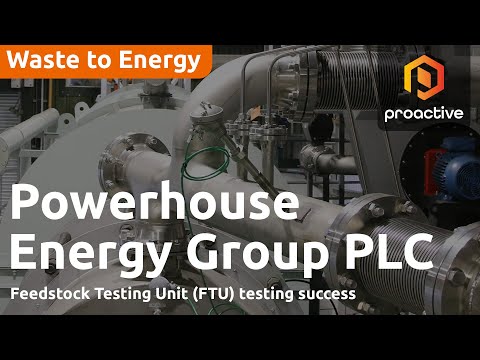
Powerhouse Energy Group PLC (AIM:PHE) this week updated investors on the progress of its Feedstock Testing Unit (FTU) following six months of intensive testing and system enhancements.
The company told Proactive that the FTU had transitioned from commissioning into a full testing regime. Test materials have included raw plastic pellets, Solid Recovered Fuel (SRF), and Refuse Derived Fuel (RDF).
Powerhouse Energy said it also replicated specific feedstock compositions for clients such as National Hydrogen, achieving consistent and better-than-expected results.
Chief executive officer Paul Emmitt, whilst talking with the Proactive studio, said the system had undergone technical upgrades, including changes to the kiln’s exit end, based on work with Manchester University and Engsolve. These modifications reduced residue carryover and increased gas residence time, improving hydrogen output.
Proactive: Paul, very good to speak with you today. It's been six months since you demonstrated the Feedstock Testing Unit (FTU) and you announced an update last week. Can you give us an idea of how it's been going and what you've been up to?
Paul Emmitt: Yeah, of course. Hi Stephen. Yes, it's been an extremely busy six months. We've gone from commissioning the unit, which we completed just before the CMD — maybe a little early — to running a full testing regime. We started by testing raw plastic in pellet form, which gave us a baseline for the machine.
We then brought in Solid Recovered Fuel (SRF) and Refuse Derived Fuel (RDF), which gave us a broader composition to validate against our internal model. We've also used compositions required by clients like National Hydrogen. Instead of shipping waste from Australia, we recreated the required feedstock composition in Bridgend by sourcing different materials locally.
We’ve tested that mix several times with very consistent results — better than expected. Right now, we’re preparing for tests with a UK blue chip client in the next couple of weeks. We’ve also tested alternative materials like chicken litter, which opens up a completely new potential market. We now have solid data backing up the claims we’ve made to clients, and they're queuing up to visit — exactly where we needed to be.
Proactive: Are you satisfied with your progress and the validation of your system, Paul?
Paul Emmitt: Oh definitely. We did a small amount of work with Manchester University on computational fluid dynamics for the FTU’s internals. Then, building on work from Engsolve, we implemented a new system on the external part — specifically the exit end of the kiln. This has reduced residue carryover and given the gas a longer residence time, which in turn means we’re getting a slightly higher hydrogen ratio compared to our initial model.
We haven’t done anything magical — there’s only so much hydrogen you can get from a feedstock — but we’re now more efficient and the system is more effective. It’s set us up well. Earlier this month, SP Angel published figures incorporating the modifications we've made.
Now, we can also consider additional income streams, such as the residue itself, which we hadn’t factored into our model before. Heat recovery is another area — it could be valuable depending on deployment. We could provide hot water, district heating, or even use the heat to pre-dry feedstock before it enters the kiln.
So overall, the FTU is now at a point where it can react to client needs. That’s crucial if we want to go further commercially.
Proactive: So what’s next then, Paul? What should shareholders be looking out for?
Paul Emmitt: We’re making huge progress with the FTU. Over the next six weeks, multiple clients from around the world will be visiting. They’ve already had feedstock tested. The next step for us is to get a signature on the dotted line — that’s the goal.
We really want to repay our shareholders for their patience. I’m positive going into Q4 2025. The first half of the year may have seemed quiet, but we’ve been working hard behind the scenes.
Proactive: Paul, I hope you'll continue to keep us updated with your progress.