
Yandal Resources Ltd (ASX:YRL) has extended the strike length of its Arrakis gold discovery by 400 metres, reporting fresh reverse circulation (RC) drill intercepts that demonstrate potential continuity of mineralisation across a 2.2-kilometre trend.
The latest assays returned a standout 50 metres at 1.3 g/t gold from 122 metres in hole 25IWBRC0042, including 28 metres at 1.9 g/t from 143 metres. A second hole, 25IWBRC0043, delivered 16 metres at 0.7 g/t from 140 metres, including 9 metres at 1.0 g/t from the same depth.
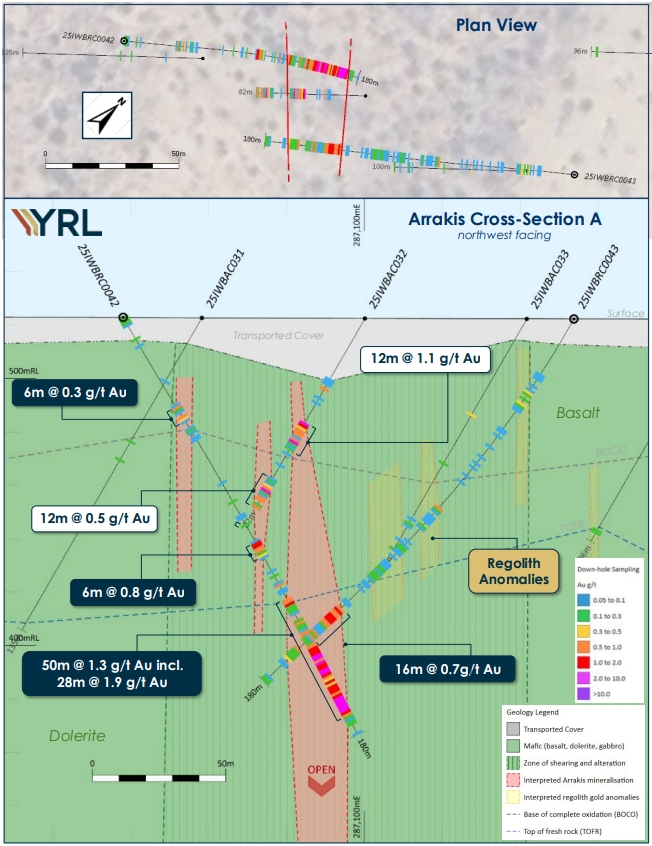
Cross-section showing all RC drilling results from 25IWBRC0042 and 25IWBRC0043, with a simple preliminary interpretation of geology.
These intercepts, located 400 metres northwest of results reported earlier this week — including 54 metres at 1.2 g/t gold from hole 25IWBRC0040 — confirm the presence of mineralisation within primary fresh rock and suggest continuity along strike.
Read more: Yandal confirms new Arrakis gold discovery with fresh rock intercepts
Exploration significance
Managing director Chris Oorschot said the results reinforce the scale and continuity now emerging at Arrakis.
“It is both encouraging and significant to observe a similar style of mineralisation in terms of grade, alteration and deformation fabrics at a 400-metre spacing,” Oorschot said.
“As we step out and consider the whole 2.2-kilometre trend initially defined by air-core drilling, the scale of this discovery begins to look regionally significant.”
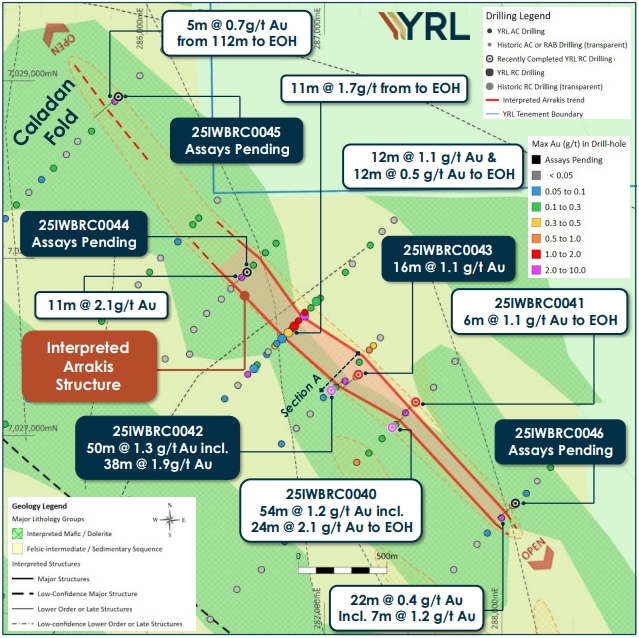
A collar plan over the Arrakis Prospect within the Caladan target area, showing simplified bedrock geology interpretation. All Yandal drilling is plotted (historic drilling has been excluded. Collars are thematically coloured by max Au (g/t) in the hole. The red line represents the approximate position of the interpreted Arrakis mineralised structure. Dashed yellow polygons represent air-core regolith anomalies (Results include ~4m @ 0.1 g/t Au or greater, with the upper profile or the bottom-of-hole sample is 0.1g/t Au or greater).
The company said the new intercepts display sub-vertical geometry and alteration styles consistent with previous fresh rock results, reinforcing evidence of a continuous mineralised system at Arrakis.
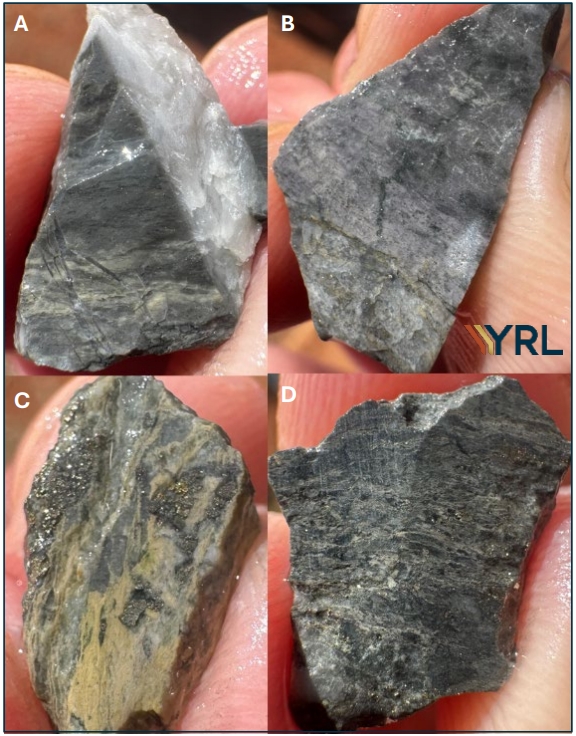
Close-up images of rock chips from RC hole 25IWBRC0042, fingers for scale, chips between 10-20mm in length: A) from 164-165m @ 3.4g/t Au. B) from 151-152m @ 1.6g/t Au. C) from 157-158m @ 1.4g/t Au D) from 167-168m @ 2.8g/t Au.
Next steps
Yandal is awaiting results from three additional RC holes testing the Arrakis trend to the northwest and southeast. A 1,200-metre diamond drilling program is scheduled to begin in October, designed to extend RC holes and probe deeper targets, while infill RC drilling on newly cleared 200-metre lines will also proceed.
Further heritage surveys are in progress to open up tighter 100-metre drill line spacing across the prospect, providing scope for more systematic drilling across the trend.
Part of a broader portfolio
Arrakis sits within the Caladan target area of the Ironstone Well-Barwidgee Gold Project, about 60 kilometres south of Northern Star’s Jundee mining complex and 18 kilometres north of the recent Siona discovery. Yandal controls a significant footprint in the Yandal and Norseman–Wiluna greenstone belts, considered among Australia’s most prospective gold regions.
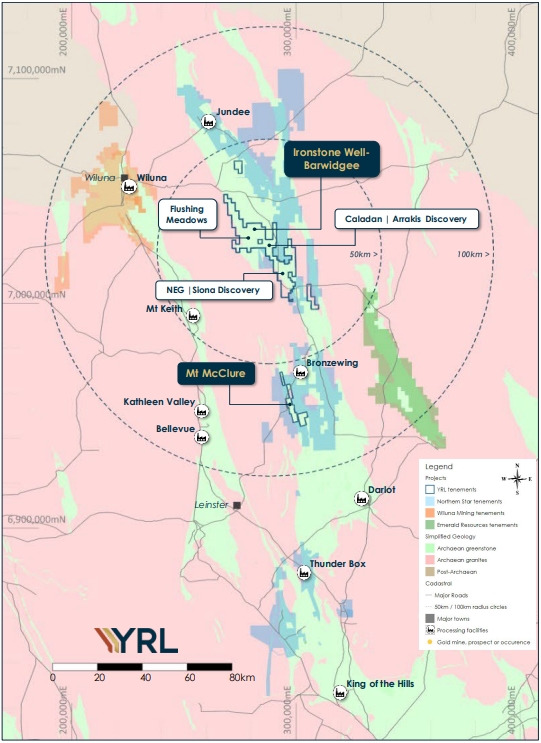
Yandal Resource exploration Project locations within the Yandal Greenstone Belt. The Arrakis Prospect is located within the Caladan target area.
The company has flagged a busy news flow for the remainder of 2025, including further RC and air-core results, the start of diamond drilling at Arrakis, first assays from the New England Granite target, and the completion of its $2.81 million Gordons Gold Project sale.