
America’s nuclear sector is once again at the centre of energy security debates. After decades of stagnation, uranium is back in the policy spotlight, with Washington pushing to triple nuclear capacity by 2050 and President Trump declaring a national energy emergency earlier this year. Executive orders have tasked the US Department of Energy with rebuilding the nuclear fuel cycle at home — from mining and processing to enrichment and recycling — in an effort to wean the nation off foreign — especially Russian — supply.
The urgency is clear. America’s 94 commercial reactors burn through around 50 million pounds of uranium every year, yet domestic output has collapsed to barely 1 million pounds. With US electricity usage projected to soar — driven in part by the rapid build-out of data centres — the gap between demand and secure supply has rarely looked wider.
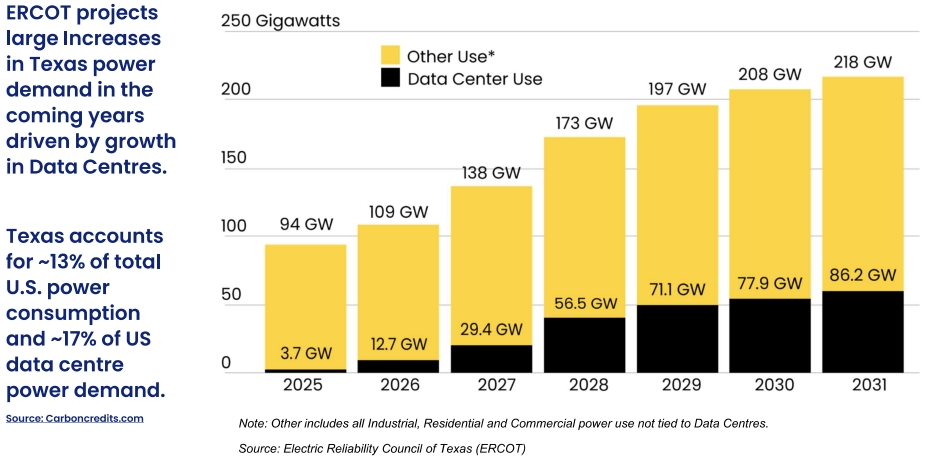
Electric Reliability Council of Texas (ERCOT) Texas electricity demand projections
That backdrop has reinvigorated exploration and development activity across the US uranium heartland. In Wyoming’s Powder River and Great Divide basins, several in-situ recovery (ISR) projects are advancing as investors and utilities hunt for near-term, low-cost resources. ISR — now the standard mining method in these districts — is already employed at major operations like Cameco’s Smith Ranch–Highland and Ur-Energy’s Lost Creek, which anchor the region as America’s key uranium hub.
One emerging developer moving forward alongside the established players in this landscape is American Uranium Ltd (ASX:AMU, OTC:GTRIF), which has carved out a meaningful portfolio of 100%-owned assets in Wyoming and Utah, anchored by the Lo Herma project — one of the few independent, near-term ISR opportunities with scale and economics to matter.
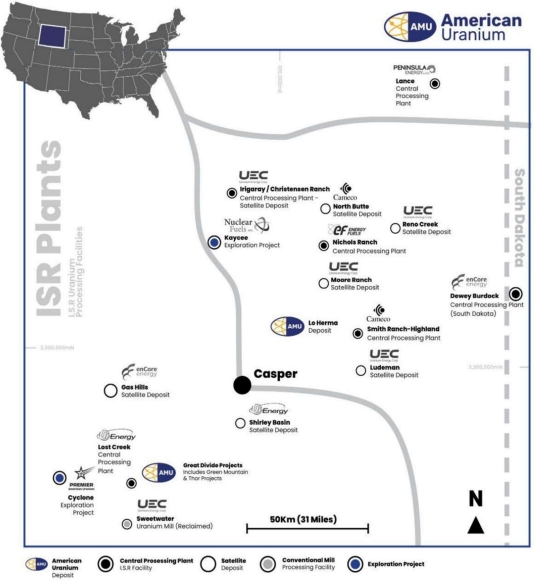
Wyoming ISR uranium projects
Lo Herma: A cornerstone in the Powder River Basin
At the core of AMU’s strategy is Lo Herma, situated in Wyoming’s Powder River Basin, the most significant uranium production district in the US. The project spans 13,500 acres, underpinned by extensive historical datasets now verified and expanded with two seasons of modern drilling.
The current JORC-compliant mineral resource estimate (MRE) stands at 8.57 million pounds of triuranium octoxide (U₃O₈), the mineral form typically processed into ‘yellowcake’ uranium, with about 32% in the indicated category. An exploration target of a further 6 million–11 million pounds underscores the potential to grow both the scale and the confidence of the resource base.
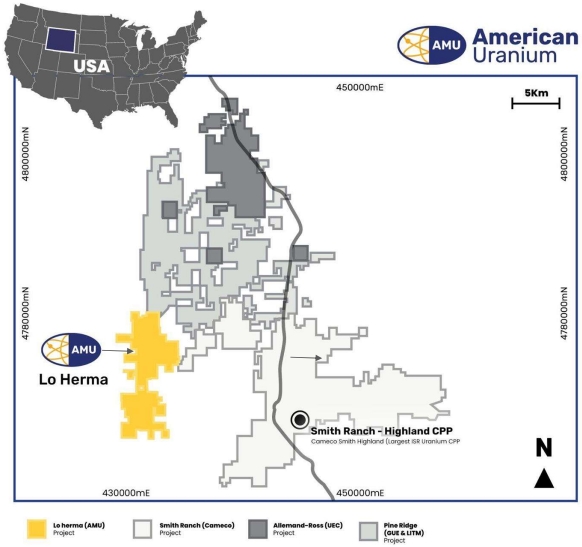
Wyoming Powder River Basin – Lo Herma Project
An interim scoping study completed this year confirmed Lo Herma’s potential as a low-cost ISR operation. Importantly, it showed strong economics under two different development scenarios — a central processing plant or a satellite operation — providing flexibility to tailor the project to financing and permitting conditions.
Proximity adds to the project’s appeal: Lo Herma lies less than 10 kilometres from Cameco’s Smith Ranch–Highland, with road access, power infrastructure and skilled local labour all in place.
With Bureau of Land Management approvals already secured and state permits expected imminently, AMU is preparing for a substantial drill program in Q4 CY2025:
- Up to 121 drill holes, totalling around 37,500 metres
- Aimed at upgrading inferred resources to indicated and expanding the overall MRE
- Collection of metallurgical and hydrogeological data to support feasibility work
The company expects to deliver a resource update by early 2026, followed by a refreshed scoping study later next year.
Read more: American Uranium to start hydrogeology testing and resource expansion drilling at Lo Herma
Expanding the Wyoming portfolio
While Lo Herma is the near-term focus, AMU is also progressing a broader Wyoming footprint across the Great Divide Basin and Green Mountain projects, covering 34,000 acres. These tenements host a maiden inferred resource of 1.66 million pounds U₃O₈, backed by historic drilling and refined targets identified through aerial geophysics.
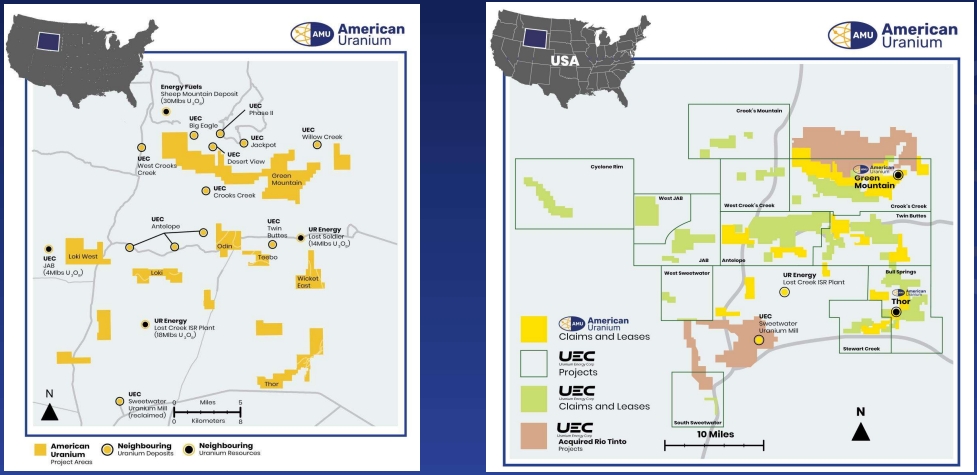
Wyoming – Great Divide Basin and Green Mountain
Permits are in place for up to 12 miles of trend drilling, which AMU intends to use to extend mineralisation and begin converting exploration targets into defined resources.
The company has advanced its Wyoming portfolio in stages since 2019, steadily adding projects with known commercial geology and metallurgy. Great Divide and Green Mountain represent the second leg of this strategy, complementing Lo Herma while diversifying the risk of a single-asset focus.
The Henry Mountains project in Utah rounds out the portfolio, offering exposure to uranium-vanadium potential in a district with a long history of mining. AMU is weighing options for renewed exploration or partnerships, keeping optionality alive for a future pipeline of opportunities.
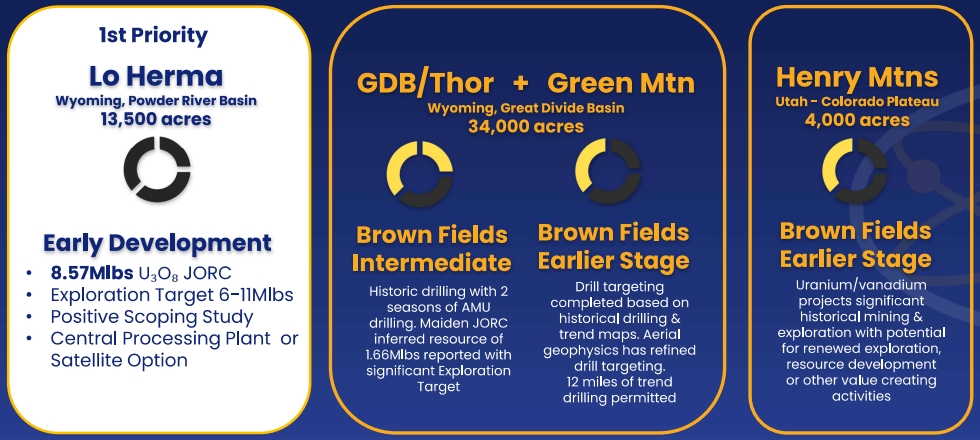
American Uranium project strategy
Together, Lo Herma and the Great Divide Basin give AMU a total Wyoming mineral resource of 10.23 million pounds U₃O₈, providing a clear baseline as it works to expand and upgrade resources across the portfolio.
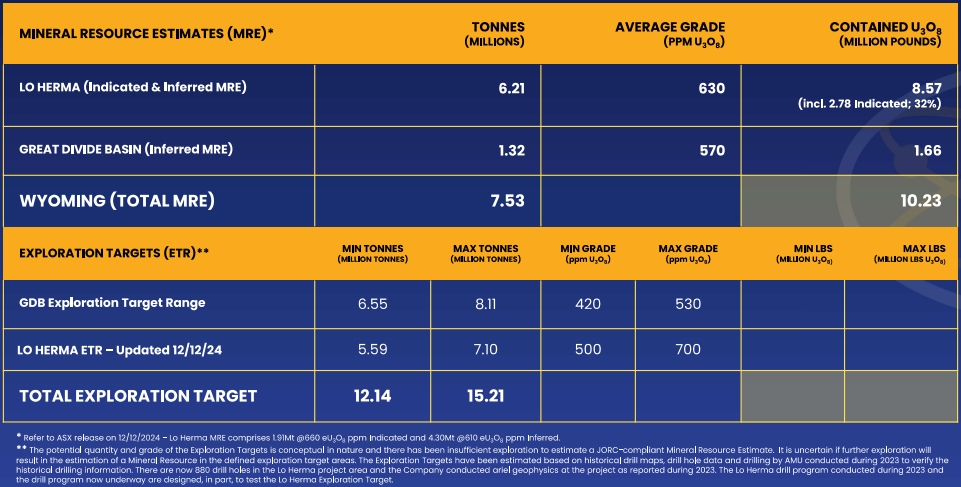
JORC resources and exploration targets
Signals from the market and peers
Investor interest in Wyoming uranium projects has been buoyed by a wave of consolidation and strategic transactions:
- Premier American Uranium recently completed its acquisition of Nuclear Fuels Inc. in a US$31 million all-stock deal.
- Uranium Energy Corp. bought Rio Tinto’s Wyoming uranium assets for US$175 million late last year, adding 175 million lbs of historical resources.
- Snow Lake Energy in March entered into a US$22.5 million joint venture with Global Uranium & Enrichment to acquire the Pine Ridge project north of Lo Herma, a deal that valued exploration pounds at US$0.44–0.92/lb and included a US$10 million spend commitment, underscoring the appetite for ISR-amenable resources along trend in the Powder River Basin.
For AMU, the link to Snow Lake runs deeper, with the company recently taking a 9.9% cornerstone stake in American Uranium itself. That investment not only provides direct validation of AMU’s potential but also situates Lo Herma within a neighbourhood of active corporate interest.
Read more: American Uranium secures Snow Lake as cornerstone investor with strategic Wyoming link
These transactions, taken together, highlight two things: the strategic importance of Wyoming’s ISR uranium resources, and the premium investors are prepared to pay for projects with defined resources or strong exploration upside.
Capital structure and development pathway
American Uranium remains a tightly held small cap, with a market capitalisation of about A$13.9 million at a share price of A$0.13 (as of September 9, 2025). As of June 30, the company reported A$4.8 million in pro-forma cash, providing capacity to deliver its upcoming drill program and complete near-term technical work.
The shareholder base is concentrated, with the top 20 investors holding 44% of stock, while directors and management account for about 1.6%. That level of insider ownership provides some alignment, even as the company gears up for a potentially capital-intensive development stage.
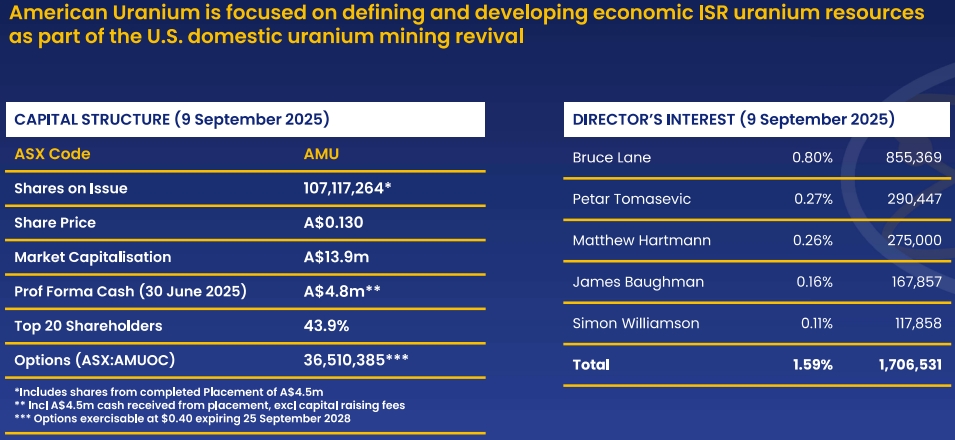
Corporate Snapshot
For AMU, the next 12–18 months bring a string of potential catalysts:
- Q4 2025: mobilisation of rigs at Lo Herma;
- Late 2025 / early 2026: updated resource estimate;
- 2026: scoping study refresh and potential transition to prefeasibility;
- Ongoing: exploration across Great Divide, Green Mountain and Henry Mountains.
These milestones, combined with a supportive policy backdrop and increasing sector consolidation, give AMU significant leverage to uranium’s unfolding story.
Positioning for America’s nuclear future
The push to re-establish a domestic uranium supply chain is not a passing theme but a structural imperative. With electricity demand rising, utilities under pressure to secure long-term supply, and policy support flowing from the highest levels of government, the environment for uranium development in the US is strengthening.
Read more: Tech Bytes: Uranium surges as nuclear revival gains pace; American Uranium jumps 30%
American Uranium is positioning itself within that trend. Lo Herma provides a clear near-term development pathway, while the Great Divide Basin, Green Mountain and Henry Mountains projects offer scale and optionality. With cornerstone support from Snow Lake and validation from peer transactions, AMU is emerging as one of the few independents capable of contributing new ISR supply in the medium term.
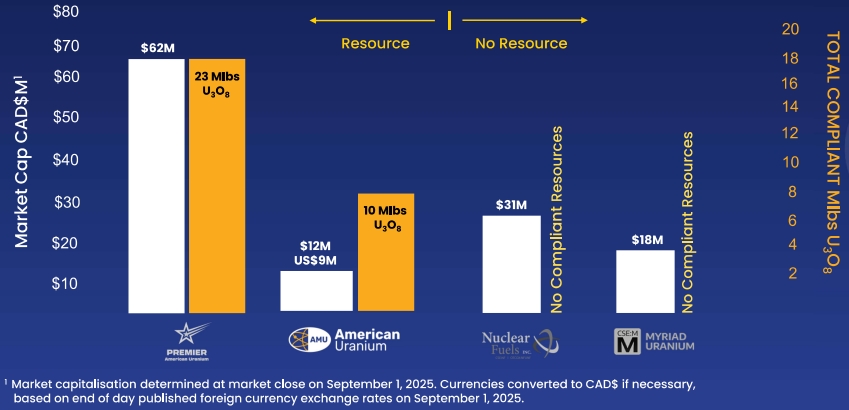
Peer Analysis – US Uranium Explorers
For investors, the appeal lies in the combination of leverage to macro energy security themes, exposure to one of America’s premier uranium basins, and upcoming catalysts that could re-rate the company. As the next round of drilling gets under way, AMU will be tested on its ability to deliver resources into a market that increasingly needs them.