
Yandal Resources Ltd (ASX:YRL) has completed reverse circulation (RC) drilling at its Arrakis Prospect, while final results from the Caladan air-core (AC) program have confirmed a significant mineralised structure extending 2.2 kilometres.
The company also finalised the first of two heritage surveys, with further work scheduled for later this month.
Caladan results highlight scale
The Caladan AC program comprised 136 holes for 13,933 metres across 10 lines, testing 6.4 kilometres of strike. The average hole depth was 102 metres, with spacing between 400 and 800 metres. Results confirmed several anomalous gold trends, the most significant being the Arrakis structure, which is part of the broader Ironstone Well-Barwidgee Project.
Mineralisation was intersected within a 3.2-kilometre-long by 200-metre-wide anomaly, hosted in altered and deformed rocks on the northeast margin of a 500-metre dolerite sequence.
Highlights from the program include:
- 11 metres at 2.1 g/t Au from 90 metres, including 7 metres at 3.1 g/t Au.
- 12 metres at 1.1 g/t Au from 45 metres.
- 12 metres at 0.5 g/t Au from 70 metres to end-of-hole.
- 11 metres at 1.4 g/t Au from 71 metres, including 6 metres at 2.3 g/t Au.
- 22 metres at 0.5 g/t Au from 75 metres, including 7 metres at 1.2 g/t Au.
- 5 metres at 0.7 g/t Au from 112 metres to end-of-hole.
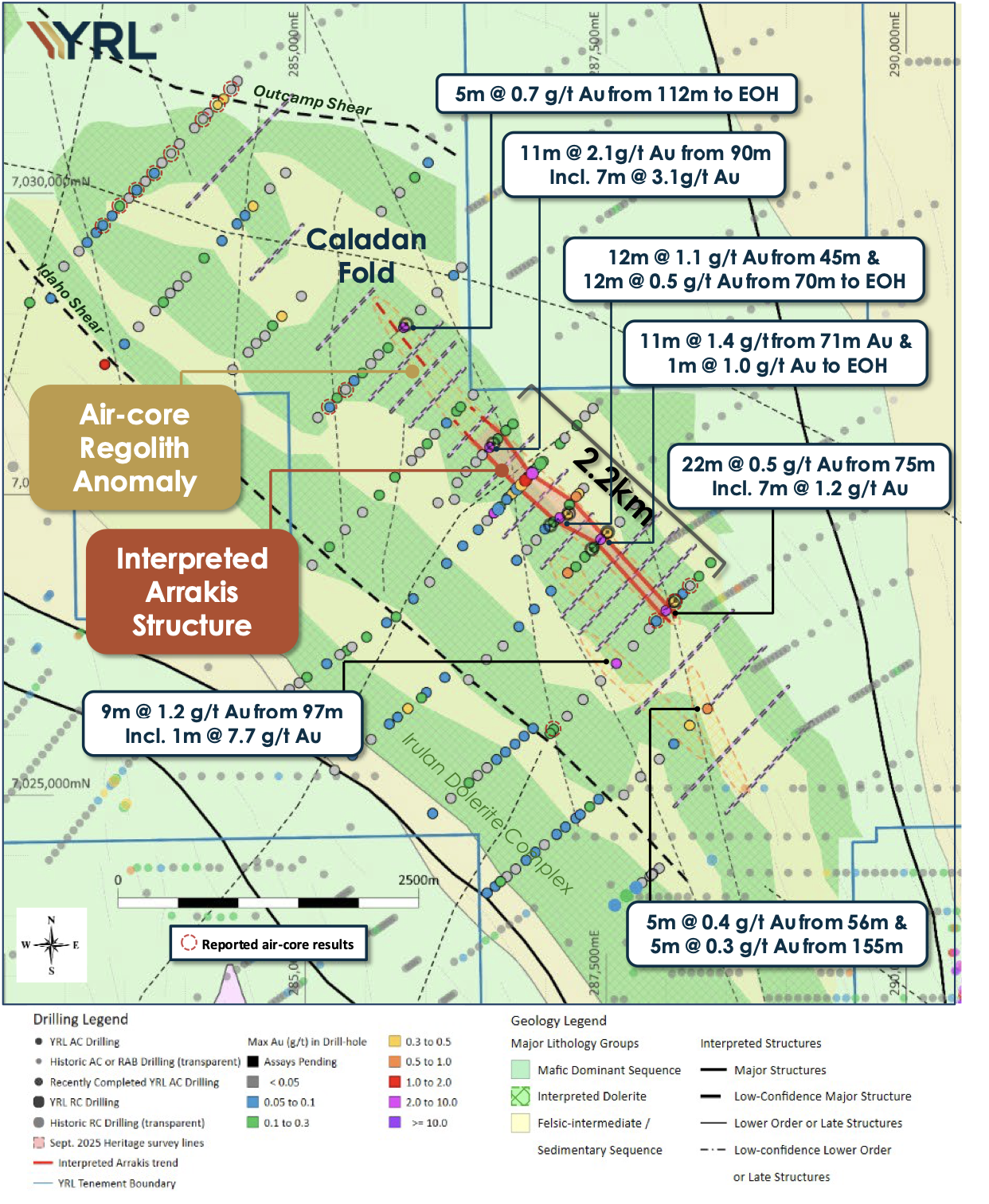
A collar plan over the Caladan target area, showing simplified bedrock geology interpretation across the Caladan and northern Irulan target areas (interpretation based on bottom-of-hole geology). The locations of effective historic drilling (>20m depth, excluding all Eagle Mining and Hunter Resources RAB drilling from 1995) and all Yandal drilling are plotted. Collars are thematically coloured by max Au (g/t) in the hole.
These results build on earlier intercepts and provide strong evidence for mineralisation continuity along strike.
Arrakis RC drilling completed
Seven RC holes were drilled for a total of 1,374 metres at Arrakis to test beneath the AC intercepts. Drilling targeted fresh rock to confirm mineralisation continuity at depth and to define the geometry of host structures.
Yandal reported that all holes intersected broad zones of shearing and alteration, with a range of alteration assemblages and deformation textures observed. These geological features are consistent with the mineralised trends defined in the AC drilling. Assay results from the RC program are expected within the next three to six weeks.
Heritage work advancing
The company has completed the first of two heritage surveys across the Arrakis Prospect. This work cleared 200-metre spaced lines across the extent of the mineralised structure. A second survey is scheduled for late September or October and will aim to clear closer spaced lines, up to 80 metres apart, across Arrakis and the broader Caladan target area.
Completion of the surveys will allow for additional infill and step-out drilling, supporting further exploration momentum into the year’s end.
Next steps and outlook
Yandal intends to follow up with more RC and AC drilling at Arrakis and Caladan once the pending results are received. Planned programs include infill drilling to test parallel regolith anomalies and additional RC holes to define the extents of the mineralisation.
In parallel, the company expects first AC results from the New England Granite target and completion of the Gordons Gold Project sale, valued at A$2.81 million in cash and Horizon Minerals Ltd shares.
Yandal has a strong cash position and active schedule. Results from Arrakis RC drilling, the second heritage survey, and broader exploration programs will drive news flow in the coming months.