
Critical Resources Ltd (ASX:CRR) has signed a binding agreement to acquire 90% of the Rock and Pillar prospecting permit application in New Zealand’s Otago region. The deal secures nearly 10 kilometres of the Cap Burn Fault strike, including its down-plunge extension, consolidating tenure adjacent to the company's Cap Burn Project.
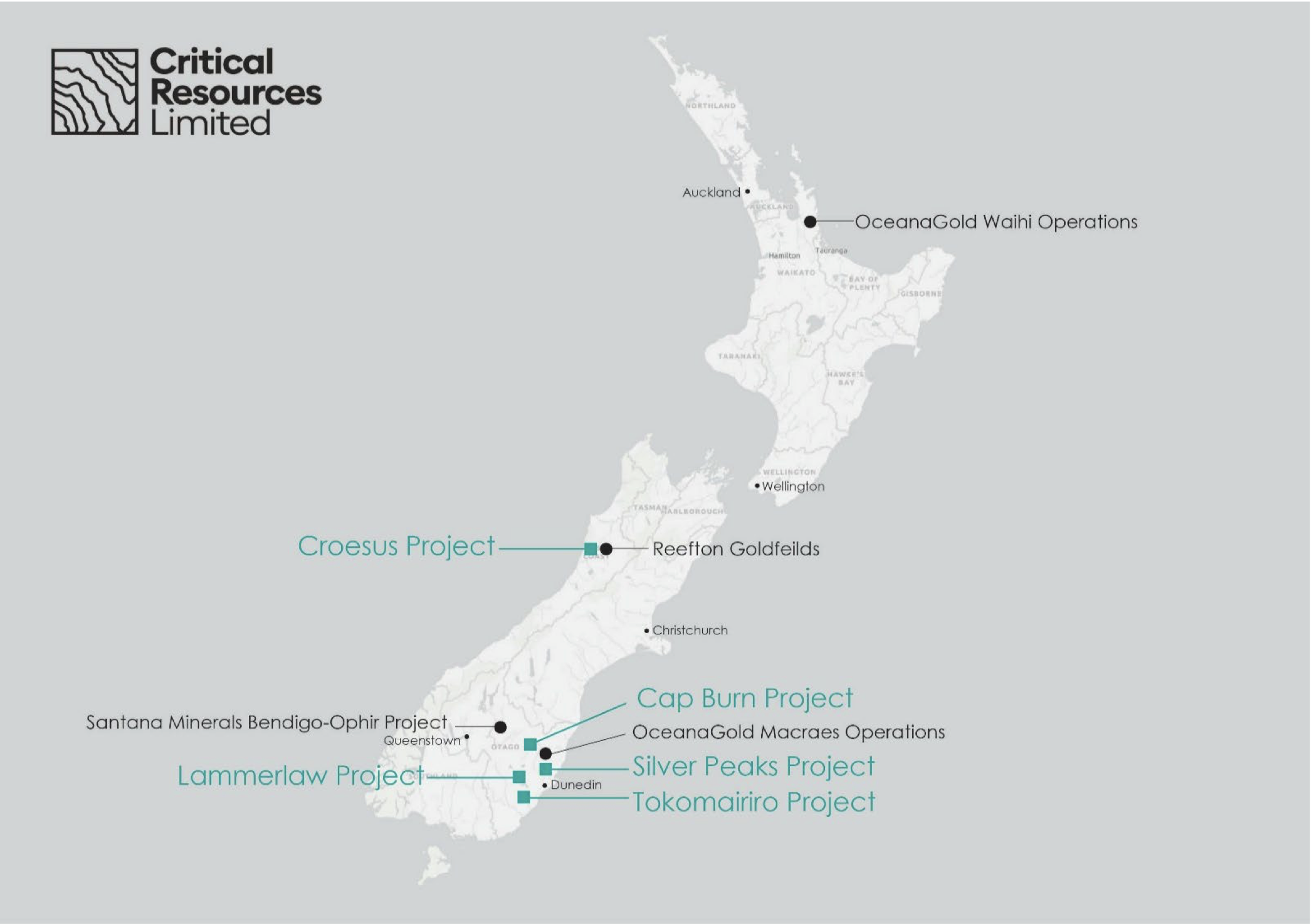
Location of acquired New Zealand projects (Green) with major gold mining projects.
The Cap Burn Project is located just 11 kilometres from OceanaGold’s +10 million ounce Macraes gold camp and sits on the same regional structure. The acquisition provides CRR with a contiguous and underexplored structural corridor for gold and antimony exploration.
The drill-ready Cap Burn Project has an access agreement in place, with a drill program expected to begin shortly after Ministerial consent is granted in October.
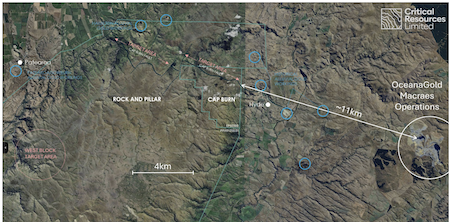
Cap Burn Project location ~11km from OceanaGold Macraes Gold Operations with major and minor interpreted structures (black lines) and historic alluvial gold workings (blue circles) (Google Earth image).
Strategic rationale for acquisition
Critical Resources chief executive officer Tim Wither said the Rock and Pillar acquisition secures “~10km of contiguous strike along the prospective Cap Burn Fault,” enabling the company to fully test mineralisation continuity.
“Previous exploration across the Rock and Pillar permit had not targeted the Cap Burn Fault, as Santana Minerals’ Rise and Shine geological model had not yet been established. Legacy work instead focused on elevated arsenic-in-soil anomalies away from the Cap Burn Fault, confirming gold and antimony mineralisation and delivering additional priority drill targets.”
The acquisition unlocks access to the fault’s down-plunge potential and several historic alluvial gold workings, including the Hamilton Digging, which produced more than 80,000 ounces of gold in just 18 months during the 1860s.
“The existence of alluvial gold workings on both western and eastern sides of the Cap Burn fault highlights the prospectivity of the area, which remains untested by modern exploration,” Wither said.
"The company is progressing the Cap Burn permit transfer, and once completed, exploration will be able to commence in cooperation with the station farming activities.”
This legacy, combined with modern geological models and technology, sets the stage for renewed exploration with low entry costs and high potential upside for shareholders.
Geological potential and historical data
The Rock and Pillar permit spans 331 square kilometres and covers structurally complex greenschist terrain. The Cap Burn Fault, a major structural corridor, bisects the tenement and displays strong geophysical and geochemical signatures.
The area has seen limited modern exploration. Historical soil sampling revealed extensive arsenic anomalies, while legacy rock samples returned antimony grades as high as 54.8% Sb. Five diamond drill holes completed in 2020 confirmed the presence of orogenic gold mineralisation, with results such as 2 metres at 1.99 grams per tonne (g/t) gold and 3 metres at 0.35 g/t gold.
The Cap Burn Project, adjacent to this acquisition, features a >1 square kilometre arsenic anomaly over the Cap Burn Fault, along with gold intersections consistent with shear-hosted orogenic systems like Macraes and Bendigo–Ophir. These analogues underpin a refreshed exploration model targeting deeper plunging mineralisation beneath surface anomalies.
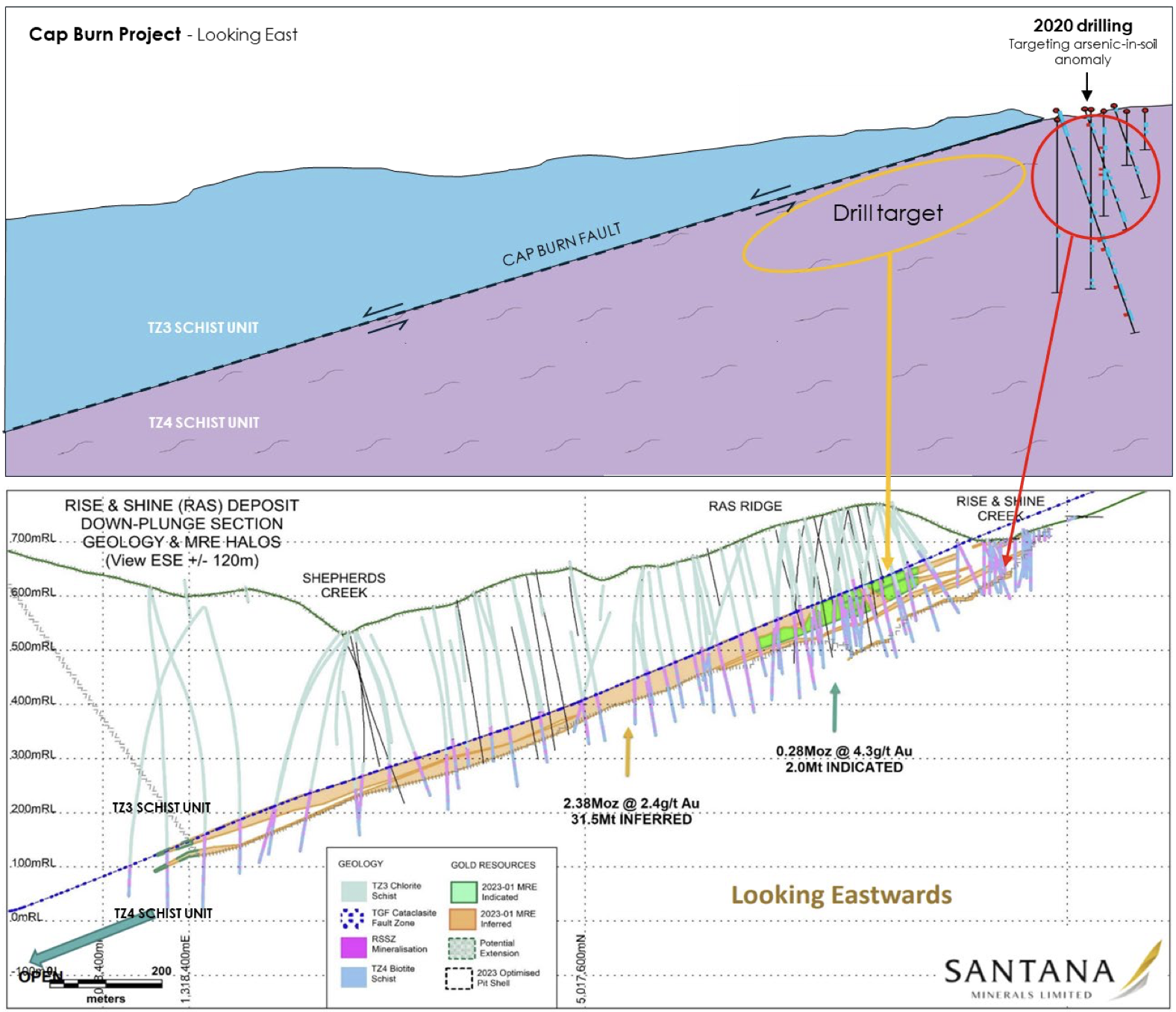
Cap Burn Project cross-section (top) – conceptual down-plunge target at Cap Burn with comparison to Santana Minerals Rise and Shine cross-section (bottom) (Santana Minerals).
New Zealand projects bolster CRR’s antimony-gold portfolio
The acquisition forms part of a broader regional strategy. Critical Resources now holds interests in over 1,700 square kilometres of highly prospective ground across Otago and the West Coast.
New Zealand’s geological appeal is matched by strong government support, with the Fast-Track Approvals Bill set to streamline permitting. The country ranks 12th on the Fraser Institute’s 2025 Investment Attractiveness Index and is committed to doubling mineral exports over the next decade.
The Rock and Pillar acquisition positions CRR as an early mover in this supportive jurisdiction, diversifying its gold-antimony portfolio alongside its lithium assets in Canada and base metals in New South Wales.
Summary of transaction and forward work program
CRR’s New Zealand subsidiary, Goldfire Resources, will acquire 90% of the Rock and Pillar permit from Euro Gold Ventures Pty Ltd. The deal includes:
- A$50,000 in cash upon completion;
- Three milestone payments (A$100,000 in shares upon permit conversion, A$150,000 on drill intersection and A$750,000 on a JORC-compliant resource definition);
- Minimum exploration expenditure of NZ$50,000 p.a. during the prospecting phase, rising to NZ$250,000 post-conversion.
A joint venture will be formed, with Euro Gold free-carried until a final investment decision is made. Field activities will commence following permit transfer and access approvals, with CRR to update shareholders as the transaction progresses.