
Australian households are showing signs of renewed caution, pulling back from the optimism that followed earlier interest rate cuts. The Westpac-Melbourne Institute consumer sentiment index fell 3.1% to 95.4 in September, slipping back into “cautiously pessimistic” territory after nearly touching the neutral 100 mark in August.
Sentiment had been steadily improving through 2025 amid falling inflation and a series of Reserve Bank of Australia (RBA) rate cuts. Optimism briefly surged in August when the cash rate was lowered to 3.6%, but the September pullback reflects ongoing uncertainty.
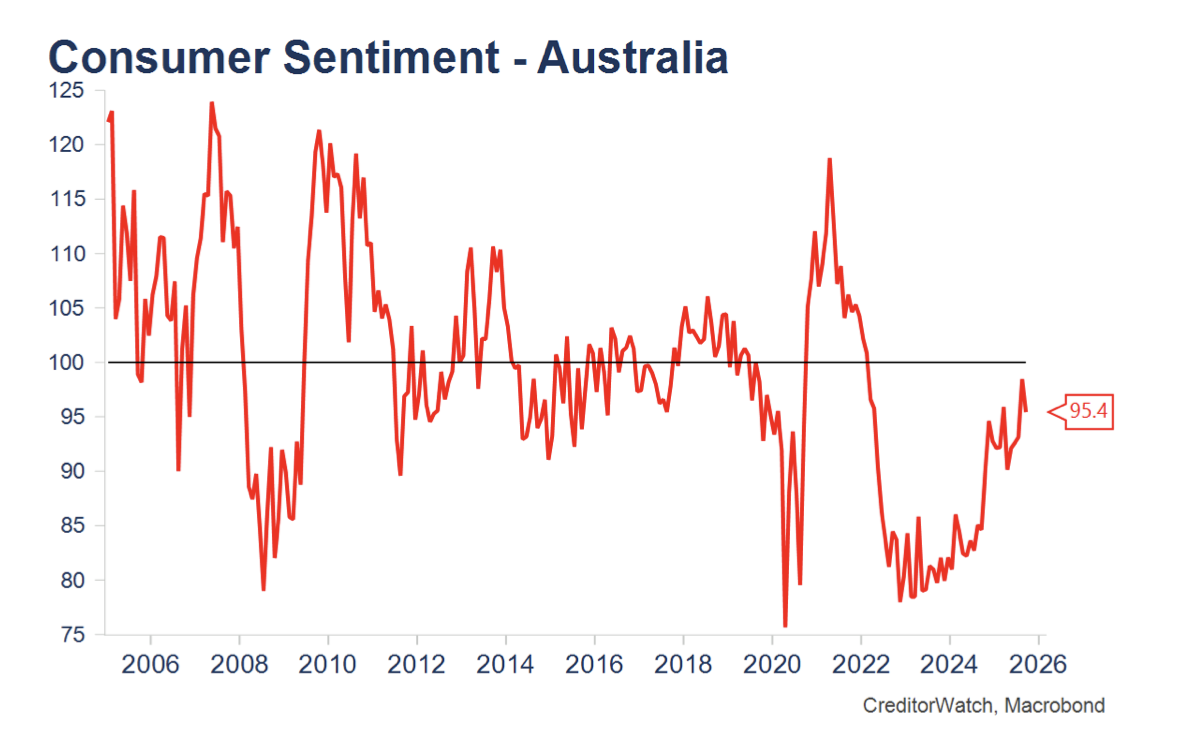
Westpac’s head of Australian macro-forecasting Matthew Hassan said the recovery was progressing unevenly. “The cost-of-living crisis may be largely over and policy easing generating some uplift, but there is still clearly some unease about the path ahead,” he said.
Uneven recovery and fragile confidence
The index showed households slightly more positive about their personal finances, but expectations for the broader economy deteriorated. Sentiment about the year ahead dropped 8.9%, while the five-year outlook fell 5.9%. At the same time, unemployment expectations rose 4.6%, extending a six-month upward trend that Westpac warns could be an early sign of labour market weakness.
“Certainly, this month's sentiment survey suggests the consumer recovery that began in mid-2024 is proceeding slowly and that further easing will likely be needed to sustain gains,” Hassan said.
Households also reacted negatively to July’s surprise jump in monthly inflation, which tempered earlier optimism about falling price pressures. While Westpac expects the RBA to hold rates steady later in September, analysts still anticipate another cut in November to support demand.
Retailers see tailwinds, but spending remains muted
Despite consumer caution, retailers are experiencing their strongest conditions in several years. Deloitte Access Economics’ latest retail forecasts point to real spending growth of 1.5% over the past year — the best outcome since 2022, though still shy of the pre-COVID average of 2.4%.
Deloitte partner and report author David Rumbens said the improvement was encouraging but uneven. “Retailers are finally seeing some more substantial economic tailwinds, but the long-awaited retail recovery is still taking its time,” he said.
He added that households remain constrained by years of lost purchasing power. “The extended cost-of-living crisis has created a hangover in more cautious consumer behaviour; real wages are nearly six per cent below their peak and consumer prices increased by almost a quarter in the five years to June 2025.”
The result has been cautious spending patterns even as inflation eases. Retailers are benefitting from gradual improvement, but consumer resilience remains limited.
Business survey shows improving conditions
A more positive tone emerged from the business sector. The National Australia Bank (NAB) August survey recorded a two-point rise in business conditions, returning the measure to its long-run average for the first time in nearly two years. Forward orders also strengthened, while capacity utilisation remained elevated, suggesting firms continue to operate close to full strength.
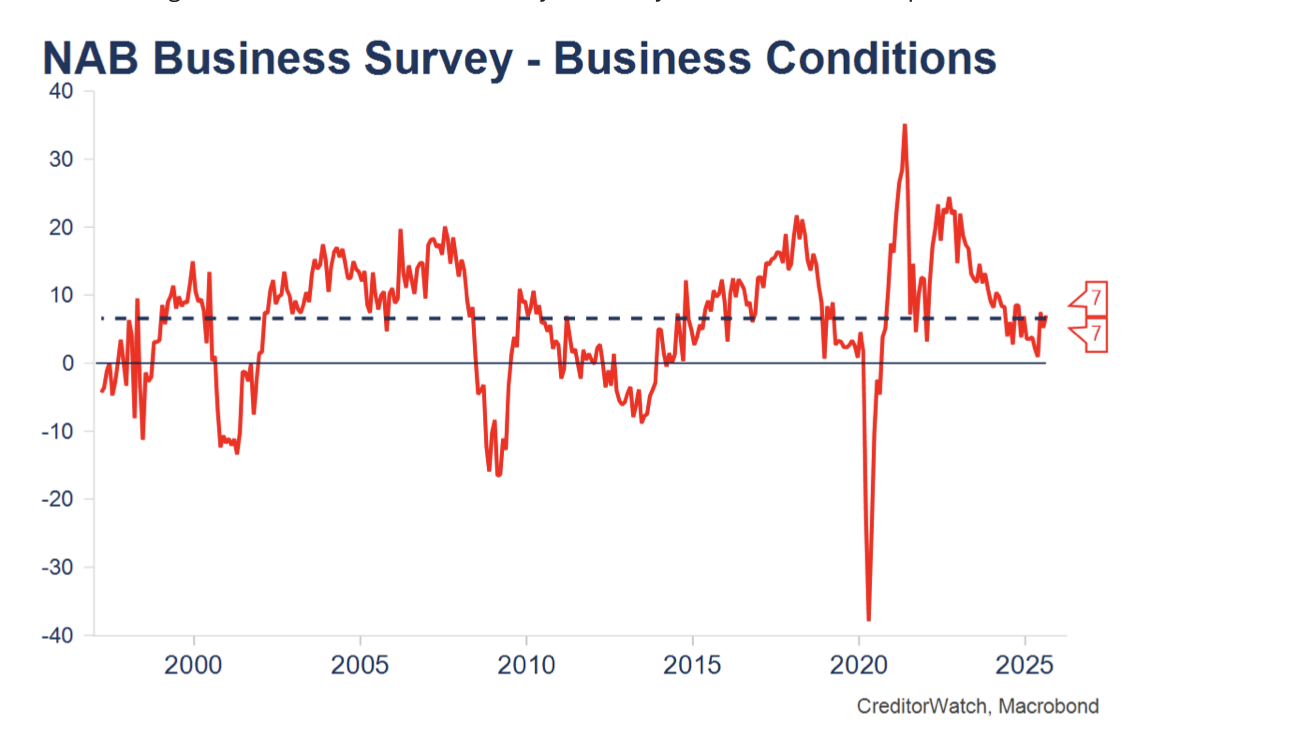
NAB chief economist Sally Auld said the results aligned with broader improvements in official data. “Overall, the survey supports the view that the business outlook has become more positive in recent months, consistent with a better tone to official economic data of late,” she said.
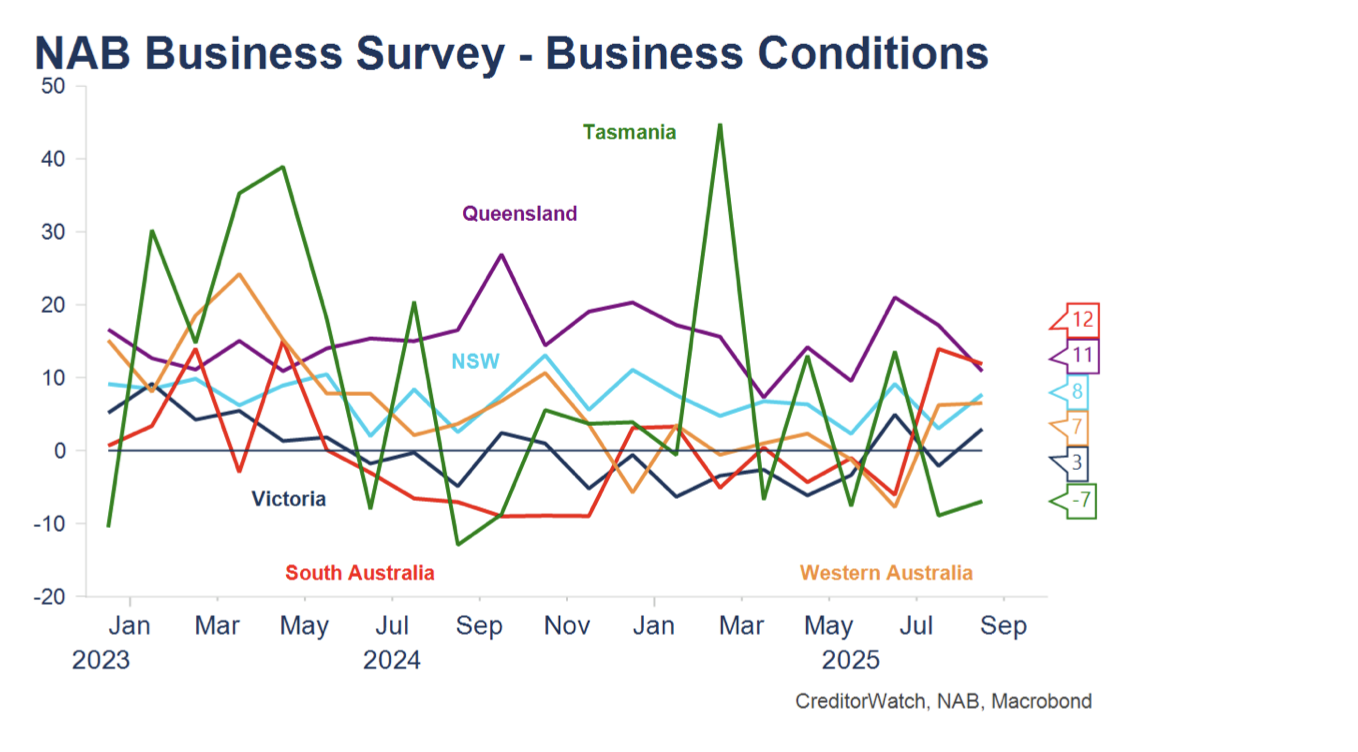
The survey highlighted regional differences, with Queensland firms leading thanks to strong population growth, while Victoria and Western Australia reported improving trends. New South Wales conditions were steady at around the national average.
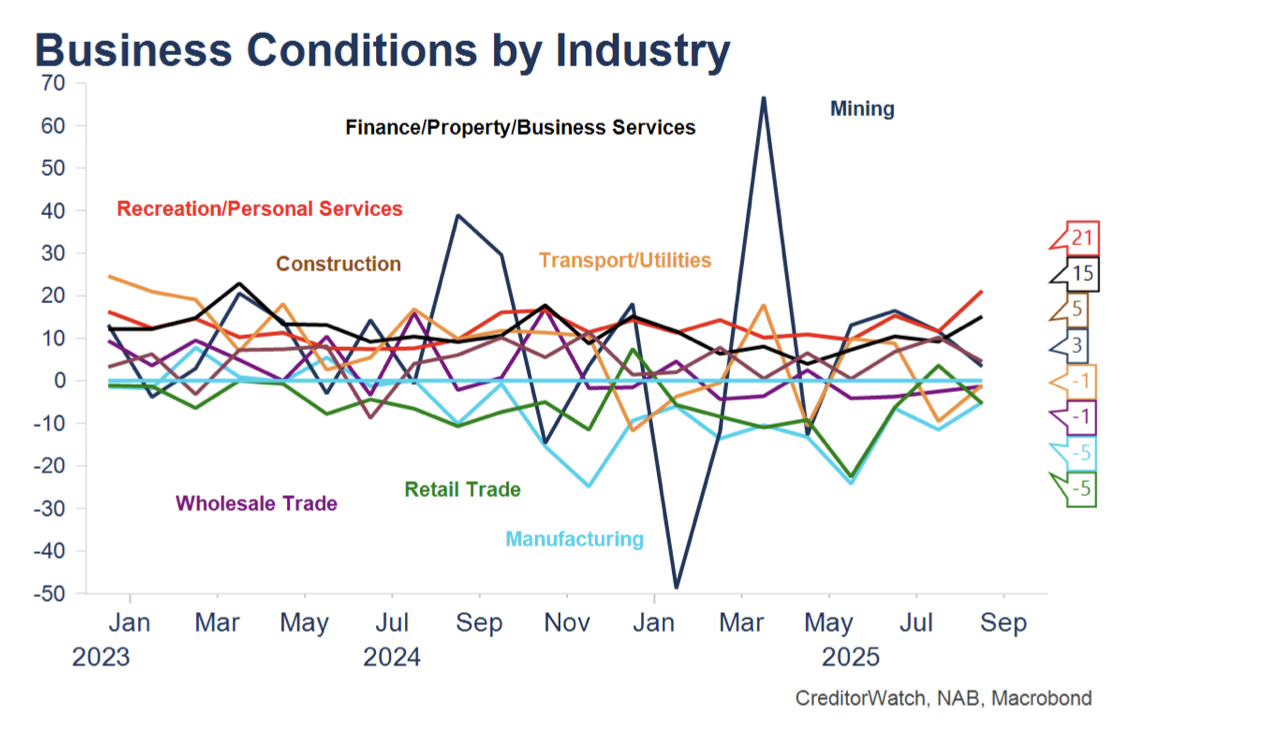
At the sector level, conditions in retail and manufacturing remained negative but were less weak, while recreation, personal services, and finance and property services were strongest. Construction lagged, reflecting high materials costs despite being sensitive to interest rate movements.
Inflation signals ease but labour market remains key
Encouragingly for the RBA, NAB’s inflation indicators showed purchase costs rising at the slowest pace since 2021, with retail price growth consistent with the inflation target. Capacity utilisation, however, underscored ongoing labour constraints, pointing to the tightness of the employment market.
While businesses appear more resilient, the contrast with consumer sentiment is stark. Westpac’s survey indicates households are increasingly worried about job security, with unemployment expectations steadily rising despite the RBA forecasting a stable 4.3% rate over the next two and a half years.
This divergence highlights a key risk for policymakers: consumer caution could hold back the recovery even as businesses gain confidence. Westpac warned that low unemployment has underpinned credit conditions in recent years, and any deterioration could place further pressure on spending.
Outlook: further easing likely
Taken together, the surveys suggest the Australian economy is on a slow but uneven recovery path. Consumers remain wary, retailers are benefitting from modest momentum, and businesses are cautiously optimistic.
The RBA’s policy challenge will be to sustain this balance while ensuring labour market stability. Westpac believes two more interest rate cuts will be required to keep unemployment from rising, with November shaping as the likely timing for the next move.
As Hassan concluded, “the consumer recovery … is proceeding slowly and further easing will likely be needed to sustain gains.”
For now, households remain hesitant, businesses are showing cautious optimism, and retailers are waiting for a more convincing rebound in consumer spending.