
Australia’s trade balance surged to its strongest level in nearly a year and a half in July, with higher commodity and agricultural exports lifting the goods surplus to $7.3 billion, up sharply from $5.4 billion in June.
Figures released by the Australian Bureau of Statistics (ABS) on Thursday showed exports rose 3.3% month-on-month, while imports slipped 1.3%. It marked the second consecutive monthly increase in export values after June’s 6.3% rise.
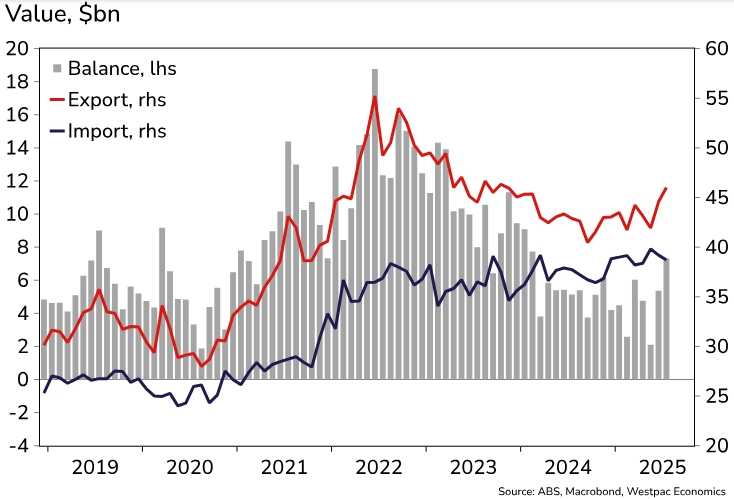
Goods Trade Balance
Westpac senior economist Mantas Vanagas said the result was driven by improvement across key sectors.
“The strength in exports was broad-based, with all three major commodities — iron ore, coal and liquefied natural gas (LNG) — posting gains from their June levels,” he said. “Elsewhere, agricultural exports rose nearly 6%/month, nearing the top of their recent range. Non-monetary gold, which tends to be highly volatile, also jumped to a new record high.”
Export strength across commodities and agriculture
Iron ore and coal export values each rose around 1.5% in July, while liquefied natural gas shipments jumped 5.1%. Vanagas said the increases were largely price-driven, as volumes for iron ore and coal actually fell.
Agricultural exports rose nearly 6%, supported by higher meat and rural product sales. Non-monetary gold hit a record high as strong global demand and record bullion prices spurred shipments.
By destination, exports to the United States stood out. After easing in the second quarter, US demand rebounded in July with strong gold, copper and meat shipments ahead of tariff changes in early August.
“Despite the 10% tariff, Australian meat producers found themselves in a strong position in the US market, as major competitors from Canada, Brazil and New Zealand faced even higher levies,” Vanagas said.
China, which takes over a third of Australia’s exports, recorded only a slight fall in shipments, broadly in line with first-half trends.
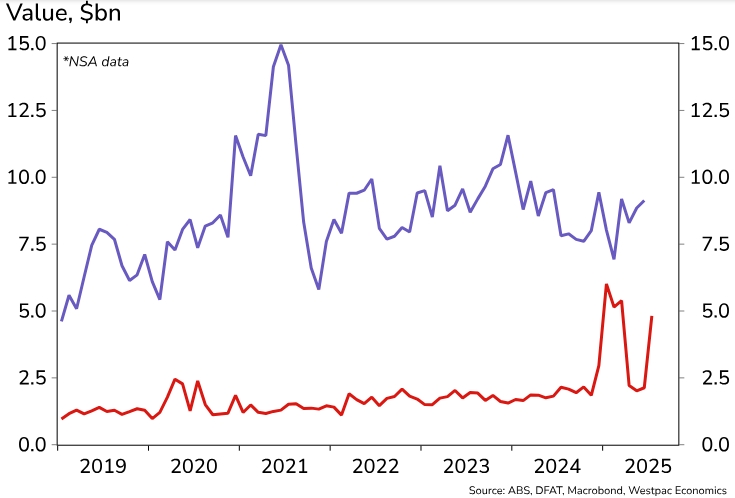
Goods Exports to the US and China
Imports ease on gold but show mixed trends
On the import side, the 1.3% fall in July was mostly explained by lower non-monetary gold. Vanagas noted that consumer goods imports dropped 2.6% and are now almost 8% below their May peak, signalling potential payback in household spending after driving GDP growth in the June quarter.
Capital goods imports rose 2.6%, while intermediate goods climbed 1.1%. Imports from Singapore fell sharply after a June spike tied to ship deliveries.
Vanagas said the heightened monthly volatility that “continues to be a defining feature of Australia’s goods trade” is likely to continue for the near term.
“As the global economy continues to adjust to new US-imposed trade barriers, the data also showed that some Australian exporters are capitalising on emerging opportunities in the US market,” he concluded.