
Sunstone Metals Ltd (ASX:STM) has reported strong surface sampling results from its Bramaderos Project in southern Ecuador, reinforcing the potential for substantial resource growth.
The program focused on two areas: the Copete porphyry system and the Brama porphyry deposit. At Copete, channel sampling across five ravines confirmed extensive porphyry mineralisation, expanding the surface footprint and aiding drill targeting. At Brama, sampling uncovered a wide zone of gold mineralisation within an epithermal corridor, including a standout rock chip assay of 38.3 grams per tonne (g/t) gold.
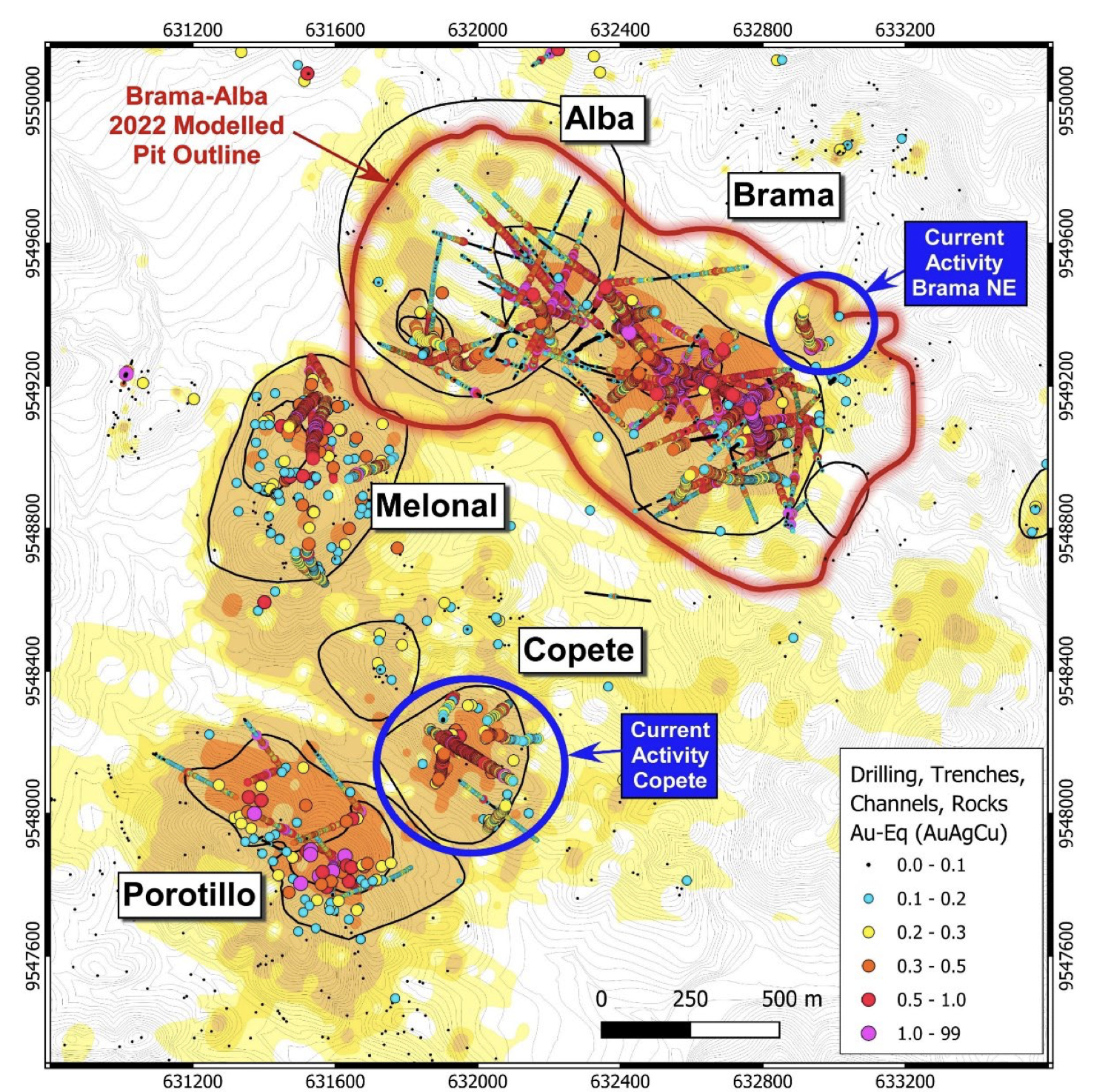
The cluster of four porphyry gold-copper systems in the central area of the Bramaderos concessions (Brama-Alba, Melonal, Copete and Porotillo) and showing the two areas of current surface sampling and geological mapping activity at Copete and Brama Northeast (blue outlines).
Managing director Patrick Duffy called the latest results out of Copete very promising.
He said they “reveal a coherent zone of porphyry-related alteration and vein mineralisation that will enable exploratory holes to be sited to test the sub-surface core of this recently discovered outcropping porphyry system.
“These results provide further confidence that the development pipeline at Bramaderos will likely include a future component from the Copete porphyry discovery.
“The latest channel sampling in a second area of activity northeast of Brama has yielded a wide zone of gold mineralisation and with local high grades that are within the confines of the modelled open pit but outside the current resource. This provides high confidence that the Brama-Alba resource will continue to grow when we progress future resource expansion drilling.
“Our technical team at Bramaderos continues to expand the opportunities in and around our main cluster of porphyry systems on the Bramaderos property while Sunstone progresses strategic corporate and asset discussions with several parties.”
Copete porphyry: footprint expanded
Geological mapping and sampling were conducted across 13 ravines surrounding trench ML01 at Copete, which previously returned 214 metres at 0.5 g/t gold equivalent.
Results indicate two mineralised intrusions spanning more than 250 metres by 300 metres, with strong stockwork veining extending into wall rocks. The mineralisation is linked to preserved porphyry systems below surface.
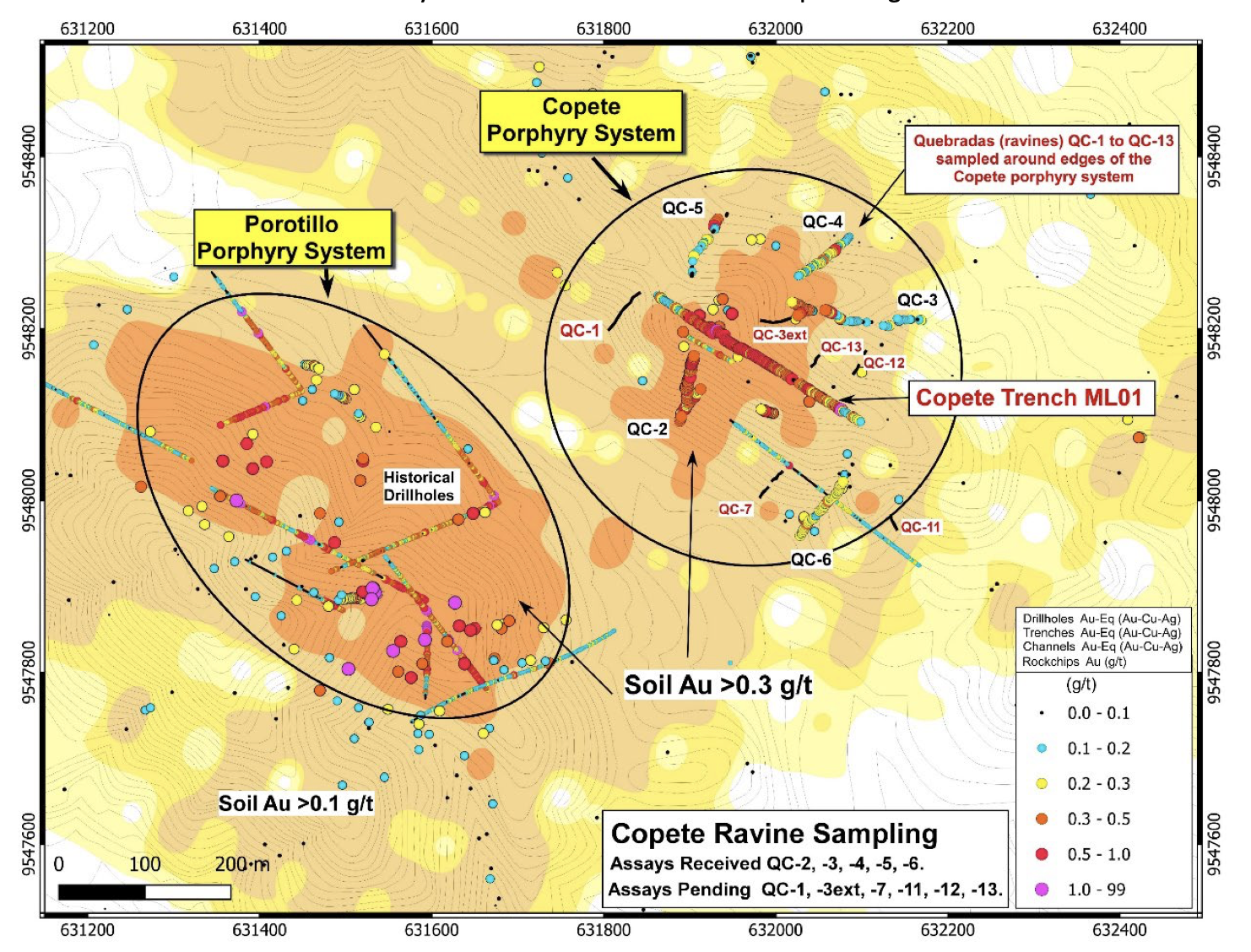
Areas of continuous channel sampling in quebradas (ravines QC-1 to QC-13) radially around the initial trench at the Copete porphyry system (ML01), and spatial relationship to the Porotillo porphyry system. The 0.3 g/t Au soil anomaly contour defines these two porphyry systems, whilst the 0.1 g/t Au soil anomaly contour envelopes both adjacent systems.
Assays from the first six ravines include 63.7 metres at 0.44 g/t AuEq and 105.1 metres at 0.22 g/t AuEq, with higher grades aligning with soil anomalies. Remaining assays are pending and will inform drill planning. Importantly, mineralisation extends undercover towards Porotillo, highlighting scale potential.
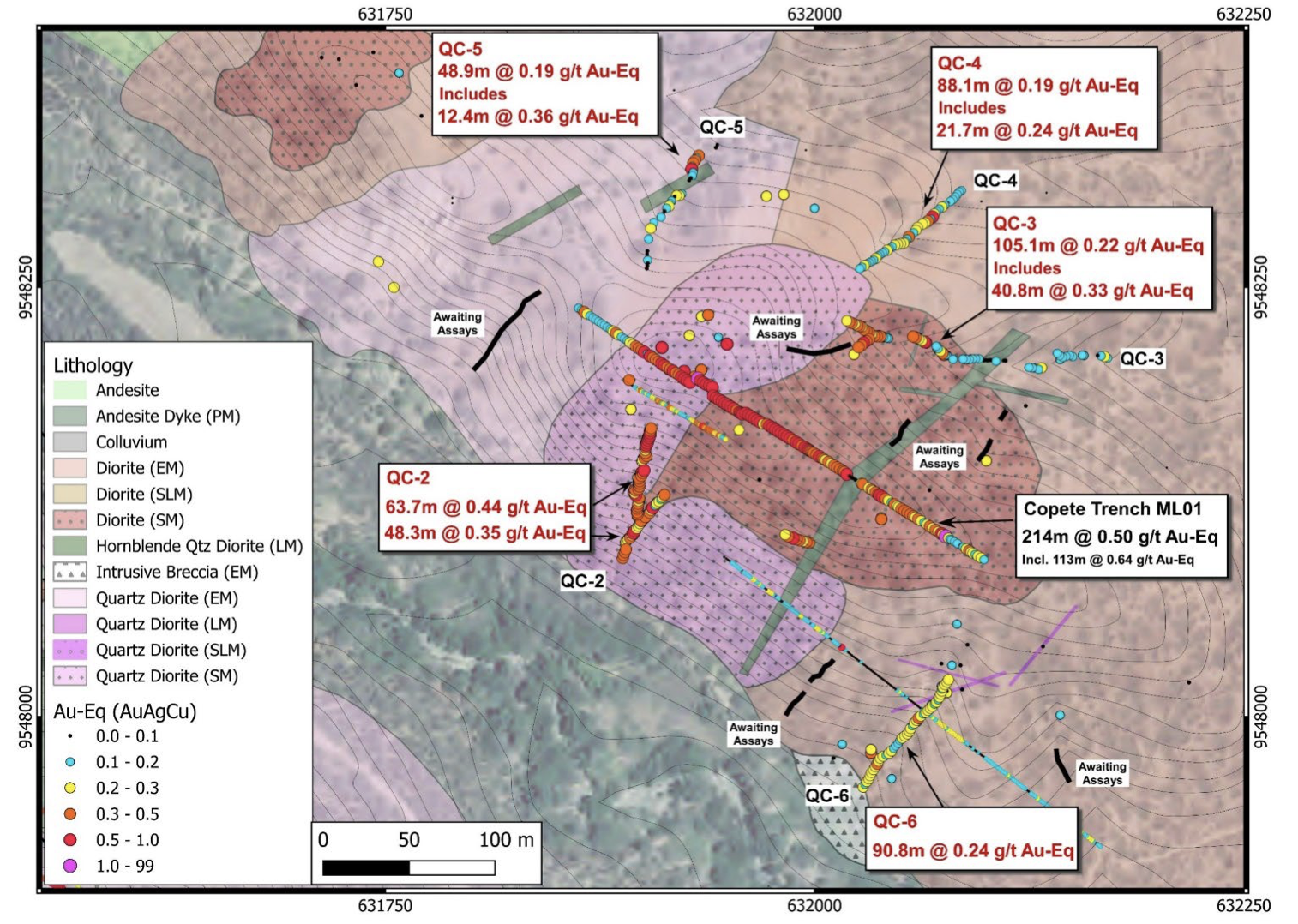
Areas of new continuous channel sampling in quebradas (ravines) radially around the initial trench (ML01) at the Copete porphyry system. Trench ML01 yielded 214m @ 0.50 g/t AuEq2 (see announcement dated 12 November 2024). New intersections in quebradas (ravines) QC-2, QC-3, QC-4, QC-5 and QC-6 occur in the wall rocks surrounding the syn-mineral intrusive bodies, with higher grades in QC-2, which was sampled within one of the two syn-mineral intrusions. Assays are pending for a further six sets of channel samples (black lines).
Brama northeast: gold corridor identified
Exploration northeast of the Brama deposit targeted gold-in-soil anomalies outside the current Brama-Alba resource. Continuous channel sampling along an access road delivered 142.3 metres at 0.29 g/t AuEq, including a higher-grade section of 15.8 metres at 0.68 g/t AuEq.

Area of new channel sampling and mapping off the northeast edge of the Brama orebody where Au-in-soil anomalies extend beyond the resource block model 0.3 g/t Au limit (yellow points). A northeast-striking epithermal corridor has been sampled outside the block model but within the confines of the modelled future open pit (red outline).
Additionally, a rock chip sample collected nearby assayed 38.3 g/t gold, confirming the presence of high-grade epithermal veins. These results lie outside the resource block model but within the previously modelled open-pit shell, giving confidence in future expansion of the Brama-Alba resource.
Sunstone’s technical team believes the area hosts corridors of higher-grade epithermal mineralisation linked to fault structures, supporting its growth strategy.
Ongoing work and project strategy
Work continues to map and sample the northern margin of Brama-Alba, with detailed surveys extending across Melonal and Copete prospects. Digital GPS surveys are also being completed to support future resource development and infrastructure planning.
The Bramaderos Project currently hosts a 2.7-million-ounce gold equivalent resource and an exploration target of up to 8.6 million ounces. Sunstone also owns the El Palmar Project in northern Ecuador, with a 1.2-million-ounce resource and a larger exploration target.
With strong infrastructure and community support, Sunstone is progressing both projects while evaluating strategic partnerships to maximise portfolio value.