
St George Mining Ltd (ASX:SGQ) has delivered strong first assay results from reverse circulation (RC) drilling at its 100%-owned Araxá Project in Brazil, confirming thick, high-grade rare earths and niobium mineralisation from surface.
The initial batch of assays returned grades of up to 13.98% total rare earth oxides (TREO) and 7% niobium pentoxide (Nb₂O₅), reinforcing Araxá’s position as one of the highest-grade undeveloped rare earths projects globally.
Strong first RC results
Results from the first seven shallow RC drill holes showed multiple broad intercepts of high-grade mineralisation, including:
- 41 metres @ 4.52% TREO and 0.87% Nb₂O₅ from surface.
- 13 metres @ 7.06% TREO and 1.45% Nb₂O₅ from 4 metres.
- 11 metres @ 7.03% TREO and 0.91% Nb₂O₅ from 5 metres.
- 16 metres @ 5.56% TREO and 0.81% Nb₂O₅ from surface.
- 5 metres @ 11.83% TREO and 3.12% Nb₂O₅ from 8 metres.
These results confirm both the grade and continuity of the carbonatite-hosted mineralisation that underpins the current mineral resource estimate (MRE) of 40.6 million tonnes at 4.13% TREO.
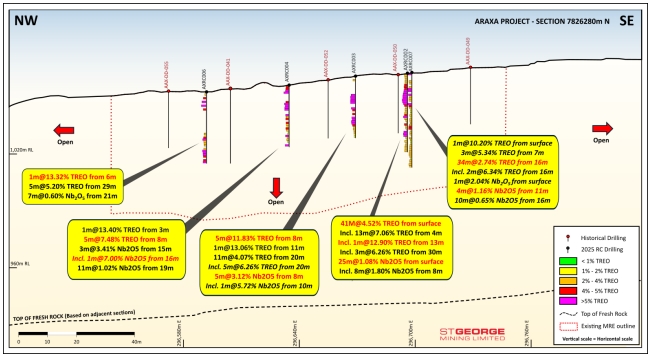
Section showing high-grade TREO intercepts (cut-off 1% TREO) and existing JORC MRE.
New discovery potential east of the MRE
Assays from auger drilling 1 kilometre east of the existing resource also point to a significant new discovery. Intercepts included 13.5 metres at 12.34% TREO from 0.5 metres’ depth, with many shallow holes ending in high-grade mineralisation.
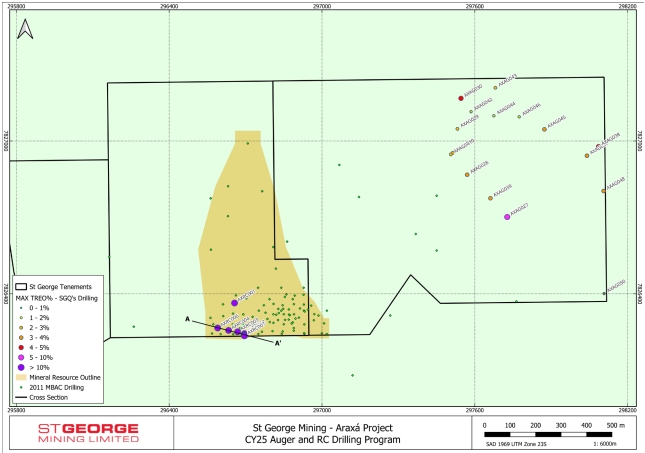
Plan view map of the Project area showing the location of the RC and auger drilling relative to the MRE.
This suggests strong continuity at depth and the potential for a large expansion to the Araxá mineral system. RC drilling has now begun in this eastern area to define the scale of mineralisation.
High-value NdPr and heavy rare earths
Importantly, the drilling also returned elevated levels of neodymium and praseodymium (NdPr) — the key inputs for permanent magnets used in electric vehicles and wind turbines. NdPr grades were as high as 2.89% (28,900 parts per million), with NdPr-to-TREO ratios reaching 42%, placing Araxá at the high end of carbonatite-hosted deposits globally.
The company also reported increased occurrences of heavy rare earths such as terbium, dysprosium, lutetium and gadolinium, adding further strategic value to the project.
Showcasing scale
Executive chairman John Prineas said the early results confirmed Araxá’s world-class potential.
“These first RC assay results are an excellent start and show that we are on track to upgrade the large carbonatite-hosted MRE at the Araxá Project — the same style of deposit as the two major producing rare earths mines outside of China, Mountain Pass in California and Mt Weld in Western Australia,” Prineas said.
“When combined with the early-stage auger results, which confirmed a very significant and exciting discovery of high-grade rare earths mineralisation to the east of the main deposit at Araxá, it is clear that our efforts on the ground are starting to showcase the outstanding endowment, scale and growth potential at the project,” he added. “And we are confident there is more good news to come.”
Prineas noted that mineralisation from surface, combined with free-digging conditions and a supportive permitting environment in Brazil, highlighted Araxá’s potential as a low-cost, sustainable development.
Next steps
Three diamond rigs and one RC rig are now operating at site, with more than 9,000 metres of drilling planned over the next 10–12 weeks. Assays are expected on a rolling four-week basis, ensuring steady news flow.
The drilling campaign is designed to both upgrade the existing MRE and test the scale of new mineralisation east of the resource, paving the way for a potential major resource expansion in the coming months.