
Chimeric Antigen Receptor T-cell (CAR T) therapies have transformed cancer treatment over the past decade, providing options where standard care often fails and offering new hope to patients with aggressive blood cancers. Yet the technology still faces major hurdles: therapies are expensive, personalised manufacturing takes time, and effectiveness in solid tumours has been elusive.
This is where the next wave of innovation is now focused. Allogeneic, or “off-the-shelf,” CAR T aims to take cells from healthy donors, engineer them in bulk, and make them available immediately — sidestepping the bespoke and time-consuming process of manufacturing a therapy from each individual patient. If successful, this shift could redefine accessibility and economics in the field.
Imugene’s flagship azer-cel
Australian biotech Imugene Ltd (ASX:IMU, OTC:IUGNF) is one of the companies making strides in this space. Its lead candidate, azer-cel (azercabtagene zapreleucel), is an allogeneic CAR T that targets CD19, a proven marker in blood cancers.
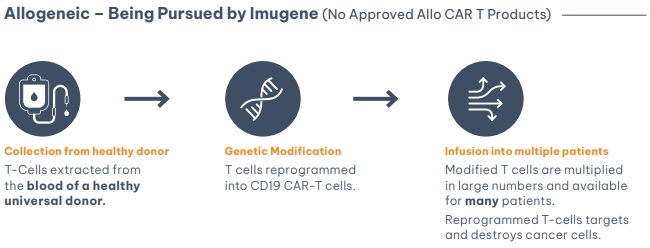
The company’s Phase 1b trial in diffuse large B-cell lymphoma (DLBCL) has shown some striking early signals: among 14 evaluable patients, 79% responded, with six complete responses and five partial responses. Many of these patients had already failed on prior autologous CAR T therapy, making durability of up to 15 months especially noteworthy.
The US Food and Drug Administration (FDA) granted Fast Track designation to azer-cel during the year, an acknowledgement of both the unmet need and the potential clinical impact. Imugene is now expanding the program into additional rare blood cancers such as primary central nervous system lymphoma (PCNSL) and chronic lymphocytic leukaemia, with ramped-up recruitment in the US and Australia and the first Australian patient recently dosed at Royal Prince Alfred Hospital in Sydney.
The company expects to meet with the FDA later this year to discuss a potential pivotal Phase 2 trial in 2026.
What makes off-the-shelf different?
Traditional CAR T therapies, like Novartis’ Kymriah or Gilead’s Yescarta, involve extracting a patient’s own T-cells, engineering them to recognise cancer, and reinfusing them. The process can take weeks and is vulnerable to failure if a patient’s immune cells are too weak.
By contrast, Imugene’s approach uses healthy donor cells. These can be engineered, multiplied, and stored for use in multiple patients, theoretically offering faster treatment turnaround and broader scalability. The challenge lies in ensuring the donor-derived cells do not trigger immune rejection and remain potent over time — hurdles researchers worldwide are racing to overcome.
Expanding into solid tumours
Imugene is also advancing onCARlytics, a novel approach that tries to crack the tougher problem of solid tumours. Using an engineered oncolytic virus (CF33-CD19), the therapy makes solid tumours express the CD19 protein — essentially turning them into targets that CAR T drugs can attack.
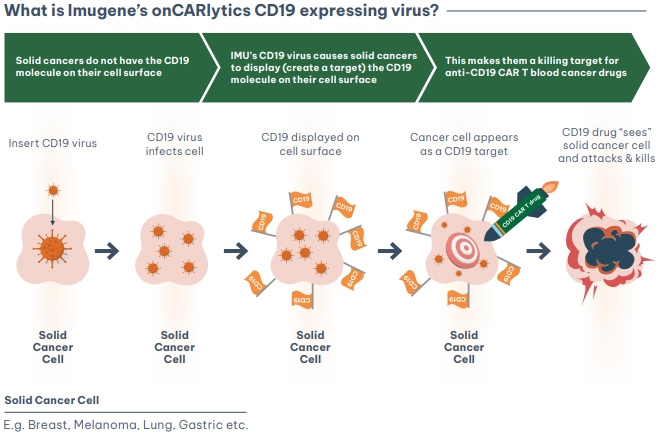
The Phase 1 OASIS trial is testing this strategy in advanced solid cancers, with both intratumoural and intravenous delivery routes under evaluation. If successful, it could open the door for CAR T therapies well beyond blood cancers, where they have so far been limited.
Momentum in the field
Imugene’s work comes at a time of growing activity across the CAR T sector, where large pharmaceutical companies are looking to reinforce their positions as the science evolves. Just last month, Gilead Sciences acquired Interius BioTherapeutics, a biotech developing in vivo cell therapy platforms, in a move seen as bolstering its CAR T capabilities.
Meanwhile, Johnson & Johnson has begun direct-to-consumer advertising for Carvykti, its multiple myeloma CAR T, signalling a push to expand awareness and uptake of approved therapies. These developments underscore how major players are both investing in next-generation approaches and working to normalise CAR T in routine cancer care.
Why investors are watching
For Imugene, the months ahead will be defined by continued readouts from the azer-cel Phase 1b trial, including data from newly added patient groups with rare lymphomas. The company is also preparing for an FDA end-of-phase meeting in the fourth quarter of 2025 that will help shape the path to a registrational study.
Progress with onCARlytics will be another key marker, with dose escalation and combination work designed to test whether CD19-targeting strategies can truly be brought into the solid tumour setting.
For the broader sector, the trajectory is clear: CAR T is moving from experimental breakthrough toward mainstream therapy, but only if scalability and accessibility can be improved. Off-the-shelf products are central to that effort, and Imugene’s programs place it in the middle of a global race that is drawing in both established pharma leaders and emerging innovators.