
- FTSE 100 rises 21 points to 9,309
- UK flash services PMI comes in at 12m high
- CBI industrial trends survey orders balance falls
4.52pm: FTSE 100 notches new record high
The FTSE 100 climbed 21 points higher to finish Thursday's session at 9,309.2.
This is another new all-time closing high for the London index.
Nine out of the benchmark's top 10 largest companies finished in positive territory, with RELX the exception.
Top risers today were gold miner Endeavour (up 2.3%), defence pair BAE Systems and Babcock (up 1.9% and 1.7%), financials NatWest and Prudential, another precious metals miner in Fresnillo and Rolls-Royce.
3.59pm: London blue-chips up despite gilt yield rebound
The FTSE 100 has returned to roughly where it started the day, nudging its nose into new territory just above 9,300, hitting another new intraday high above 9,307 in the process.
Precious metals miners and defence stocks led the way for the London benchmark.
A drop in demand for UK government bonds, sending yields higher, reverses the dynamic seen yesterday. The 10yr gilt yield is up to 4.74%, almost back to where it was two days ago.
Across the pond, US tech stocks have mostly pared all their early losses, with the Nasdaq back to almost flat, though the S&P is down 0.1% and the Dow 0.2%.
2.55pm: US stocks open lower, FTSE climbs
US stocks are firmly lower in early trade with the Dow Jones and Nasdaq down 0.6%, with the S&P 500 off 0.5%. The Russell 2000 is also weaker, down 0.3% at 2,269.
Among the S&P 500’s biggest movers, Walmart fell 5.1%, while First Solar dropped 4.2% and Intel lost 3.2%.
Back in London, the FTSE has climbed back into positive territory.
2.46pm: View on US-EU deal
Today's joint EU-US statement solidifies an "unequal deal", says economist Salomon Fiedler at Berenberg.
The framework agreement that fleshed out their 27 July deal keeps the broad strokes the same: the US will collect tariffs of 15% on most goods from the EU while the EU eliminates tariffs on all industrial goods from the US.
"The EU also makes some hard-to-implement promises to e.g. buy energy from and increase investment in the US," says Fielder.
"The agreement also envisions some improved access to the EU market for the US.
"While the agreement is unequal (especially the much higher tariffs by the US), it builds further on the earlier deal in reducing the extreme uncertainty around trade policy that US President Donald Trump had introduced with his initial tariff threats on 2 April.
"Firms are now at least able to plan ahead more confidently again."
He sees it as unlikely that the EU will be able to renegotiate this unequal deal, but the lack of balance reflects the geopolitical imbalance, "with European leaders relying heavily on the US for military security" as major EU states start on the long process of rearmament.
"The US, meanwhile, is hoping that the new tariff revenues will plug part of the gaping hole in its public finances. On a positive note, some of the provisions in the agreement could lead to some much-needed reduction of European bureaucracy."
1.40pm: Mining reporting season analysed
The first-half reporting season has left the big miners treading water: solid enough numbers, but plenty of headaches still to work through, says UBS.
In its review of the sector, UBS said the story for the diversified miners is one of balance sheets under pressure and shifting capital priorities.
Rio Tinto and BHP are now diverting more money into transition metals, but near-term volume growth is thin and cash returns look modest.
BHP sweetened its payout ratio to 60% on the back of strong operations, while Rio stuck to 50%.
Anglo American is UBS’s top pick, despite the collapse of its met-coal sale to Peabody. But copper growth is the real prize, and bolt-on deals could accelerate the shift.
Glencore, meanwhile, is dangling an 8% free cash flow yield and another US$1 billion of savings but it needs to deliver a step-up in copper output in the second half to regain credibility.
Copper producers all reaffirmed 2025 guidance but will need a stronger second half to hit it, with UBS turning more cautious: Antofagasta is still a 'buy', but Freeport, Southern Copper and Lundin have been marked down, with KGHM slapped as a 'sell'.
Aluminium remains a waiting game: short-term earnings momentum is flat, but medium-term fundamentals hold up.
Gold miners, by contrast, are enjoying their moment, with dividends and buybacks flowing. If prices hold, UBS thinks M&A chatter will pick up.
12.53pm: US-EU deal fleshed out
The United States and European Union have announced that the framework deal on trade, including on drugs, chips, agriculture and automobiles, has now been agreed.
This adds meat to the bones of a deal struck by Donald Trump and European Commission President Ursula von der Leyen last month.
Washington has agreed to cap tariffs on pharmaceuticals, semiconductors and lumber at 15%, while Brussels will eliminate tariffs on industrial goods and widen preferential access for US agricultural and seafood products.
Trump had previously threatened levies as high as 250% on drugs and 100% on microchips.
US automobile tariffs are set to ease once the EU presents legislation on its own industrial tariff cuts.
The EU has pledged to procure $750 billion worth of US liquefied natural gas, oil and nuclear products through 2028, alongside $40 billion of US artificial intelligence chips, as Trump and von der Leyen said last month.
Stocks and futures still remain down on both sides of the Atlantic.
12.15pm: Markets modestly in the red everywhere
At midday, the FTSE 100 and 250 both perked up, having been down 29 points (0.3%) at 9,259and 139 points (0.6%) at 21,746, respectively.
European markets are also in the red.
Wall Street futures too, with the S&P 500 indicated down 0.2%, the Dow Jones 0.3% and the Nasdaq 0.1%.
US retail giant Walmart has just posted second-quarter earnings that missed expectations, but it raised the full-year outlook.
The shares are down 3% premarket.
11.35am: UK economic analysis
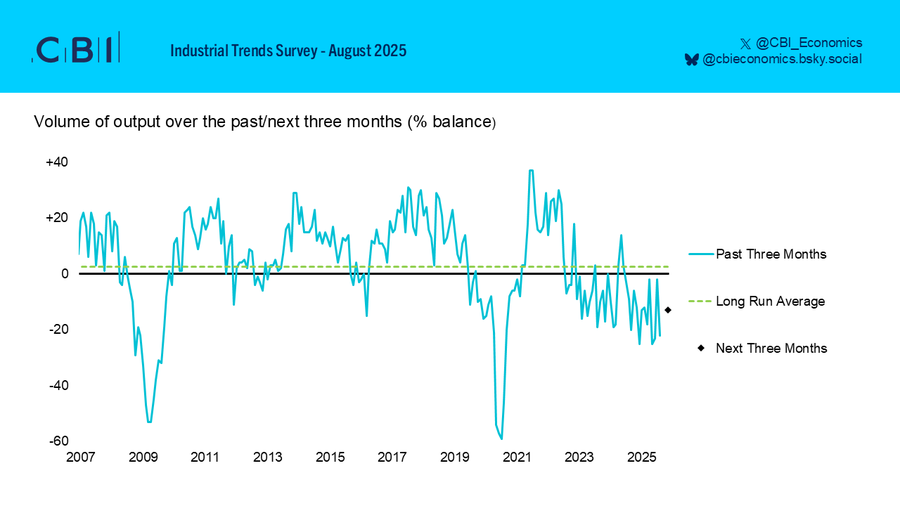
The CBI’s industrial trends survey suggests that manufacturing activity slowed in August, says Elliott Jordan-Doak at Pantheon Macroeconomics, with the seasonally adjusted total orders falling to its second-lowest point over the past eight months.
"The CBI’s survey is erratic, so we tend to focus on the trend rather than the more volatile month-to-month movements."
He notes that the three-month average of the seasonally adjusted total orders balance to July was -34, so August’s print of -36 is fractionally worse.
"But given the typical noise in the series, we think the CBI is signalling that manufacturing activity is broadly stable at low levels."
This broadly corroborates the message from the flash manufacturing PMI’s output index for August released this morning, which showed manufacturing activity stabilising in August.
"We continue to think that the worst of the slowdown is over for manufacturing and expect that activity will slowly improve over the coming months.
"That said, the manufacturing continues to be dogged by tariff-related uncertainty amongst trading partners. Its high sensitivity to interest rates and swings in energy prices also makes it more vulnerable to a further downturn in activity than the services sector for instance."
Jordan-Doak said the earlier flash PMI "shows that the economy is ticking along at a healthy pace".
"The bigger picture from the MPC’s perspective is that the dataflow since the August cut has been decisively hawkish, weakening the justification for reducing rates at that meeting.
"We think healthy growth and inflation miles above target means the MPC will have to keep rates on hold for the rest of the year."
11.03am: Manufacturing data from CBI not great
The CBI industrial trends survey's total orders balance fell to -33 in August, from -30 in July, below the consensus forecast -28.
It found that manufacturing output volumes fell in the three months to August, after being broadly unchanged in the three months to July.
Manufacturers expect output volumes to decline again in the next three months.
Total order books and export order books were reported as below “normal” in August, with export order books deteriorating relative to July. Both stand below their respective long-run averages.
Expectations for average selling price inflation eased in August. August’s expectations were the weakest since October 2024 and stand close to the long-run average.
9.58am: Services sector stronger, despite uneven demand enviro
The flash UK PMI survey for August "indicated that the pace of economic growth has continued to accelerate over the summer after a sluggish spring," says Chris Williamson, chief business economist at S&P Global Market Intelligence, which carries out the PMI surveys.
Services companies led the expansion, though he says manufacturing showed "further signs of stabilising".
Measures of industry order books show that "the demand environment remains both uneven and fragile", he cautions.
"Companies report concerns over the impact of recent government policy changes, as well as unease emanating from broader geopolitical uncertainty. Goods exports are still falling especially sharply."
Recruitment is also negative, with workforces being cut "at an aggressive rate by historical standards", Williamson says, pointing to firms citing weak order books and concerns over rising staff costs, which also contributed to inflation pressures.
9.40am:
The UK flash PMIs for August have surprised to the upside, with the services sector index hitting a 12-month high.
Using data from surveys of purchasing managers in the sectors during the past week, the UK composite PMI index to 53.0 from 51.5, also a 12-month high.
This was all down to the dominant services PMI also hit a 12-month high at 53.6, up from 51.8 and above the 51.8 expected.
Manufacturing remained weak, with the headline manufacturing PMI falling to a three-month low of 47.3 from 48.0 and with a rise to 48.3 having been expected, while the manufacturing output index held steady at 49.5.
9.05am: FTSE flattens off
The Footsie has scraped a new intraday high of 9,301.5 but has now dropped back to 9,289, with almost all its modest gains wiped out.
Mainland European stock benchmarks are a mix of flat to slightly down, with Germany's DAX up 0.1% and France's CAC down 0.2%.
Appreciation has been shown for the London benchmark's "defensive qualities and income credentials", says Susannah Streeter, head of money and markets at Hargreaves Lansdown.
"With President Trump’s unpredictable policymaking and the full effect of tariffs on the global economy uncertain, there’s more demand for assets which offer stable returns, and the dividend strong FTSE 100 is coming into its own."
The creeping back up of oil prices has also put more wind in the sails of Shell and BP, with Brent crude up 1% to a two-week high above $67 a barrel, following a larger drawdown than expected in US oil stocks.
Defence stocks are being boosted as doubts are "creeping back in about a resolution to the war in Ukraine," Streeter adds, with Moscow saying that without its participation in discussions over future security in the region, the talks were on a "road to nowhere".
Looking to later this morning for the UK and Europe and this afternoon for the US, market analyst Kyle Rodda at Capital.com says PMI surveys will be "closely watched" for forward looking signals about inflation and the labour market.
"There’s a stagflationary-lite dynamic potentially evolving in the US economy, which could complicate policy makers efforts to tackle inflation and the growth slow down," he says.
"Previous surveys – along with the ISM data – have shown a pick-up in the price subindex and a trend lower in the employment sub-index, painting an ominous picture for the US economy not reflected currently in asset prices.
"An acute rise in price indices and another drop in employment indices could stoke further nervousness going into Jackson Hole and contribute to further risk aversion in stock markets as well as possible strength in the US dollar."
8.43am: WH Smith plunges, Boohoo bounces
WH Smith shares have plummeted 33% after its profit warning (see below).
Analyst Jonathen Pritchard at Peel Hunt has removed his rating for the stock and says: "It remains unclear to us how this issue arose or what the implications will be for outer years.
"However, the impact on group profit is to be severe, and our forecasts are likely to gather around the guided £110m for FY25.
"Given that North America was the cornerstone of the growth story, we expect the market to react badly. In light of the uncertainty, we place our recommendation Under Review (from Add)."
His colleague John Stevenson also comments on the Boohoo/Debenhams debt facility, saying the retailer has "completed its re-fi process".
"With the re-fi complete, boohoo will release its FY25 results before the end of August. Given the recent weakness in the share price ahead of the re-fi, we believe the shares are likely to bounce strongly."
Indeed, Boohoo shares have jumped 7.7% to 15p.
8.15am: Defence stocks lead FTSE higher at open
The FTSE 100 has indeed started trading at above 9,300 in early deals, climbing just over 12 points to reach the milestone again.
Defence and aerospace sector shares are leading the front line in initial deals, with BAE Systems up 1.4%, Rolls-Royce rising 1.3% and Melrose Industries just over 1%.
As often on Thursday, the index is being held back by some stocks going ex-dividend, with the biggest fallers Legal & General, Schroders and Entain all in this group.
Imperial Brands, Mondi, InterContinental Hotels, Anglo American, Convatec and Babcock also ex-dividend, with a combined hit to the FTSE 100 of 4.36 points.
7.54am: UK public borrowing mixed figures
UK public finances are slightly better news for the Chancellor, as borrowing comes in lower in July than expected at £1.1 billion, though this was largely offset by June borrowing revised higher.
Public sector net borrowing excluding public sector banks was down from July last year’s figure of £3.4 billion and better than the consensus expectation of £2 billion.
Borrowing in June was revised up to £22.6 billion from £20.7 billion previously, and borrowing in the fiscal year to June was revised to £58.9 billion from £57.8 billion previously.
"Borrowing this July was £2.3 billion down on the same month last year, and was the lowest July figure for three years," says ONS deputy director for public sector financesm, Rob Doody.
"This reflects strong increases in tax and National Insurance receipts.
"However, in the first four months of the financial year as a whole, borrowing was over £6 billion higher than in the same period in 2024."
7.43am: WH Smith profit warning
WH Smith has warned that profits for its current financial year will be £30 million lower than current market expectations due to over-inflating North American profit by booking supplier rebates early.
The FTSE 250 group said it has asked accountants Deloitte to carry out a "comprehensive review" after the amount of headline trading profit was overstated due to "accelerated recognition of supplier income".
These supplier incentives and discounts, which should have been accrued over time as a reduction in cost of sales, were booked too early, inflating divisional performance. The board has commissioned an investigation by Deloitte.
7.24am: Bond boost for London stocks
UK stocks were helped by the bond market yesterday, says Peter Sidorov in Deutsche Bank's morning macro strategy note.
Gilts yields saw a larger rally than those in the US and elsewhere, with 10yr yields down almost seven basis points despite July inflation coming in slightly stronger than expected at both headline and core rates.
"A saving grace noted by our UK economist Sanjay Raja is that with the volatile transport and travel services components driving the upside, most core services metrics ticked down on the month," says Sidorov.
He notes that money markets moved to price in more Bank of England easing for early 2026 following the release, with the amount of cuts priced by next June rising 5.5bps to 38bps.
"The repricing in UK rates helped the FTSE 100 outperform," he says, with the London index up over 1%, while the Euro Stoxx 600 rose 0.24% and continental indices were more subdued, with the CAC flat and the DAX down 0.69% and FTSE MIB losing 0.36%.
Elsewhere, Sidorov flags the main US stories as the further Mag 7 tech sell-off and continued concerns over the independence of the US Federal Reserve, after President Trump suggested that Fed Governor Cook should resign over allegations of mortgage fraud.
"The news was a reminder of the lingering concerns over future Fed independence and risks of fiscal dominance, though the extent of the market reaction was fairly modest. The most sustained reaction was in gold (+0.98%)".
7.15am: FTSE 100 to start exploring above 9,300
The FTSE 100 could start the morning exploring the virgin territory above the 9,300-point mark, after making base camp at just under that mark last night.
London's blue-chip index is being called eight points higher on the futures market, having finished 98 points to the good yesterday at a record closing high of 9,288.1 and having banged its flag at 9,301 in an all-time intraday high earlier in the session.
All but two (Rolls-Royce and BP) of the index's top 20 largest companies finished in the green, many with gains of over 2% or 3%, including bond proxies and solid dividend payers such as United Utilities, Unilever, Coca-Cola Europacific, Imperial Brands and BAT.
Across the Atlantic, Wall Street's main indices mostly extended their losses, led by the 0.67% retreat for the Nasdaq, though this was less than half its deficit during the rout earlier in the session.
The S&P 500 fell 0.24% and Dow Jones was 16 points above the flatline.
Asian markets are mixed again, with Japan still on the down slope.