
Tryptamine Therapeutics Ltd (ASX:TYP, OTC:TYPTF) has entered into an exclusive biomarker development agreement with Professor Robin Carhart-Harris, chair of TYP’s Scientific Advisory Board, and Professor Pedro Mediano of Imperial College London to develop a proprietary electroencephalogram (EEG)-based biomarker platform for its lead program, TRP-8803 (IV-infused psilocin).
The collaboration will leverage real-time cortical entropy research to predict and optimise therapeutic outcomes from TRP-8803. The biomarker platform will provide clinicians with a tool to identify patients most likely to benefit from psychedelic therapy and adjust dosing in real time to achieve the optimal neuroplasticity window.
The initiative builds on Carhart-Harris’ Entropic Brain Hypothesis, which suggests psychedelics increase brain entropy, improving neural flexibility and creating potential for therapeutic change. Previous EEG data from Tryp’s trials has shown TRP-8803 induces high-entropy states, supporting the scientific basis for development.
“This agreement, with two of the world’s foremost experts in the field of neural entropy and psychedelic research, marks a transformational step in advancing mental health care,” Tryp CEO Jason Carroll, said. “By linking precision IV infusion and entropy to clinical response, we aim to combine traditional, subjective patient efficacy endpoints with dynamic, data-driven biomarkers to generate true quantitative outcomes of efficacy and safety.”
Clinical and commercial implications
Biomarker-guided central nervous system trials have been shown to have more than a tenfold higher probability of regulatory approval. Drugs with companion biomarkers also typically achieve stronger pricing power and enhanced intellectual property protection.
The companion biomarker program will integrate machine learning with closed-loop EEG monitoring to define and modulate the therapeutic zone for TRP-8803 infusion. This tool is expected to deliver regulatory-grade quantitative measures for mental health conditions, setting a new precedent in precision psychiatry.
Development of the biomarker will start next month using EEG data from the completed Phase 1 trial and the upcoming study of TRP-8803 for binge eating disorder.
Entropy as a therapeutic mechanism
Professor Robin Carhart-Harris’ Entropic Brain Hypothesis proposes that the richness and flexibility of conscious experience are linked to the entropy — or variability — of spontaneous brain activity. In normal waking states, brain entropy remains relatively low, supporting stable and ordered cognition. Psychedelic compounds such as TRP-8803 elevate brain entropy, shifting activity toward a dynamic zone between order and complexity, where connectivity patterns become more adaptable and receptive to change. This state may help disrupt rigid, maladaptive neural pathways, providing a potential mechanism for the therapeutic effects observed in mental health and neuropsychiatric disorders.
EEG offers a non-invasive, high-resolution method to capture real-time entropy by recording voltage fluctuations from neuronal activity across the scalp. These signals reflect synchronised cortical activity and reveal patterns that underpin perception, attention, emotion, and cognition.
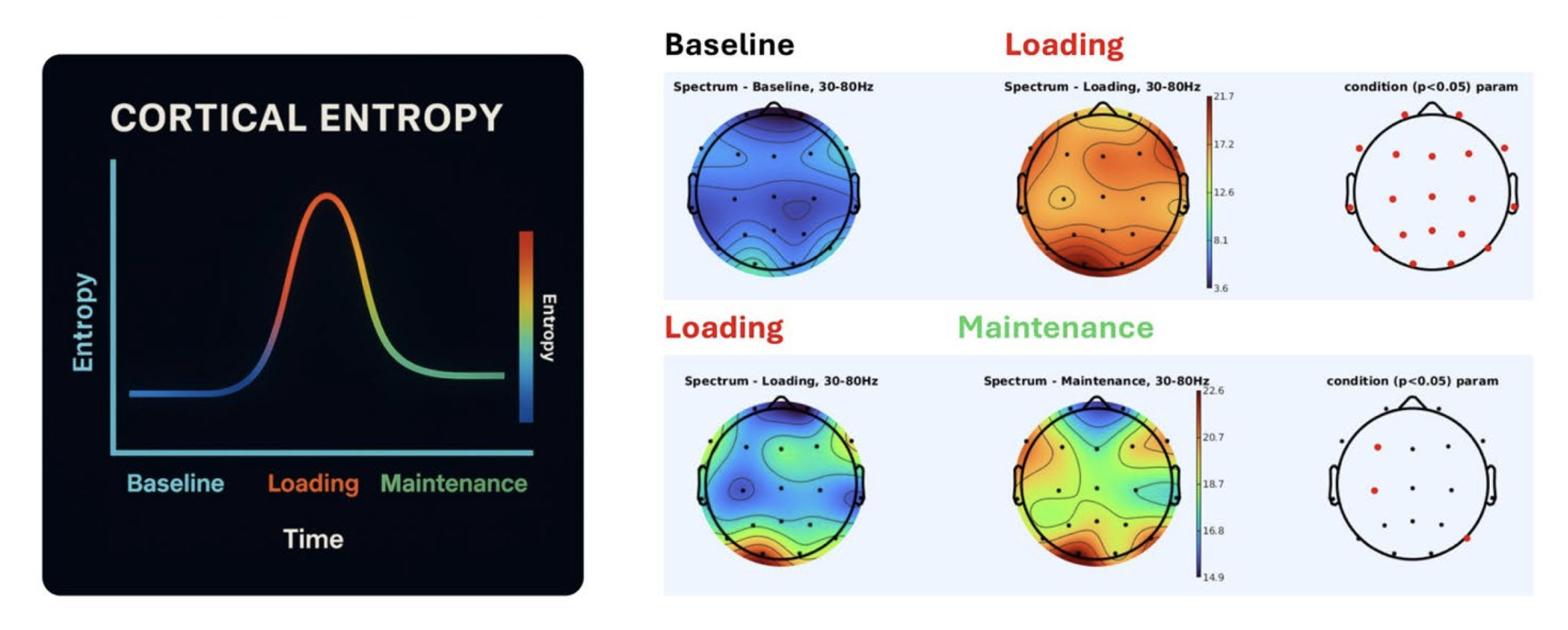
Real time EEG measurements from administration of TRP-8803 during TYP’s Phase 1b trial.
“The entropic brain hypothesis highlights how shifts in brain dynamics can shape mental health and wellbeing. To have secured an agreement with Tryp to develop a specific biomarker anchored in this framework has the potential to transform psychiatry and marks an important step in translating complex neuroscience into practical tools for real-world care. By creating a measurable signal of brain entropy, we unlock the possibility for personalising treatments and predicting therapeutic response — allowing for more effective interventions for patients in need,” said the chair of TYP’s Scientific Advisory Board, Professor Robin Carhart-Harris.
Tryp has already generated encouraging findings, with animal studies showing psychedelic-induced reorganisation of brain networks and Phase 1b EEG measurements demonstrating significantly higher spectral power across all electrode points during TRP-8803 loading doses compared to baseline. These results underscore the biomarker potential of the Entropic Brain Hypothesis.
What’s next?
Development of the EEG-based biomarker platform will begin on September 1, leveraging data from animal models, Phase 1b trials and upcoming studies, including TRP-8803 for Binge Eating Disorder.
“Tryp's data offers an unprecedented opportunity to apply our research and maximise the benefits of psychedelic therapy. I'm thrilled to work with Jason and the team to push the boundaries of computational neuropsychiatry and accelerate this very necessary research," collaborator Professor Pedro Mediano said.
Results are expected to shape future clinical strategy for TRP-8803 in neuropsychiatric disorders.
The initiative will be funded from Tryp’s pro forma cash balance of A$5.63 million, supported by its R&D loan facility and pending FY24 R&D tax incentives valued at approximately A$800,000.