
Research platform MST Access has raised its valuation on Lumos Diagnostics Holdings Ltd (ASX:LDX, OTC:LDXHF) following the company’s submission of a CLIA waiver application to the US Food & Drug Administration (FDA) for its flagship FebriDx point-of-care test.
Senior analyst Chris Kallos now values the company at A$223 million, or $0.22 per fully diluted share, up from A$176 million ($0.10). The higher valuation reflects an increase in the assumed probability of success for FebriDx’s US regulatory pathway to 95% from 80%.
CLIA waiver submission opens new market horizon
After completing a key clinical study, Lumos announced on August 18 that it has lodged a Clinical Laboratory Improvement Amendments (CLIA) waiver submission with the FDA, paving the way for significantly broader use of FebriDx across US healthcare settings.
The clinical study demonstrated 99.1% concordance for bacterial-positive cases and 98.4% for non-bacterial patients between trained and untrained operators, underscoring the test’s simplicity and suitability for decentralised use.
MST noted that the submission has already triggered milestone payments of about US$1.3 million from the Biomedical Advanced Research and Development Authority (BARDA) and a US$1.5 million product purchase prepayment from PHASE Scientific. Additional payments are due on CLIA waiver approval.
Lumos expects FDA feedback by the end of the March 2026 quarter. If successful, the addressable US market for FebriDx could increase more than 15-fold to more than US$1 billion.
Strategic push on reimbursement
To support market adoption, Lumos has partnered with US consultancy PRO-spectus to strengthen reimbursement and market access for FebriDx through to December 2026.
While Medicare already reimburses the test, Lumos is targeting wider coverage from private insurers, which account for 60% of the US healthcare market. PRO-spectus will provide consulting services, a dedicated reimbursement helpline and field-based support integrated with Lumos’ sales team.
MST said this strategy is critical for maximising uptake once regulatory clearance is secured.
Investment case: Rapid diagnostics in demand
Kallos highlighted strong tailwinds for Lumos as the healthcare system prioritises rapid diagnostic solutions to improve treatment decisions and curb unnecessary antibiotic use.
“The global healthcare system is increasingly prioritising rapid diagnostic solutions, particularly in infectious disease management and antibiotic stewardship,” he wrote.
“LDX’s proprietary technology addresses this need with point-of-care solutions that reduce the time to diagnosis and treatment. Stricter antimicrobial stewardship guidelines and government support for point-of-care testing could drive adoption.”
Lumos’ mix of proprietary tests, reader technologies and contract development services also provides diversification, reducing reliance on a single product, the analyst noted.
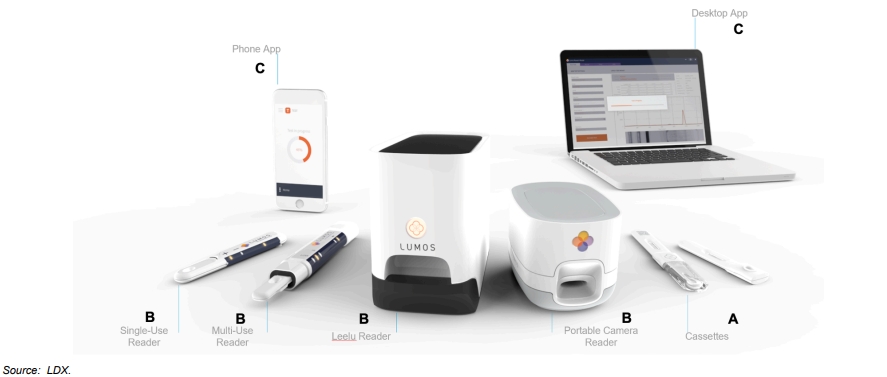
LDX portfolio of platforms.
FebriDx remains the lead driver, offering results in about 10 minutes to differentiate bacterial from non-bacterial respiratory infections — which MST cites as a unique capability in a market projected to grow at around 10% annually.
Valuation and risks
MST’s discounted cash flow valuation of A$223 million assumes a long-term gross margin of about 64%, a terminal growth rate of 2% beyond 2034, and a weighted average cost of capital of 12.5%.
Key risks flagged include regulatory delays, commercialisation hurdles, reimbursement challenges, competitive pressures in the diagnostics market and reliance on distributor networks. MST also noted that Lumos remains loss-making and exposed to funding volatility, though its intellectual property position is considered strong with 88 patents granted or pending.
Near-term catalysts
MST highlighted several upcoming milestones:
- 1QFY26: Milestone in Hologic fFN agreement
- 3QFY26: FDA update on FebriDx CLIA waiver submission
- 1HFY26: Women’s health diagnostic update
- 2HFY26: Completion of Hologic fFN agreement
Outlook
MST concludes that Lumos is advancing towards a pivotal period in its development, with the FebriDx CLIA waiver submission and reimbursement initiatives setting the stage for significant US market expansion.
“Strategic partnerships and regulatory approvals will be key drivers of revenue scalability and long-term profitability in the diagnostics sector,” Kallos said.