
EnergyPathways PLC's (AIM:EPP) MESH Project has the potential to be the “industry standard” when it comes to fully integrated co-location energy storage infrastructure, and it might be the answer to many of the challenges faced by the Clean Energy 2030 Mission.
As the company prepares to resubmit its gas storage licence to the NSTA and launch a Section 35 Directive request for key components of the project not under the remit of this application, let’s take a look at the recent rapid evolution of the MESH Project and how it all will work.
The Marram Energy Storage Hub (MESH) is a project of great ambition and complexity, but at the heart of its design is an elegant simplicity. It is a model of efficiency, where waste energy and emissions are utilised to create products and commodities that are useful, green, clean, and highly valuable.
MESH is set to produce homegrown UK natural gas, green hydrogen, clean ammonia and decarbonising synthetic graphite, while providing a diversified array of energy storage solutions — all vital for the government’s Clean Energy 2030 Mission and the UK economy as a whole.
Not only does this broad and efficient offering make for good business, but it also ensures MESH ticks all the relevant regulatory boxes in the eyes of government energy and net-zero policymakers. So why has the NSTA (North Sea Transition Authority) asked the company to resubmit its gas and hydrogen storage licence application?
One of the reasons cited is a “change of circumstance”. Since the original licence application was submitted in August 2024, the MESH Project has undergone a major transformation.
Listed on AIM in December 2023, EnergyPathways recognised and sought to respond to the critical needs of the UK energy sector. In doing so, MESH has evolved from a standalone gas production outfit to its latest incarnation — the largest integrated energy storage infrastructure project in the UK — with a highly diversified revenue mix encompassing natural gas production, gas storage, green hydrogen production and storage, compressed air long-duration energy storage (LDES), synthetic graphite, and clean ammonia production.
This transformation has been driven by EnergyPathways’ forward-thinking team, led by CEO Ben Clube, who has spearheaded the project to meet urgent UK energy demands and address the challenges faced by the Clean Energy 2030 Mission.
Partnerships with Siemens Energy, KBR, Costain and Wood Group have brought unrivalled industry expertise to the table during the Pre-FEED and FEED phases, driving the project along exciting, cutting-edge avenues to further enhance efficiency, productivity, and profitability.
Situated 11 miles off the Lancashire Coast, EnergyPathways holds a 100% stake in MESH. It is ideally located for energy storage, close to the highest population and industrial demand outside of London, and near the HYNET Cluster.
As well as benefiting from high-quality geo-storage reservoirs, MESH is surrounded by an expansive 7-8 GW array of planned and existing offshore wind farms in the Irish Sea.
The aim is to provide the UK with a secure and reliable supply of LDES, natural gas, and green hydrogen for more than 25 years, along with high-grade synthetic graphite and clean ammonia. MESH will be the UK’s largest energy storage facility, with capacity of up to 20 TWh — equivalent to 7% of the UK’s current annual electricity demand — and the capability to heat 2.7 million UK homes over winter with stored gas.
By converting waste offshore wind energy into clean hydrogen and compressed air LDES, saving government and taxpayers hefty curtailment costs and lowering consumer bills, and producing synthetic graphite via methane pyrolysis — a method to decarbonise while generating a valuable product — the MESH Project has been dubbed the “pragmatic, common sense solution to the UK’s clean energy transition”.
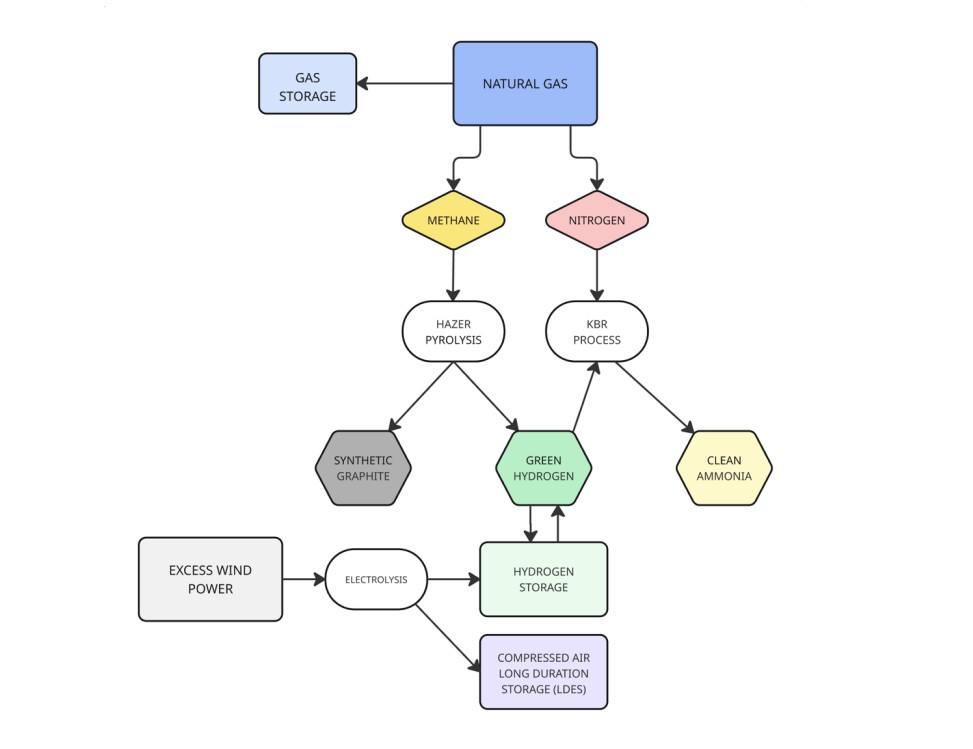
Since the original gas storage licence application, MESH has evolved into a potentially vast piece of integrated energy storage infrastructure. Despite its scale, it is now better equipped to satisfy the NSTA’s regulatory demands on efficiency, Scope 3 emissions, and other criteria.
In addition, EnergyPathways has secured strategic partnerships with Siemens Energy, KBR, Costain, Wood Group, Hazer Group, PDi Ltd, and Zenith Energy, ensuring applications are no longer being submitted in isolation.
To streamline approval, EnergyPathways has submitted a Section 35 Directive to seek direct approval from the Department of Energy Security and Net Zero and the Secretary of State for Energy for all aspects of MESH outside the NSTA licence remit. This includes compressed air LDES, flexible low-carbon power generation, onshore gas and hydrogen conditioning, and MESH’s clean hydrogen, ammonia, and synthetic graphite production facilities. The Section 35 will cover about 80% of the project’s scale and revenues, with a 28-day expected response time.
Natural Gas Production and Storage
In its first phase, MESH will produce homegrown UK natural gas from Marram, a fully appraised, 100%-owned, 46 bcf (460 million therms) gas field in the East Irish Sea, for which EnergyPathways was granted an operatorship licence by the NSTA in January 2025.
The gas mix in Marram contains relatively high levels of nitrogen (48%), but despite this, it is projected to have a break-even price per therm of around 35p, making it commercially viable even as a standalone production setup.
EnergyPathways plans to use Marram’s nitrogen in later stages of the project. Based on gas production revenues, coupled with gas storage and offtake income, this arm of the MESH Project alone promises to be highly profitable.
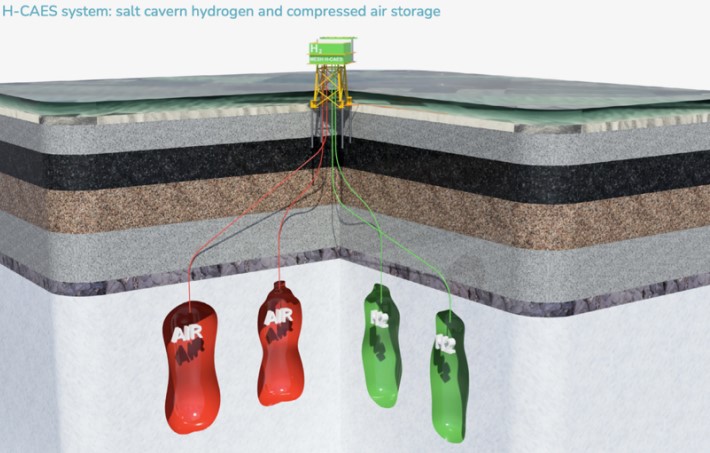
As gas flows and generates revenue, the subsea caverns will empty, allowing the reservoirs to be used for gas storage. The aim will be to store natural gas in phases one and two and green hydrogen in later stages, alongside compressed air LDES.
First gas production is planned for late 2027, with gas storage possible by early 2028 when around 20% of the subsea cavern is depleted. Pre-FEED data with lead engineering partner Wood Group has increased estimated gas storage capacity to 500–600 million therms — equivalent to, if not exceeding, Centrica’s Rough facility, the UK’s largest current energy storage site.
Given the UK’s relatively low ranking for gas storage capacity in Europe and the planned closure of Rough, the strategic importance of MESH is clear. The gas storage licence will also cover hydrogen storage.
Hydrogen Production and Storage
MESH will have hydrogen storage capacity of 2.8 TWh, surrounded by an array of existing and planned wind farms from operators including Ørsted and BP.
Currently, the UK’s offshore wind power infrastructure is inefficient, with excess wind energy often wasted due to grid constraints. In 2024, this curtailment cost the government about £1 billion; by 2030, it is forecast to rise to £6 billion annually.
MESH will convert surplus wind energy into green hydrogen and compressed air LDES, storing it for deployment when needed. This will provide dispatchable energy to the grid, reduce curtailment costs, and help lower consumer bills.
Hydrogen will be used for applications including heating, industrial supply, and transport. The storage of hydrogen falls under the NSTA licence remit, but compressed air LDES does not and can proceed via the Section 35 Directive.
Hydrogen – Methane Pyrolysis and Graphite Production
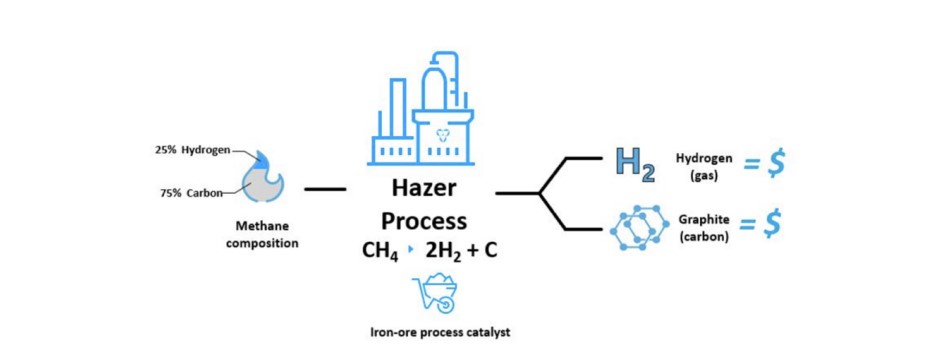
Through a memorandum of understanding with Hazer Group and KBR, EnergyPathways plans to use the HAZER® Process to convert natural gas into hydrogen and high-quality synthetic graphite.
This method will produce cost-effective clean hydrogen with ultra-low CO₂ emissions, alongside valuable high-grade graphite for use in lithium-ion batteries.
Indicative hydrogen production capacity is 90 MW (20,000 tonnes per annum), with graphite output of around 60,000 tonnes per year. This process will also help reduce Scope 3 emissions, aligning with government targets.
Ammonia Production
EnergyPathways will also use the HAZER® Process to produce low-carbon ammonia, using Marram’s nitrogen combined with green hydrogen. Estimated output is 110,000 tonnes per year.
This will reduce UK reliance on high-emission ammonia imports, supporting re-industrialisation and protecting against upcoming carbon border tariffs from 2027.
Compressed Air LDES (Long-Duration Energy Storage)
Partnering with Siemens Energy, MESH will deploy advanced H-CAES compressed air technology, storing air in subsea caverns for later electricity generation.
This system offers up to seven days of storage capacity — far beyond the hours offered by most current technologies. EnergyPathways owns the intellectual property rights to H-CAES, creating potential for further commercialisation.
Conclusion
EnergyPathways aims to deliver a pragmatic, profitable, and zero-emissions approach to the UK’s clean energy transition. By integrating multiple technologies and revenue streams, MESH is designed to meet national energy security needs while reducing costs, emissions, and reliance on imports.
With a resubmitted gas storage licence and Section 35 Directive in play, the project is positioned to move rapidly once approvals are granted.