
Buru Energy Ltd (ASX:BRU, OTC:BRNGF) has unveiled a new deep gas target, dubbed Flying Fox, directly beneath its proven Rafael gas and condensate field in Western Australia’s onshore Canning Basin.
Identified through interpretation of the Rafael 3D seismic survey, the prospect sits at a depth of about 4,015 metres true vertical depth subsea (TVDSS) in exploration permits EP 428 and EP 457. Buru estimates it contains gross unrisked prospective resources of 60 billion–614 billion standard cubic feet (Bscf) of gas, with a best estimate (P50) of 247 Bscf, plus between 1.2 million and 12.6 million stock tank barrels (MMstb) of condensate, with a P50 of 5.0 MMstb.
Those volumes are comparable in scale to the contingent resources for Rafael’s primary reservoir, which underpins the company’s development plans for the Rafael Gas Project.
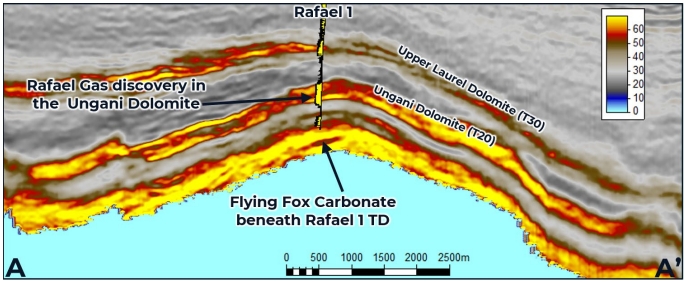
Seismic inversion – a method to determine carbonate reservoir presence
CEO Thomas Nador said the new target underlines the potential upside to Rafael’s base development case.
“The investment case for the Rafael Gas Project is based on conservative (P90) resource assumptions with significant opportunities for upside,” Nador said.
“Whilst Buru’s immediate focus is the timely commercialisation of the Rafael Gas Project, future exploration success at Flying Fox could have significant additive benefits for the project, both in terms of potential resource addition to a base development as well as the potential to maintain ‘higher for longer’ gas flow rates.”
Drill-ready below Rafael B
The company says Flying Fox can be tested by drilling an extra 500 metres beneath the Rafael gas accumulation at the planned Rafael B target location, offering an efficient way to appraise the deeper structure. The primary reservoir target is the dolomitised, vuggy carbonates of the Nullara or Pillara Formation, sealed by May River Formation shales.
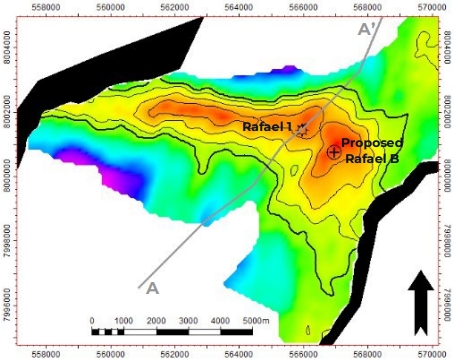
Top Flying Fox depth structure map
The 26-square-kilometre structure features up to 370 metres of vertical relief and is positioned immediately beneath the gas-bearing Ungani Dolomite (T20) at the proposed Rafael B location.
Strategic context
Rafael, discovered in late 2021, is the only proven conventional gas and condensate field in the Kimberley region. A 2022 flow test from Rafael 1 returned more than 7 million cubic feet per day of high-quality gas with high condensate content and low inert gas levels.
Buru revised its appraisal plan in July 2025, prioritising drilling Rafael B before re-entering Rafael 1 to optimise reserve outcomes and reduce risk. Activity is scheduled to start in the June quarter of 2026, with a final investment decision targeted for early in the third quarter of that year and first gas by late 2027.
The Rafael LNG Project, to be developed with Clean Energy Fuels Australia, aims to supply lower-emission, locally produced energy for up to 20 years, replacing trucked-in gas and diesel in the Kimberley and supporting Western Australia’s 2028 energy transition goals.
With Flying Fox now in the frame, Buru is signalling the potential for substantial additional resources that could extend Rafael’s production profile and enhance project economics.