
Recce Pharmaceuticals Ltd (ASX:RCE, OTC:RECEF) has reported strong pre-clinical results for its RECCE® 327 Topical Gel (R327G), showing significant antimicrobial activity and accelerated wound healing in infected burn wounds during in-vivo studies.
The study — part of Recce’s ongoing US Department of Defense (DoD) burn wound program — demonstrated R327G’s effectiveness against Methicillin-resistant Staphylococcus aureus (MRSA) and Pseudomonas aeruginosa, two antibiotic-resistant bacteria included on the World Health Organization’s list of the most dangerous drug-resistant pathogens.
Outperforming standard antibiotic treatment
In rat burn wound infection models, R327G delivered statistically significant reductions in bacterial load compared with untreated controls and Soframycin, a standard comparator antibiotic used in topical wound care.
By Day 4, R327G achieved approximately a 99% (2-log) reduction in MRSA and a 99.9% (3-log) reduction in P. aeruginosa. By Day 8, these reductions increased to about 99.9% (3-log) and 99.99% (4-log), respectively.
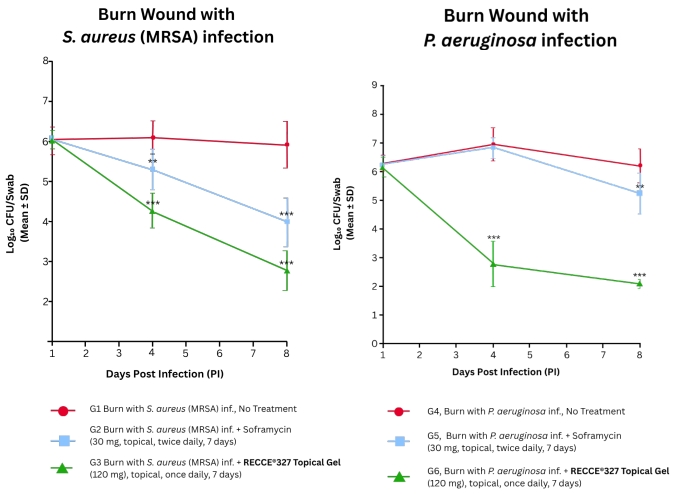
R327G’s once-daily application also compared favourably to Soframycin, which requires twice-daily treatment for optimal performance.
Faster healing
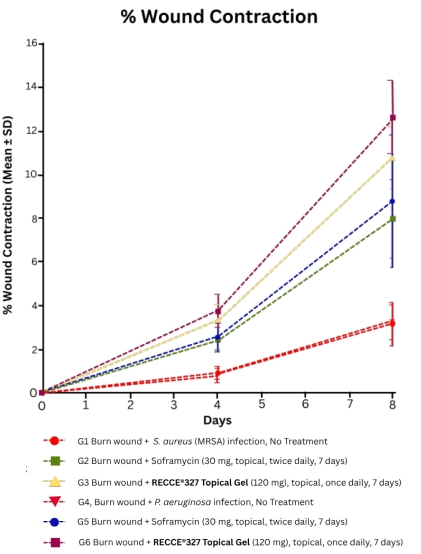
Beyond antimicrobial activity, R327G significantly improved wound healing rates, as measured by wound contraction. Using Analysis of Variance (ANOVA) comparison testing, wounds treated with R327G contracted faster than those in untreated or Soframycin-treated groups throughout the seven-day treatment period.
No adverse clinical signs or effects on body weight were observed, with R327G well tolerated in all treated animals.
Chief executive officer James Graham said the results represent “a further step forward for our US DoD burn wound program”.
“R327G not only demonstrated superior antimicrobial performance but also promoted significantly faster healing of burn wounds,” Graham said. “We look forward to progressing R327G further to deliver an urgently needed solution to patients suffering from these unmet medical needs.”
Supported by US collaboration
The findings build on Recce’s US$2 million grant and Cooperative Research and Development Agreement (CRADA) with the US Army Medical Research Institute of Infectious Diseases, which aims to develop R327G for military and civilian burn wound treatment.
The DoD’s interest reflects the significant medical challenge posed by antibiotic-resistant infections, particularly in severe wounds sustained in combat or disaster situations.
Tackling the superbug threat
Recce is developing a new class of synthetic anti-infectives designed to address antibiotic resistance — a growing global health crisis. Its pipeline includes:
- RECCE® 327: intravenous and topical therapy for serious bacterial infections;
- RECCE® 435: oral therapy for bacterial infections; and
- RECCE® 529: antiviral therapy.
All three are broad-spectrum, patented synthetic polymer compounds with multi-layered mechanisms of action that may overcome bacterial and viral resistance.
R327 has received Qualified Infectious Disease Product designation from the US Food and Drug Administration, providing Fast Track status and 10 years of market exclusivity upon approval.
With its wholly owned automated manufacturing facility, Recce says it is positioned to support current and future clinical programs targeting both urgent and long-term infectious disease challenges.