
Australia’s trade surplus reached a surprising $5.37 billion in June, significantly surpassing market expectations of about $3.2 billion and up from the modest surplus of $1.6 billion reported in May, according to data released on Thursday by the Australian Bureau of Statistics (ABS).
This marks a notable recovery, given the previous month saw the smallest trade surplus since August 2020, driven by lower shipments to key markets and an increase in capital goods imports.
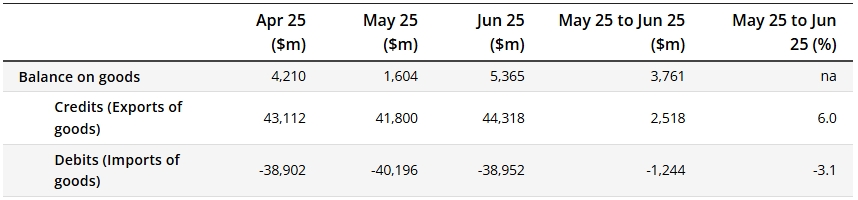
Key figures, seasonally adjusted (Source: ABS).
Exports boosted by non-monetary gold
The June trade balance was largely propelled by a robust 6% increase in goods exports, which rose by $2.52 billion compared with the previous month. The standout performer was non-monetary gold, which contributed significantly to export growth. The gold market has remained buoyant, with rising global demand amid ongoing economic uncertainty driven by US President Donald Trump’s tariff battles, particularly in major markets like China.
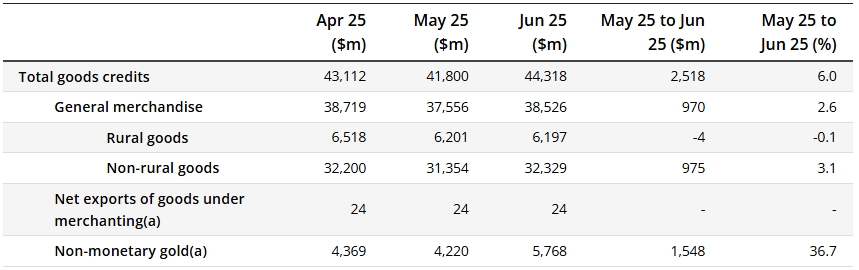
Goods credits (exports), seasonally adjusted (Source: ABS).
Other commodities also performed well, including metal ores, minerals and fuels. The recovery in commodity prices, while still below previous highs, added to the positive export outlook.
The demand for these resources remains strong, buoyed by global infrastructure and energy transitions, alongside China’s improving economic environment as the country navigates geopolitical challenges.
Imports ease as capital goods fall
On the import side, Australia saw a 3.1% decline, or $1.24 billion, in goods imports for June. The decrease was primarily driven by a significant drop in capital goods imports, reflecting softer local business investment and a natural correction following high levels of machinery and equipment imports in previous months.
The decline in capital goods imports could suggest a slowdown in domestic industrial activity, as businesses may be scaling back on investments in fixed assets due to uncertainty around global economic conditions and slower domestic growth. However, the overall reduction in imports helped to narrow the trade deficit and boost the surplus.
A positive sign for mining and resources
For Australia’s mining and resources sector, the strong export performance — particularly in gold, metal ores and minerals — suggests a positive outlook for the second half of 2025. Despite ongoing price volatility in global commodities markets, Australia’s resource exports continue to play a critical role in balancing the trade account.
In June, key commodities like iron ore, coal and liquefied natural gas (LNG) all showed notable trends. Iron ore fines saw a 6.1% increase in export volumes, despite a 5.0% drop in unit value. Thermal coal volumes rose by 48.6%, while semi-soft coal exports increased 47.8%, despite modest price changes. Hard coking coal also saw a 7.7% rise in exports.
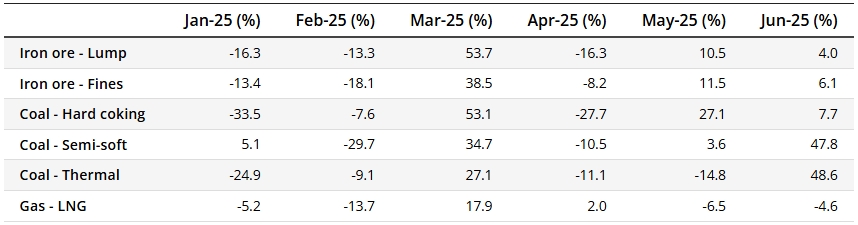
Selected commodities, quantities (Source: ABS).
While LNG exports declined slightly by 4.6%, overall, these strong export volumes reflect steady demand for Australia’s resources. This stability in key sectors positions Australia well for continued trade surpluses, even amid fluctuating global commodity prices.
In addition, the dip in capital goods imports could indicate a slowdown in domestic demand for industrial goods, which may further emphasise the importance of export-driven growth.
Impact on the Australian dollar
The positive trade balance has also provided support for the Australian dollar (AUD), which saw a slight uptick against the softening US dollar following the release of the data, after notching a 0.5% gain in Wednesday trading. The stronger-than-expected surplus reflects a healthy export sector, bolstering investor confidence in the Australian economy.
The AUD, which had been facing some headwinds recently, is expected to benefit from the ongoing strength in resource exports, particularly as global demand for key commodities remains robust.
Looking ahead
With global conditions continuing to shift, the trend in Australia’s trade balance will depend on the movement of commodity prices, especially gold, and the stability of key trading relationships, notably with China. While the outlook for resources remains positive, the broader macroeconomic environment will need to stabilise to maintain the momentum.
For investors, June’s trade surplus signals a potential for ongoing growth in the resources sector, although caution is warranted amid the global economic backdrop.