
Results from ore sorting test work on bulk samples from Nova Minerals Ltd (ASX:NVA, NASDAQ:NVA, OTC:NVAAF)s Styx prospect at its Estelle Gold and Critical Minerals Project in Alaska indicate that a high-grade, saleable antimony concentrate can be produced on site. This is important as a February 2025 report by RFC Ambrian identified Estelle as one of only nine projects globally with near-term antimony production potential, putting it in good stead to meet its US supply ambitions.
Key results from Styx ore sorting test work
- A conceptual flowsheet outlines a viable pathway for on-site recovery and upgrading of antimony ore using ore sorting technology.
- Bulk ore sorting on a 500-kilogram sample from Styx delivered a 60.3% recovery of antimony in just 26.1% of the mass, achieving a concentrate grade of 35.2% antimony (Sb) or 49.1% stibnite (Sb₂S₃). This represents a 2.3-fold upgrade from the original feed grade of 15.2% Sb (24.5% Sb₂S₃).
- Gold was effectively rejected to the ore sorting tails, resulting in a 52.5% recovery, with the grade increasing from 1.90 grams per tonne (g/t) to 2.99 g/t, a 57.4% improvement. These results suggest potential synergy between antimony and gold circuits at Estelle.
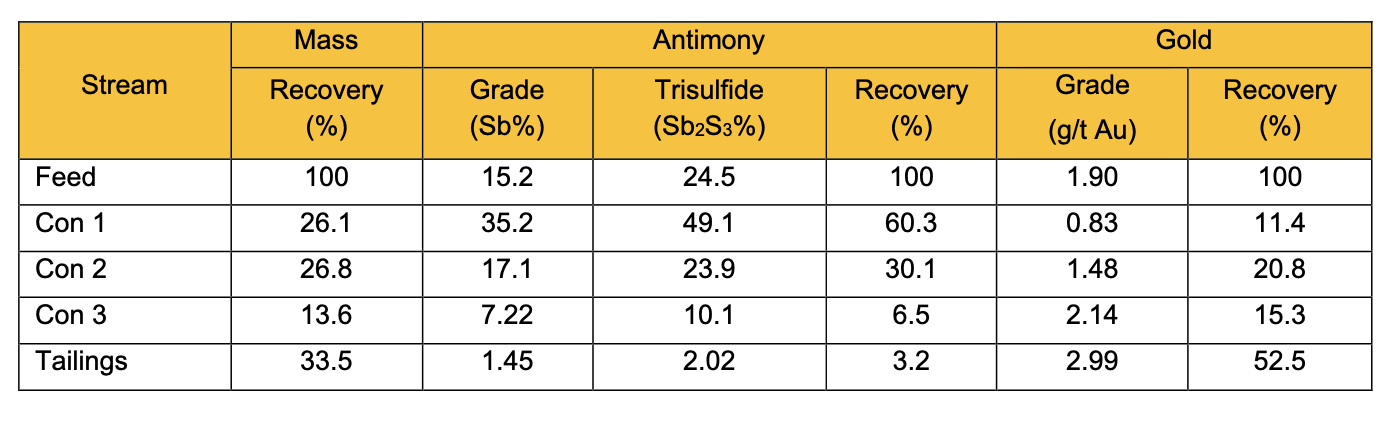
Results of ore sorting test work.
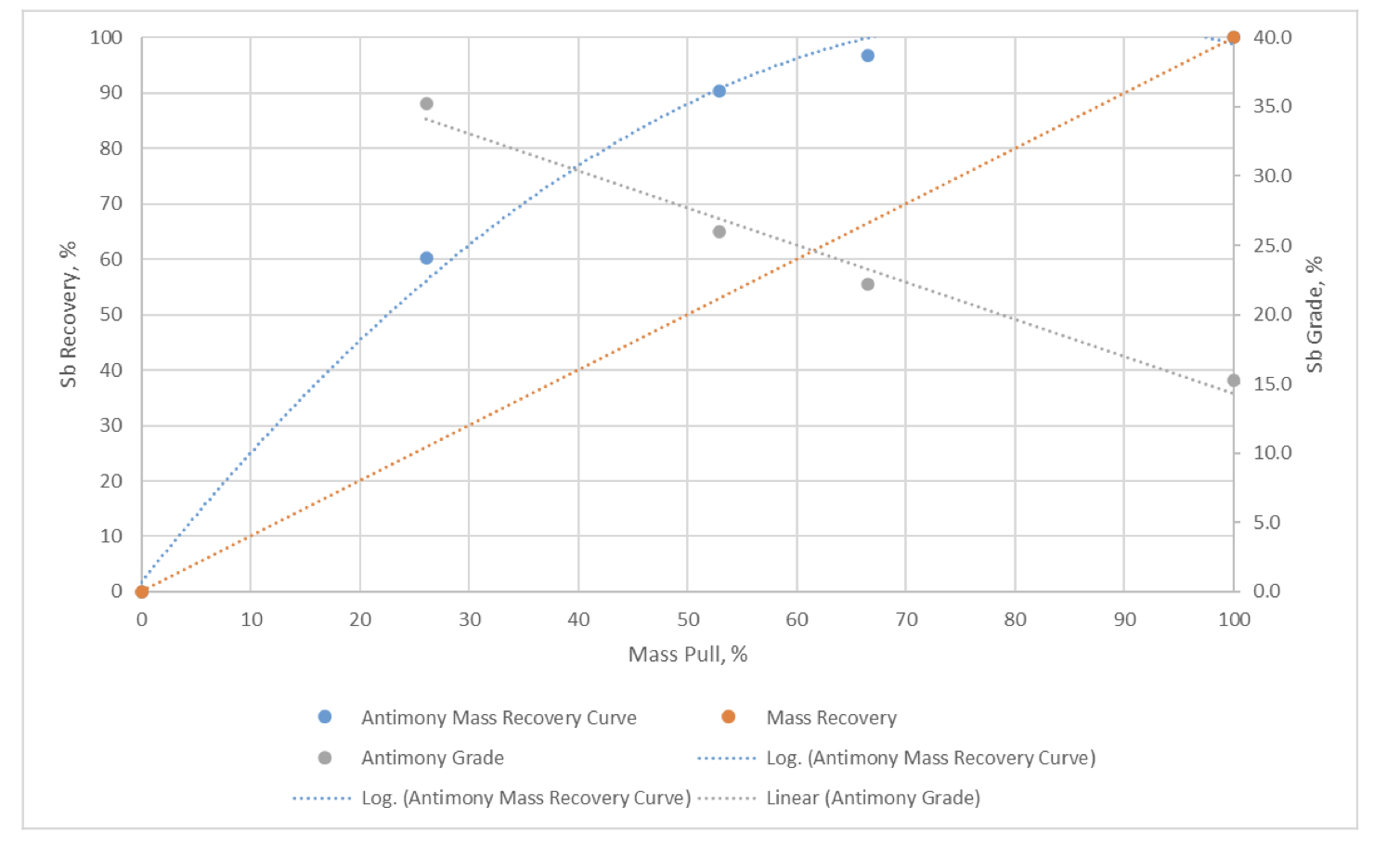
Recovery-mass pull and grade-mass pull curves for the Styx antimony bulk sample.
“These ore sorting results from our Styx prospect represent a significant breakthrough in the advancement of Estelle’s critical minerals strategy. Achieving a 132% upgrade to produce a 49.1% antimony trisulfide concentrate from a single pass demonstrates Estelle’s high-grade antimony is amenable to low-cost, scalable, on-site processing,” Nova Minerals CEO, Christopher Gerteisen said.
“Importantly, we’ve shown that 60.3% of the contained antimony can be recovered in just 26.1% of the mass, with gold beneficiating to the tailings — opening up synergies between the antimony and gold circuits at Estelle.”
Western defence under strain as Nova’s Estelle project emerges as strategic antimony source for US
Mounting concerns over the security of Western defence supply chains—exacerbated by China’s export restrictions on critical minerals—have sharpened focus on antimony, a key material in munitions, semiconductors and other advanced technologies. In response, Nova is positioning Estelle as a potential domestic supply solution for the United States.
Recent surface sampling at Estelle’s Styx and Stibium prospects returned standout antimony grades of up to 56.7% antimony (Sb), well above the typical commercial range of 2–4% Sb. Several samples also reported high-grade gold.
The company is progressing ore sorting trials on a bulk Stibium sample, with results expected shortly. In parallel, Nova is undertaking further beneficiation and purification test work to finalise a downstream flowsheet to support future processing operations.
“With this success, we believe Nova is rapidly positioning itself to become the first fully integrated US domestic antimony producer at scale. In the current geopolitical environment, where Western defence supply chains are under immense pressure, we believe our Estelle Project stands out as a truly strategic asset,” Gerteisen said.
“With Styx and Stibium now confirmed as high-grade, near-term development prospects, and US government engagement well underway through our DIBC membership and DoD grant applications, Nova is fast-tracking a solution to the critical antimony supply gap.
“We are proud to lead the charge in re-establishing domestic production of this defense-essential mineral, and today’s results mark another key step toward potentially delivering a secure, US-based supply chain — right here in Alaska.”
Nova has joined the Defense Industrial Base Consortium (DIBC) and is advancing its grant applications with the US Department of Defense. The company aims to produce direct shipping ore (DSO) as an initial revenue stream while developing full downstream capacity to enable a vertically integrated antimony supply chain within the United States.
Ore sorting details
In collaboration with METS Engineering and Steinert Mining, Nova completed a bulk ore sorting test at Estelle’s Styx prospect, confirming the ore body’s amenability to sensor-based ore sorting using X-ray transmission (XRT) technology.
A 500-kilogram sample of Styx ore was tested, producing three separate product streams across three passes. The first pass yielded a high-grade antimony concentrate, recovering 60.3% antimony (Sb) in just 26.1% of the mass. The resulting product contained 35.2% Sb (equivalent to 49.1% antimony trisulfide, Sb₂S₃) from a feed grade of 15.2% Sb (24.5% Sb₂S₃) — representing a 2.3-fold upgrade from a single pass.
Under the current flowsheet scenario, a second ore sorter pass is used to recover a middling product with a grade of 13.8% Sb (19.2% Sb₂S₃) in 29% of the mass, further increasing total recoveries. The stagewise mass rejection from feed to the second ore sorter totals 45%.
Notably, the tailings stream — representing 33.5% of the original feed mass — contains 52.5% of the original feed gold, suggesting further value may be recovered. Nova believes this opens up the potential for Styx to support dual production as both an antimony project and a satellite gold operation to the nearby RPM deposit.
Conceptual antimony-gold flowsheet
Nova has outlined a high-level conceptual flowsheet for antimony ore processing at Estelle, following positive test results. Additional test work and engineering studies are underway to refine the plan.
The proposed flowsheet highlights the use of ore sorting technology to enhance ore value by separating high-grade antimony and gold concentrates for further processing. Ore sorters would be installed on site, with the potential for high-grade antimony concentrate to be shipped off-site for downstream treatment. This strategy supports a low-capital expenditure (CAPEX), streamlined processing solution.
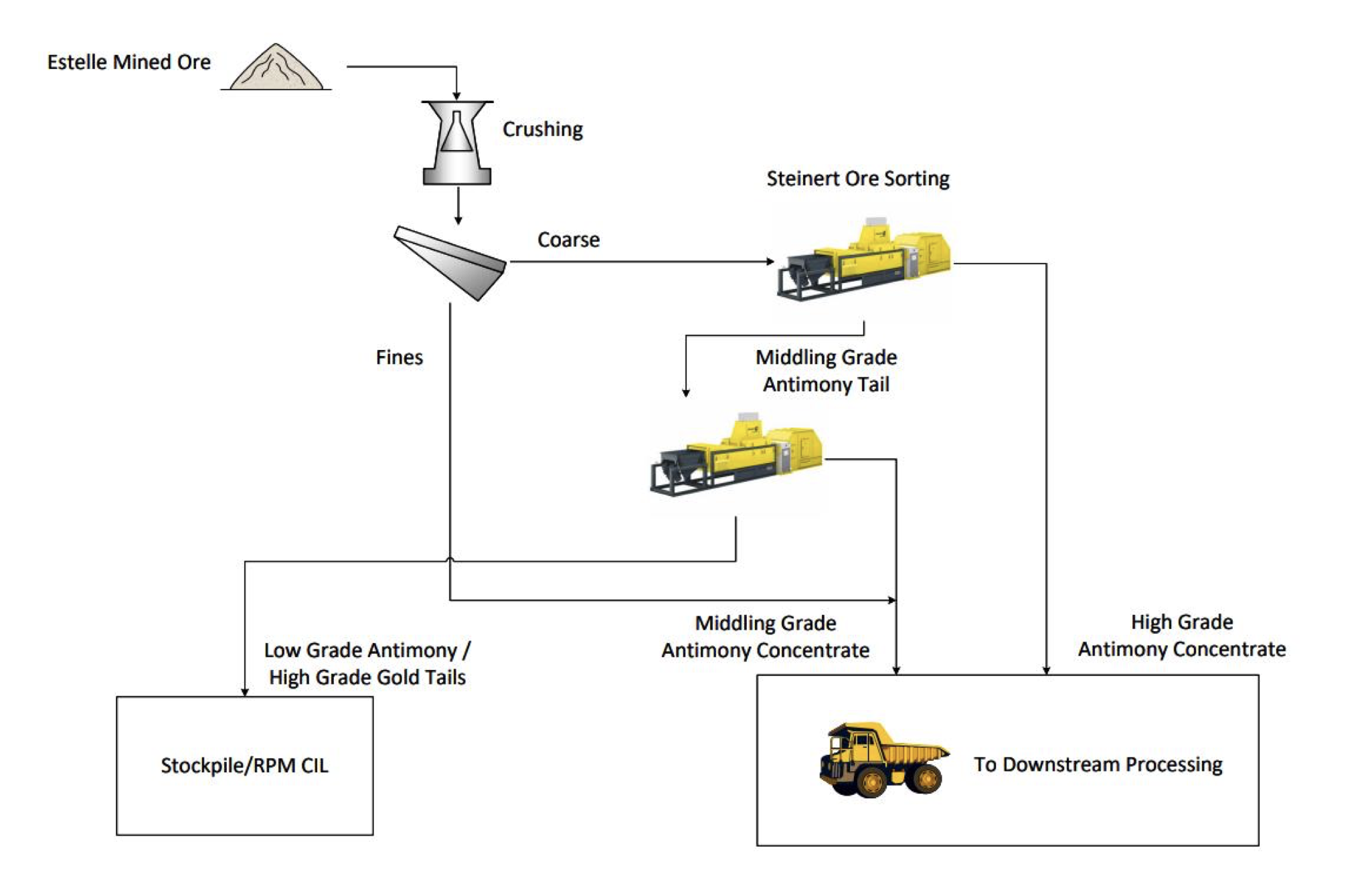
High Level Conceptual Flowsheet for Estelle Antimony Ore.
The early production of a premium-grade antimony concentrate, potentially classified as direct shipping ore (DSO), could provide initial cash flow while Nova develops its downstream facilities. Lower-grade sorted material could be stockpiled for future processing, while a potential plant would process ore-sorted middlings along with pre-screened fines.
Tailings from ore sorting at the Styx prospect may also deliver a high-grade gold concentrate, which could supplement feed for the Estelle RPM carbon-in-leach/carbon-in-pulp (CIL/CIP) plant.