
Recce Pharmaceuticals Ltd (ASX:RCE, OTC:RECEF) will present new data on its lead synthetic anti-infective, RECCE® 327 (R327), at the 2025 Military Health System Research Symposium (MHSRS) in Florida, United States. The presentation will be delivered as a poster and in-person oral session and will highlight R327’s activity against a suite of high-priority bioterrorism pathogens.
The session, titled Optimising Medical Readiness, MHS Resilience, & Biodefense across R&D for Future Pandemics, will feature Recce’s abstract, RECCE® 327: A Novel Countermeasure for High-Priority Bioterrorism Pathogens. It showcases promising laboratory data against Category A and B biological threats identified by the US Centers for Disease Control and Prevention (CDC), including anthrax, tularemia, glanders, melioidosis and plague.
The presentation builds on Recce’s ongoing Cooperative Research and Development Agreement (CRADA) with the US Army’s top biodefence facility, USAMRIID.
Significant laboratory results against bioterrorism threats
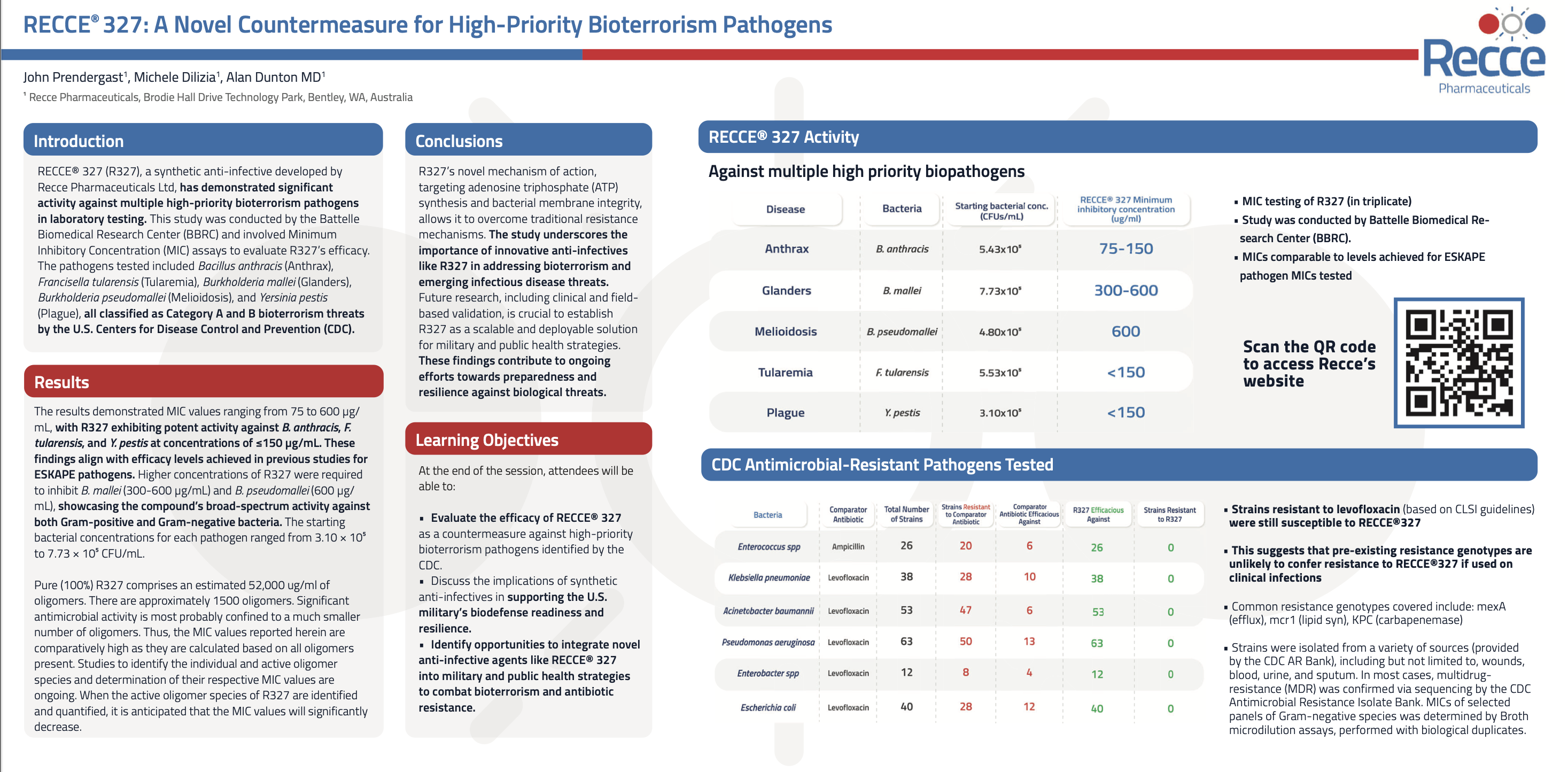
The data presented stems from studies conducted by the Battelle Biomedical Research Center (BBRC), using minimum inhibitory concentration (MIC) assays. R327 demonstrated antimicrobial activity against five CDC-listed high-priority threats: Bacillus anthracis, Francisella tularensis, Burkholderia mallei, Burkholderia pseudomallei and Yersinia pestis. Potent responses were noted particularly against the first three pathogens, with MIC values ranging from 75 to 600 micrograms per millilitre (µg/mL).
Despite higher concentrations being required for B. mallei and B. pseudomallei, results confirmed R327’s broad-spectrum efficacy across both Gram-positive and Gram-negative bacteria. The data also aligned with efficacy observed in Recce’s previous testing against ESKAPE pathogens.
Novel mechanism counters resistant strains
RECCE® 327 acts via a unique dual mechanism — targeting both adenosine triphosphate (ATP) synthesis and bacterial membrane integrity. This enables activity against multidrug-resistant (MDR) strains, including those resistant to levofloxacin. According to the CDC Antimicrobial Resistance Isolate Bank, tested strains carried resistance genotypes such as mexA, mcr1 and KPC, yet remained susceptible to R327.
These findings suggest that traditional resistance mechanisms are unlikely to compromise R327’s efficacy in clinical settings. The compound's resilience against established resistance pathways underscores its value as a potential countermeasure for both military and public health applications.
Future optimisation and formulation pathways
The pure form of R327 comprises roughly 52,000 µg/mL of oligomers, although significant antimicrobial activity likely derives from a small subset. Ongoing studies aim to identify and isolate the most active oligomer species to refine dosage and reduce calculated MIC values. This could enhance R327’s clinical utility and scalability.
Separately, Recce has received US$2 million in funding from the US Department of Defense’s Congressionally Directed Medical Research Program (CDMRP) to develop R327G — a gel-based formulation for treating burn wound infections. This project aligns with the broader goal of delivering versatile anti-infectives for field and clinical deployment.
Engagement at premier military research forum
The MHSRS is the US Department of Defense’s flagship research forum, attracting around 4,000 delegates annually. It serves as a venue for presenting scientific advances with direct relevance to Warfighter health and readiness. The 2025 symposium will be held in Kissimmee, Florida, from August 4–7.
Recce’s poster and abstract are now available on the company’s website. This exposure marks a significant milestone in advancing R327 as a next-generation countermeasure for biological threats.