
Nova Minerals Ltd (ASX:NVA, NASDAQ:NVA, OTC:NVAAF) has reported strong metallurgical test work results from its RPM gold deposit, part of the Estelle Project in Alaska, where innovative ore sorting and heap leaching methods have significantly improved gold recoveries. The results, part of ongoing pre-feasibility studies, highlight the ability to enhance gold extraction from both high- and low-grade ore at the project.
The test work demonstrated significant advancements in recovery rates, particularly from lower-grade ore, where Nova achieved gold recoveries of up to 68.7% using heap leaching. This process is a cost-effective method for extracting gold from low-grade sources, and its application at RPM could unlock additional production potential from previously less economical material.
Ore sorting enhances ore grade and recovery potential
A standout result from the test work is the successful ore sorting program, which is designed to enhance ore grade prior to further processing.
Using Steinert Mining’s X-ray Transmission (XRT) ore sorting technology, Nova conducted a large-scale 1,000-kilogram bulk test. The test successfully upgraded material from 1.32 g/t gold (Au) to 5.72 g/t Au in a single pass, a 4.33 times increase. This represents the potential to substantially increase the volume of high-grade feed delivered to processing circuits, reducing energy consumption and waste generation in the process.
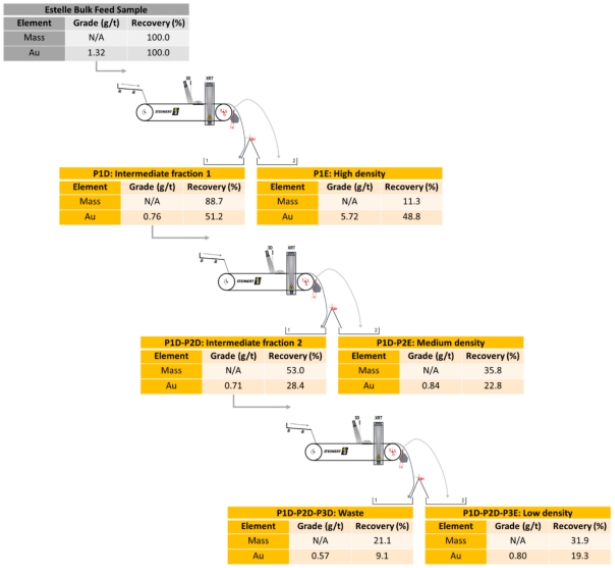
Steinert Illustration of the three-stage XRT and 3D-laser separation process, reporting the mass yields, Au recoveries and Au grades for the Estelle RPM gold bulk sample
The first-pass recovery from the sorting program has led Steinert to recommend the integration of sensor-based sorting into RPM's processing flowsheet. As Nova continues refining the ore sorting technology, the company aims to further optimise the process to enhance efficiency and gold recovery.
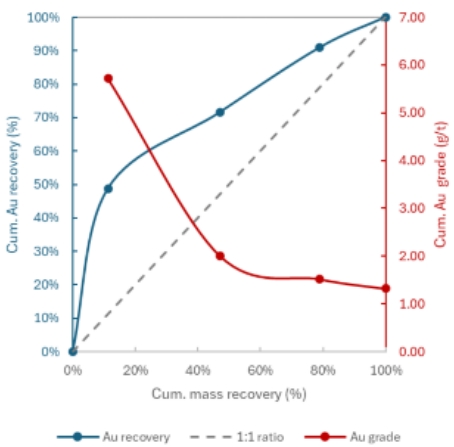
Cumulative gold recovery (%), mass pull (%) and grade (g/t) for the Estelle RPM gold bulk sample
Heap leaching complements ore sorting for maximum recovery
In parallel with the ore sorting program, heap leaching has shown potential to recover gold from the lower-grade material that is rejected by the sorter. Nova’s heap leach column test work achieved a gold recovery rate of 68.7% from the low-grade ore, proving the viability of heap leaching as a complementary process to the ore sorting and CIP/CIL (carbon in pulp/carbon in leach) circuits.
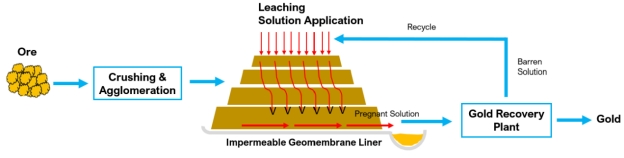
A typical heap leach process
The test work included multiple phases, with a focus on optimising crush sizes and understanding the leaching kinetics, which were favourable for achieving higher recoveries.
A multi-pronged approach for enhanced processing efficiency
The combination of ore sorting, heap leaching and conventional CIP/CIL processing at RPM provides a comprehensive strategy for gold recovery. Nova’s conceptual flowsheet outlines a clear pathway for the project, aiming to maximise recovery rates while reducing overall processing costs.
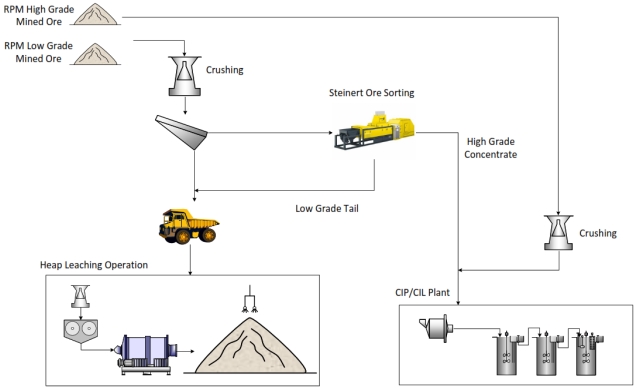
High level conceptual flowsheet for Estelle RPM ore
The company is progressing with further test work, including ongoing CIP/CIL studies and high-pressure grinding rolls (HPGR) crushing tests, to further enhance the process and improve power cost efficiencies.
“We are extremely pleased with the results emerging from our ongoing metallurgical test work program at the RPM Deposit, which we believe continues to demonstrate the exceptional quality and scalability of the Estelle Project,” said Nova CEO Christopher Gerteisen. He emphasised the project’s potential as a "low-cost, high-margin gold producer," noting that the innovative processing methods could significantly enhance the project’s economics.
Nova Minerals continues to advance the Estelle Project, with the latest test results reinforcing RPM's potential as a high-value, long-life gold district. Ongoing optimisation work is focused on refining the project’s economic and processing efficiency, with the company working towards pre-feasibility as it works to develop a major North American gold mine.