
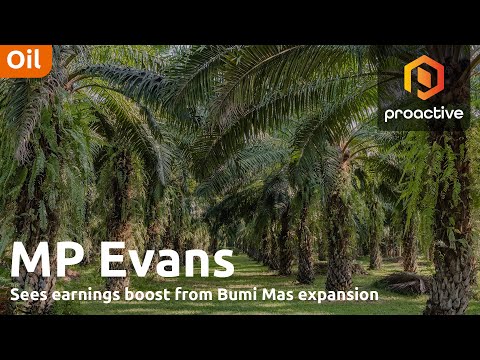
MP Evans Group PLC (AIM:MPE) earlier this week outlined a series of operational and strategic developments ahead of its interim results due in September.
The company said its own harvested crop rose by 9.00% in the first half of 2025. It reduced third-party supply to improve crop mix, which it expects will enhance extraction rates and margins.
MP Evans said overall processed crop volumes remained steady despite the supply shift.
It also highlighted that prices for palm oil and palm kernels rose sharply, with the average price for crude palm oil was nearly $100 higher than last year.
Chief executive Matthew Coulson joined the Proactive studio to give us an update, here we take a closer look at what was said.
Matthew Coulson: Good morning Stephen, great to be here.
Proactive: So Matthew, we've got lots to talk about today. So let's start off with your first half results. Crop volumes up despite a dip in production.
What's behind the strong harvest performance and how are you managing that mix of your own fruit and third party supply?
Matthew Coulson: Yes, you're quite right, Stephen, we've seen a big bounce back in our own crop in the early part of 2025.
The crops we harvested was up by 9% in the first half of this year. But you're quite right also to highlight the fact that we've been managing our crop mix.
So deliberately we've also been just reducing a little bit the amount that we're buying in from third parties, which has meant that overall, we've actually processed about the same amount of crop in total in the first half of this year.
But we do expect to see a benefit from that change in mix.
Proactive: So prices are up sharply. So both for palm oil and palm kernels at 71%. How much of that is market driven? And also chat about your extraction rates and how you've benefited from that?
Matthew Coulson: Yes, exactly. So we're very pleased to see the increase in prices in the first half of this year, the average price we achieved for the CPO, the crude palm oil that we sold in the first half of this year, was actually up almost $100 compared to the first half of last year, which is going to make a big difference to our result.
And you're also right, particularly to highlight palm kernels, our secondary product prices, they're up over 70% year on year, which is great news for us.
Again, that mix that I referred to earlier, that's going to have a beneficial impact on the extraction rates that we're able to achieve. Because of course, the crop that we harvest is so much better than the crops that we buy in from third parties.
Proactive: And pricing going forward. So you see it supported at those levels.
Matthew Coulson: Well, we're moving into the second half now. Of course, some encouraging signs for pricing in the second half. And we'll see how things continue to develop as we move deeper into the second half of the year.
Proactive: Okay. Let's move on to expansion. And you just completed the $35 million acquisition in East Kalimantan. It's two properties, but one project really. What attracted you to those two estates, and how quickly do you expect them to contribute to earnings?
Matthew Coulson: Yeah, we were delighted to complete that transaction earlier this month.
So as you say, at our Bumi Mas project in East Kalimantan we've added those 3,000 hectares, which is going to bring the size of that particular project up to almost 12,000 hectares. And that very much fits in with our strategy, to make sure that we're making the most of the mills that we've invested in.
So immediately, we expect that to be earnings enhancing as we bring the crop from those acquired estates into our existing mill.
Proactive: So Bumi Mas you said nearly 12,000 hectares, but in total you have about 70,000 hectares. So really a sizable operation.
Matthew Coulson: Yes, exactly. I mean, we're delighted to get towards that milestone of 70,000 hectares managed. And as you say that that's quite important for us as we continue on our growth journey.
Proactive: Something else that's important was highlighted in your Taskforce on Climate-related Financial Disclosures (TCFD) aligned reports that was out this week. 36% drop in greenhouse gas emissions since 2021. How are you delivering these cuts and what's next on the sustainability front for the company?
Matthew Coulson: Yes, we were very pleased to publish that report just yesterday. And that really goes into some more detail in how we've been achieving those reductions in our CO2 equivalent emissions.
As you say, we started to measure this in detail in 2021.
We call that our baseline year. And getting that 36% reduction is a big deal for us because we're already a long way to, in fact, already at the interim target we'd set for our net zero strategy.
Really, we've been doing that through a number of methods, both internally looking at what we're doing and how we're focusing on what we're achieving in our what we call our scope one and scope two emissions, but also working very closely with our partners, both upstream and downstream, thinking about what's called our scope three emissions.
So it's an integrated approach to thinking about how we can reduce those emissions.
Proactive: Matthew, more than 10% of your planted area is now conservation land. How does this balance sustainability with productivity, and how do you see that land use ratio evolving?
Matthew Coulson: Well, that was one of our targets that we'd set ourselves, particularly within that concept of sustainability and TCFD.
We said that we wanted to get to at least 10% conservation land, and we're very pleased that we've achieved that target now. And that's something we're very keen to at least maintain. I think we're at 12% now.
We took on a big area of conservation land during 2024. And again, you're exactly right to highlight it's about maintaining a balance.
Thinking about, of course, we want to have very productive land. But at the same time it's extremely important that we maintain a ratio of conservation land alongside that.
Proactive: I know your interim results are going to be answered in the next month or two. But looking ahead to the rest of 2025, what's your top priorities and what should investors be looking out for in terms of performance and also catalysts?
Matthew Coulson: Yes. Absolutely. So we're very excited about sharing our interim results in September.
They will be out in the market in the middle of the month, very shortly.
So look forward to those. But as we go forward, there are a number of things that we're focusing on.
When we look internally, we're very excited about some of our continuing planting programs, and they will form a continuing engine of growth for the group. So we're continuing to plant both in Sumatra, and also in East Kalimantan.
So again, alongside those acquisition opportunities that we're developing.
We're continuing to ensure we've got that engine of growth internally as we plant more of our own hectares.
Proactive: We look forward to chatting to you when those results come out in September.