
Midnight Sun Mining Corp (TSX-V:MMA, OTCQB:MDNGF) Vice President of Business Development Adrian O’Brien talked with Proactive about the company’s latest progress on its two priority projects in Zambia: Dumbwa and Kazhiba.
Proactive: Welcome back inside our Proactive newsroom. Joining me now is Adrian O’Brien. He is the Vice President of Business Development for Midnight Sun Mining Corp. Adrian, nice to see you again. How are you?
Adrian O'Brien: Good to see you, as always. Doing great. Very busy — bouncing around to lots of conferences and super busy in the field right now. So it's a big time for us.
Absolutely. You’ve had a couple of news releases recently, one about expansion drilling and another on the IP survey. Let’s start with the IP survey — that’s an important one for the company.
It is. This is a critical step. There’s a very clear analog between Dumbwa, our flagship target, and Lumwana, which is Barrick’s flagship copper asset. It sits just 20km west of us. The person who helped unlock Lumwana for Barrick after almost 20 years of work was Kevin Bonel, a PhD geologist — and he’s now our Chief Operating Officer.
The key thing Kevin did at Lumwana was a dipole-dipole IP survey, which correlates surface expression with what sits at depth. Kevin has guided us to do the same on all of our targets. We’ve now completed this on 60% of Dumbwa — a 20km surface anomaly — and announced the results.
That showed 11.5km of mineralization. We now understand the correlation between surface results and what lies at depth. All the historic drilling now makes sense, and it’s given us a roadmap to drill Dumbwa for the first time — which kicks off in about ten days.
Will this involve stepping out to make it larger? What’s the plan?
Exactly. The soil anomaly is 20km long and peaks at 0.73% copper. The average deposit in the area is around 0.56%, so this is high grade. It’s roughly 1km wide at surface, sometimes wider, and 20km in strike length.
What we want now is to define the extent of the sulfide system at depth in correlation with that anomaly. If you look at the 11.5km footprint — and that's just 60% of the anomaly — running for 200–300m at depth, it's rather extraordinary.
So we’ll go back, follow up on historic results, and drill this from top to bottom to see how big it really is.
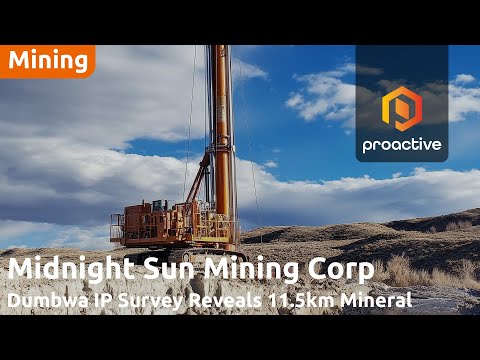
And this drilling will continue into the fall?
This is ongoing. It’s what we’ve been building toward. This drill program will start and keep going for the foreseeable future. We want to see how big this system really is.
That's not the only program underway. You’ve got another, right?
Yes, we just kicked off RC drilling at our Kazhiba oxide target. We did some drilling in November last year under the cooperative exploration plan with First Quantum. The goal is to deliver oxide copper to their SXEW circuit at the Kansanshi mine.
That’s important because it helps neutralize acid from their smelter, and it’s the economic engine of the mine. We have a lot of material at surface. Results last year were spectacular — 21m at 10.5% copper, 26m at 5.5%, all at surface and zero strip ratio.
We’ve done detailed assessment and found that only about 40% of the oxide blanket has been explored. Beyond that, we’ve identified 3–5 other oxide targets that could be similar. We’ve done more detailed sampling and are preparing those for follow-up drilling.
This is what makes Midnight Sun different. We have the exploration upside at Dumbwa and the potential for near-term production and cash flow from oxide copper at Kazhiba.
Quotes have been lightly edited for clarity and style