
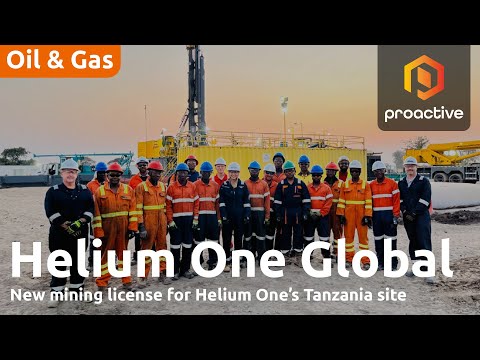
Helium One Global Ltd (AIM:HE1, OTCQB:HLOGF) earlier this week confirmed it had received an official mining license for its project in Tanzania, marking a key milestone in its transition from exploration to development.
The company said the license, effective from July 2025, will allow it to initiate an Electrical Submersible Pump (ESP) operation at the Itumbula discovery within its Southern Rukwa project.
This follows a discovery in 2023 and is aimed at upgrading its resource base.
CEO Lorna Blaisse joined the Proactive studio to tell us more about the latest developments – here, we take a closer look at what was said.
Proactive: Lorna, good to speak with you, and good news on the mining license. What does this actually mean for the company and what are the next steps?
Lorna Blaisse: Yes, it certainly is very good news for us.
We knew that this was on its way, but it's always very reassuring when we have actual confirmation of a signed document from the ministry, which is now also in the public domain via the cadastre portal.
I think, although we were offered this ML at the end of February earlier this year, the first official commencement of the license is now July 2025, which is quite key.
In terms of next steps, the award of this license, unlike the previous PL, actually enables us to now move forward away from the prospecting phase of exploration and enables us to move more formally into development of the project post last year’s discovery at Itumbula.
The first phase of this advancement towards development will be what we refer to as the ESP operation, which is an electrical submersible pump.
It's important to note that the helium we brought to surface last year during the testing was under normal conditions, and therefore what this new phase will do is allow us to bring it to surface again using artificial lift through the use of that ESP.
This will then allow us to identify variances in helium concentrations from variable flow rates in both the fractured basement and the Karoo intervals.
We anticipate that the results of this will then further enhance our resource estimate and move us beyond the contingent resource classification, as per the recent CPR that was done, and into those all-important bookable reserves which is ultimately what we'll need to move forward for project financing.
We've already started the planning phase of this operation, and once this fundraiser is complete, we’ll be able to order those long-lead items for operations to commence in Q4 this year.
In preparation for this, we'll also be shaking down the rig that's been on site at Itumbula and has been warm stacked, but will soon be very ready to work.
Proactive: Lorna, presumably part of this fundraise will be used for your operations in Tanzania.
Can you provide more details on this as well as what you're using the funds for in the US following your September raise last year?
Lorna Blaisse: As I've just alluded to, a large portion of these funds will primarily be used on that Southern Rukwa project in Tanzania for the ESP operation.
However, as you've rightly noted, we did raise funds for the US in September last year, and the majority of this was spent on the actual acquisition.
So we paid $1.5 million to Blue Star. We also have carried the cost of each of the subsequent six development wells, which have subsequently now been drilled.
Our commitment there was capped at $450,000 per well.
There were some overruns and delays, which costs have been met equally by both parties, and as a JV, both parties are also looking at ways to now accelerate the project.
So we're also factoring in significant CO2 production as well as the helium, and giving some thought as to how we can advance the drilling of the next phase of the Galactica development, which is an additional further nine development wells.
On top of this, the joint venture is also discussing ways of developing the adjacent Pegasus field, and the program that will follow there once Galactica is in production and online.
We certainly are very much valuing our working in partnership with Blue Star and looking forward to what this next phase of the development with them will bring as we move the project on stream.
Proactive: Why have you structured the fundraise this way, and who are the three investors planning to come into the company?
Lorna Blaisse: Yeah, I think this is an important question. In order to allot new shares, we require a mandate from shareholders, which isn't currently in place.
As our existing shareholders will be very aware, the last few fundraises that the company has undertaken have been done by way of a cash box structure, which subsequently has precluded our existing shareholders from taking part.
Moving forward, we want to get away from this type of arrangement.
We're asking shareholders to provide us with that headroom so that we can execute this transaction and move both our Tanzanian and US projects forwards.
The investors that are part of this raise were introduced to us by Marex Financial.
We know that they have worked together on a number of previous deals. We've met those principals in person and the funds certainly are being welcomed as new shareholders to the company. I'm sure in time they'll make those necessary disclosure requirements when appropriate.
Proactive: What happens if your shareholders vote against the resolutions at the general meeting on the 5th of August?
Lorna Blaisse: Another good question. It's certainly hoped that they don't, as this will allow them an opportunity to participate.
The company is very keen to get both projects moving forward, as I've mentioned.
However, it's important to highlight we are currently a revenue-generating company.
So if shareholders do vote against it, then we will have to revert to another cash box structure for the institutional investors so we can continue to grow the business and develop our assets.
I would certainly encourage our shareholders to vote in favour of that resolution and increase the headroom.
Proactive: Lorna, how does this fundraise position the company going forward and what milestones can investors look forward to the company achieving in the next year?
Lorna Blaisse: Well, it's certainly going to be another busy and exciting year ahead.
We've achieved a lot in the last 12 months, and we plan to continue that success in the next 12 months.
We're certainly excited about the commencement of operations in Southern Rukwa again and starting up the ESP operation at Itumbula.
That will bring a greater understanding, moving us towards the final development plan.
Part of that will also include the front-end engineering design work, the FEED work, and subsequently finalising the processing plant design as well.
In addition, we’ll be bringing the US project into production later this year.
That will be a huge milestone for the company and the JV, and certainly endorse the board's strategy at Helium One in diversifying our portfolio.
That’s enough to keep us busy in the meantime. We'll continue to update our news flow as and when these developments progress.
We certainly look forward to sharing that news and remain opportunistic as other helium projects may arise.
We're always very grateful to our shareholders for their continued support.
Proactive: Lorna, I hope you'll continue to keep us updated on your progress. Thank you very much for taking the time today.