
Critical Resources Ltd (ASX:CRR) is advancing its critical minerals portfolio with renewed momentum under the leadership of newly appointed chief executive officer Tim Wither.
Wither, a seasoned mining executive with over two decades of experience spanning Australia, South America, Africa and India, brings a proven track record in taking greenfield base metal projects through to production. His appointment aligns with the company’s strategy to accelerate development of its lithium and antimony-gold assets in Canada and New South Wales.
The company is focused on the exploration and development of key battery and base metals vital to a decarbonised economy.
At the heart of its portfolio is the Mavis Lake Lithium Project in Ontario, Canada. The company has completed more than 45,000 metres of drilling to date and defined a maiden Inferred Mineral Resource Estimate (MRE) of 8 million tonnes (Mt) at a grade of 1.07% lithium oxide (Li₂O). Ongoing exploration success continues to support the potential for further resource growth and new discoveries within the surrounding district.
In parallel, Critical Resources is progressing the Hall Peak Base Metals Project in New South Wales, located 87 kilometres south-east of Armidale and just 2.7 kilometres from Larvotto Resources’ Hillgrove Antimony-Gold Mine — the largest operation of its kind in Australia.
Following multiple drilling campaigns, CRR has established a maiden Inferred MRE of 884,000 tonnes at 3.7% zinc, 1.5% lead, 0.4% copper, 30 parts per million (ppm) silver and 0.1 ppm gold. Geological modelling indicates that mineralisation remains open along strike to the east/north-east and west/south-west, presenting near-term opportunities for resource expansion through follow-up drilling.
Mavis Lake Lithium Project well supported by infrastructure and resource growth
Critical Resources’ Mavis Lake Lithium Project is strategically located about 14 kilometres east-northeast of Dryden in northwestern Ontario, Canada. The city provides a cost-effective logistics and operations base, enhancing the project’s overall efficiency.
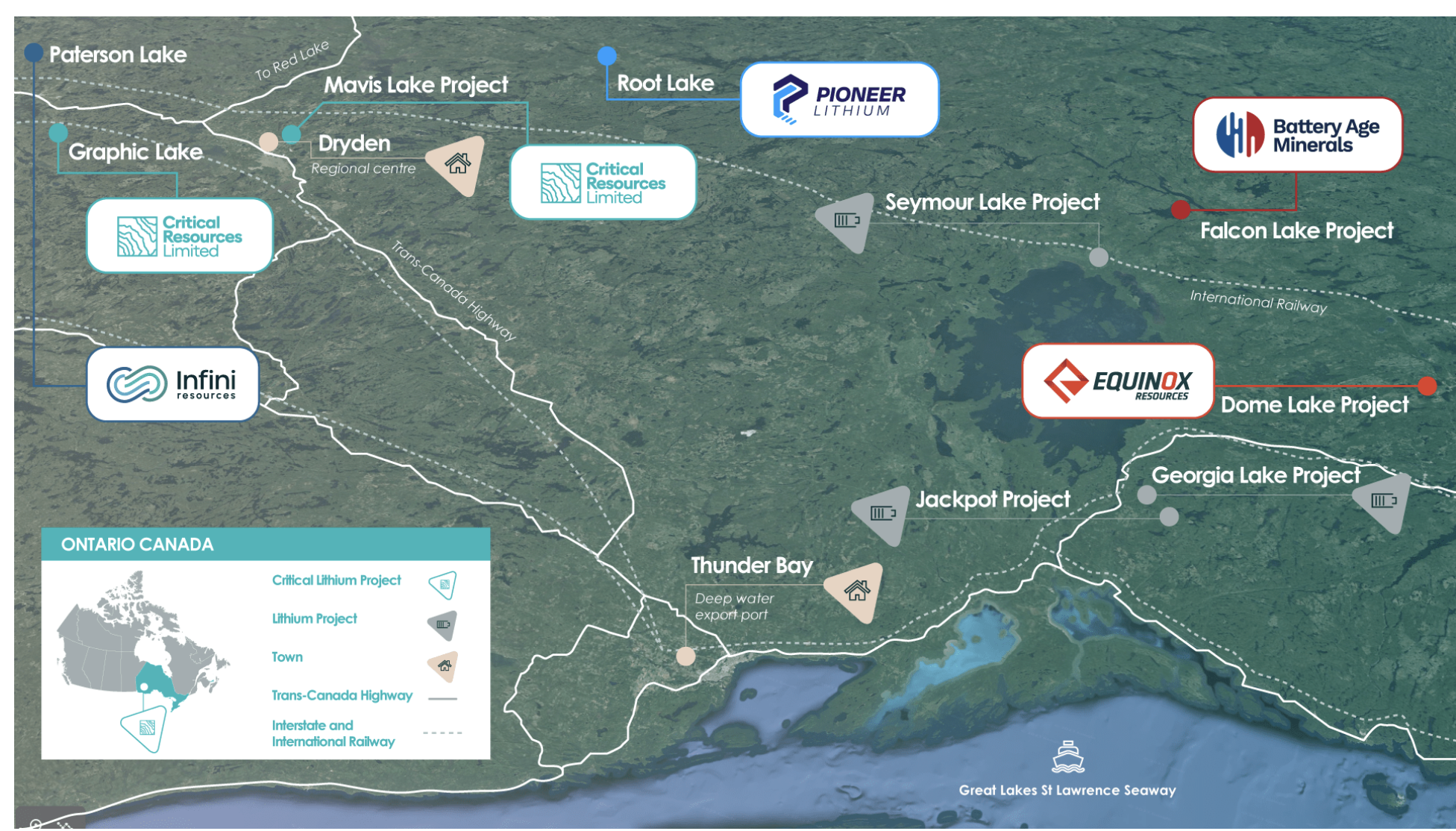
The site benefits from direct road access to Trans-Canada Highway 17 and a cross-country rail network with connections into the northern United States. These established transport routes support the movement of major equipment and, in time, will facilitate product logistics. Leveraging the nearby deep-water port at Thunder Bay, product from Mavis Lake can be shipped to downstream customers in North America and Europe, forming part of the electric vehicle (EV) supply chain.
In 2022, the company drilled over 19,500 metres and reported some of the highest lithium assay results among ASX-listed hard rock lithium companies. A maiden JORC 2012-compliant Mineral Resource Estimate (MRE) of 8 million tonnes at 1.07% lithium oxide (Li₂O) was announced in May 2023. A further 24,000 metres drilled during 2023 intercepted some of Ontario’s thickest high-grade lithium sections.
Exploration has since expanded to the Northern Prospects of Mavis Lake, where visible spodumene-bearing outcrops present near-term potential to grow the resource base. The company enters 2024 with confidence in year-on-year resource expansion.
Parallel to exploration, Critical Resources has been advancing development activities including metallurgical test work, inputs for a scoping or preliminary economic assessment study, and permitting through baseline data collection.
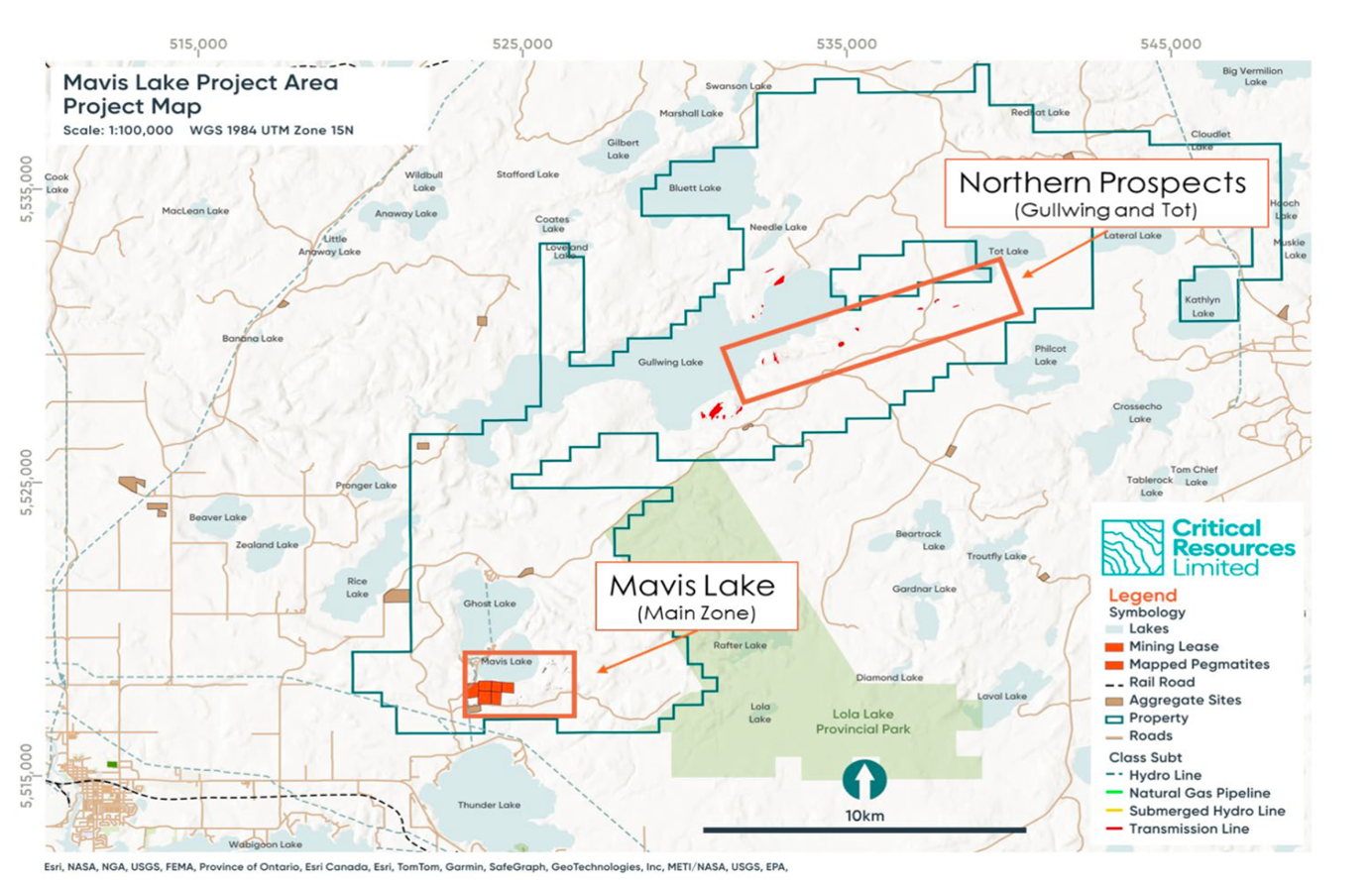
Project Location map showing Mavis Lake project area.
Recent assay results continue to validate the resource growth strategy, returning standout intercepts such as 14.6 metres at 1.83% Li₂O (hole MF24-267), 11.7 metres at 1.28% Li₂O (MF24-268), and 9.15 metres at 1.21% Li₂O (MF24-269). All lie outside the current resource boundary, demonstrating mineralisation remains open at depth and along strike.
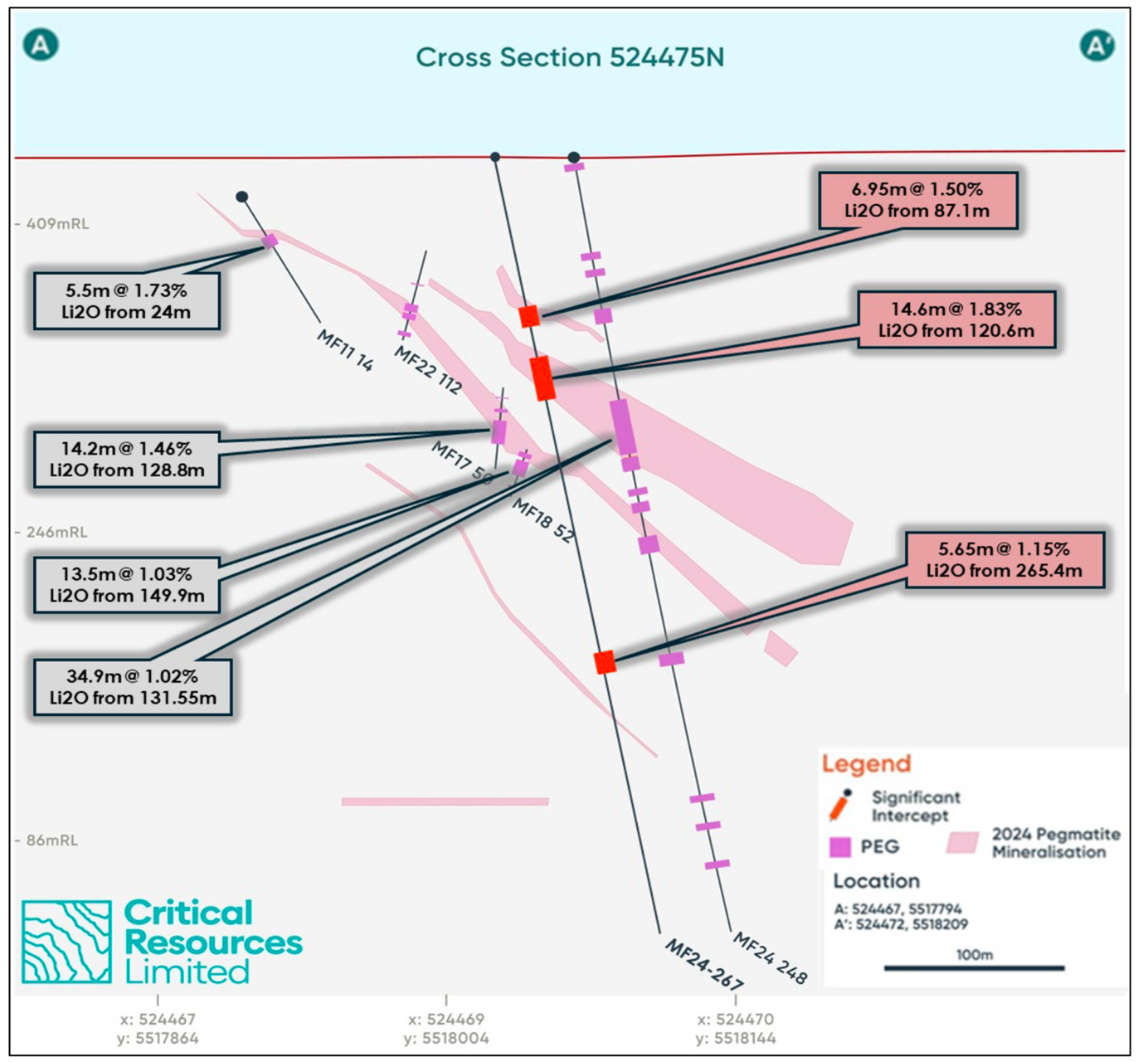
Mavis Lake Main Zone cross-section illustrating the mineralisation from MF24-267.
Further success at the Tot prospect reinforces this growth potential, with intercepts including 3.5 metres at 1.75% Li₂O (TL24-028) and 5.9 metres at 0.72% Li₂O (TL24-026), suggesting continuity of spodumene-bearing pegmatite at depth and to the south. The company is prioritising low-cost, high-impact technical work while awaiting a rebound in lithium market conditions, with development permitting and stakeholder engagement also progressing.
“These final drill results close out the drill programs at Mavis Lake," Wither said. "We continue to see impressive lithium grades and widths across the Main Zone, and the Tot Pegmatite system is clearly evolving into a fantastic new target area. We’ve proven that Mavis Lake has the scale and grade to become a meaningful contributor to the North American lithium supply chain, and we continue to monitor the lithium markets, ready for the next lithium cycle.”
Halls Peak Project: High-grade antimony-gold targets advancing
In New South Wales, the company continues to build scale at its Halls Peak Base Metals Project, which hosts a maiden Inferred Mineral Resource of 884,000 tonnes grading 3.7% zinc, 1.5% lead, 0.4% copper, 30 grams per tonne silver and 0.1 grams per tonne gold.
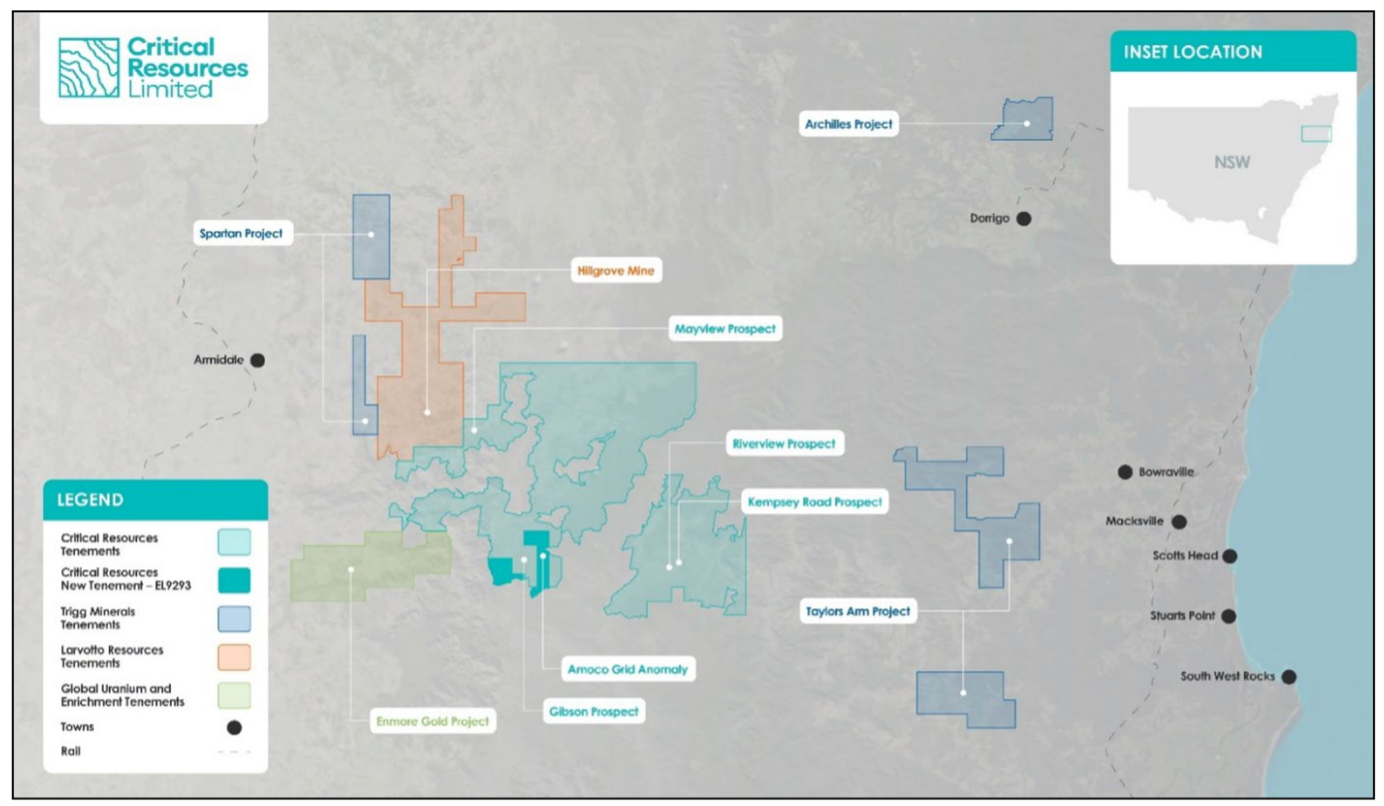
Project Location map showing Halls Peak project area proximity to significant Antimony-Gold projects in the Armidale region, NSW, Australia.
Two key targets within the broader Halls Peak tenement — Mayview and Amoco — have returned high-grade assay results and are shaping up as significant Hillgrove-style orogenic antimony-gold systems.
At Mayview, rock chip sampling returned grades up to 52.3% antimony (Sample MVS17) and 2.71 g/t gold (MVS11), indicating strong mineralisation in quartz-stibnite veins and historic waste piles. The prospect lies just 2.7 kilometres from Larvotto Resources' Hillgrove Antimony-Gold Mine — Australia’s largest of its kind. The company has submitted an application for a 12-hole reverse circulation (RC) drill program to test mineralisation at depth and along strike.
Meanwhile, the Amoco prospect, located approximately 19 kilometres southeast of Larvotto Resources Ltd’s Hillgrove Antimony-Gold operations and about 14 kilometres east of Koonenberry Gold’s Enmore Gold Project along regional controlling structural trends, has demonstrated mineralisation over a 1-kilometre trend. Recent rock chip assays returned up to 17.9 g/t gold, 0.7% antimony and 53.2 g/t silver. Mapping also revealed a new zone of mineralisation 350 metres south of the known trend, pointing to scale potential.
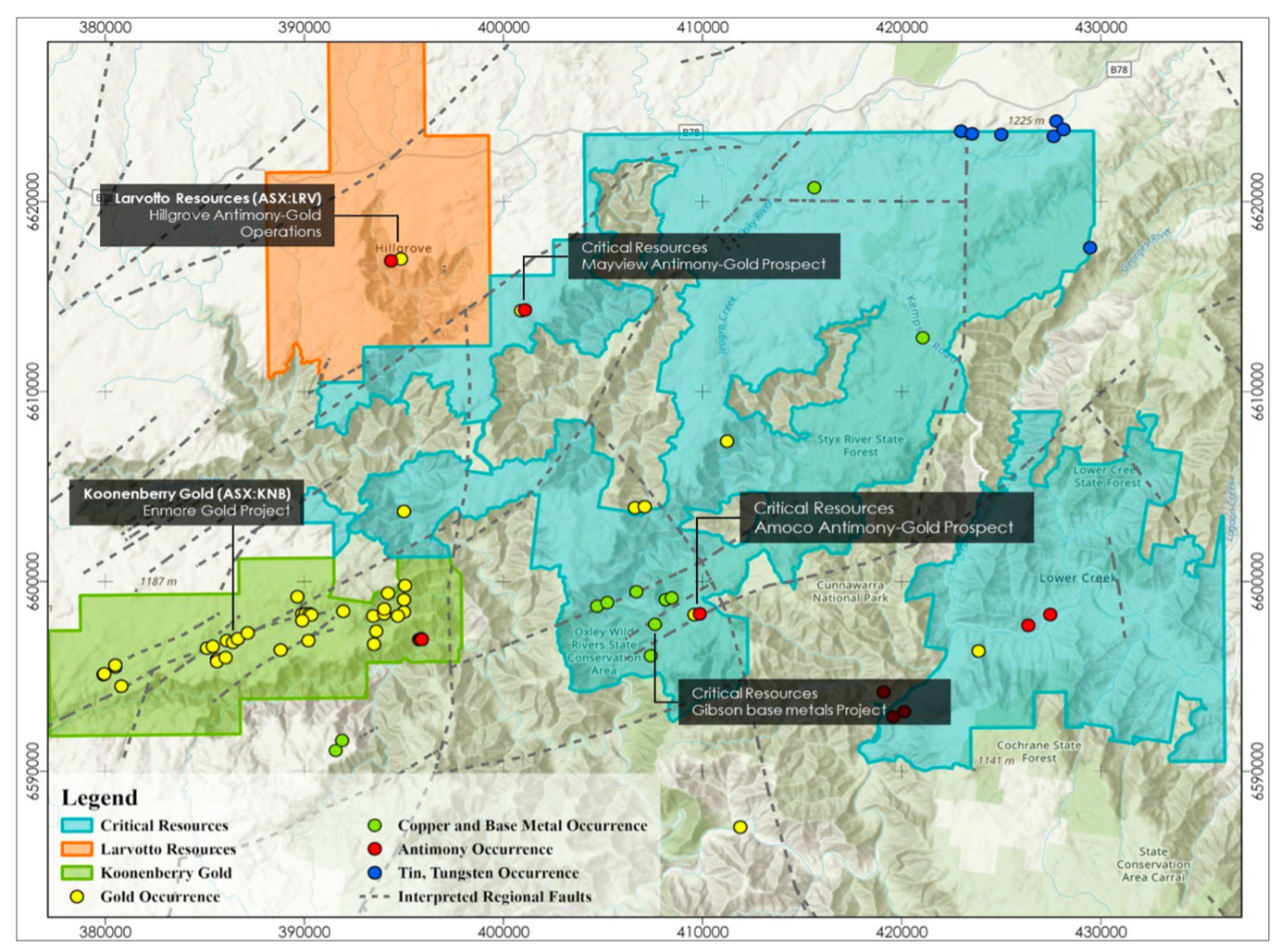
Location Plan of Critical Resources - Halls Peak tenure and regionally significant Hillgrove and Enmore with regional structures.
“The commencement of the targeted soil-geochemistry program is a step toward our maiden drill program at Amoco, as we progress the approval process with the NSW regulator and respective landholders. The systematic multi-element geochemical survey is being supported by modern geochemical assay techniques, which have led to significant improvements in the detection limits of critical pathfinder elements,” Wither said.
“The ~3km x 2km-wide soil-geochemistry sampling program is designed to provide detailed geological data focused on gold, antimony and pathfinder elements across the interpreted structural corridor to assist in determining the mineralised extents across the priority target area at Amoco. Amoco represents a compelling opportunity within the region's historically productive antimony-gold corridor with encouraging initial surface gold and antimony mineralisation.”
Petrological analysis has confirmed a structurally controlled quartz-sulphide system, further supporting the orogenic gold-antimony model. The presence of arsenopyrite and pyrite suggests deformation-hosted mineralisation, with textures typical of high-grade, structurally controlled systems.
Both Mayview and Amoco are expected to be drill-ready in the third quarter of 2025, subject to regulatory approvals and land access agreements. "These findings position Mayview as a key focus for our exploration strategy, and we are eager to advance the project in 2025 to unlock its full potential," said non-executive director Nigel Broomham.
Strategic outlook
Critical Resources is leveraging geological, geophysical, and geochemical data to refine its drill targeting across both lithium and critical minerals assets. As permitting progresses, the company is focused on maintaining a disciplined and technically driven approach across its diversified portfolio.
“With high-grade results emerging from both our Canadian and Australian assets, Critical Resources is well-positioned to play a strategic role in supplying metals essential for the energy transition,” Wither said. “We are committed to delivering shareholder value through focused exploration, project advancement and strategic partnerships”