
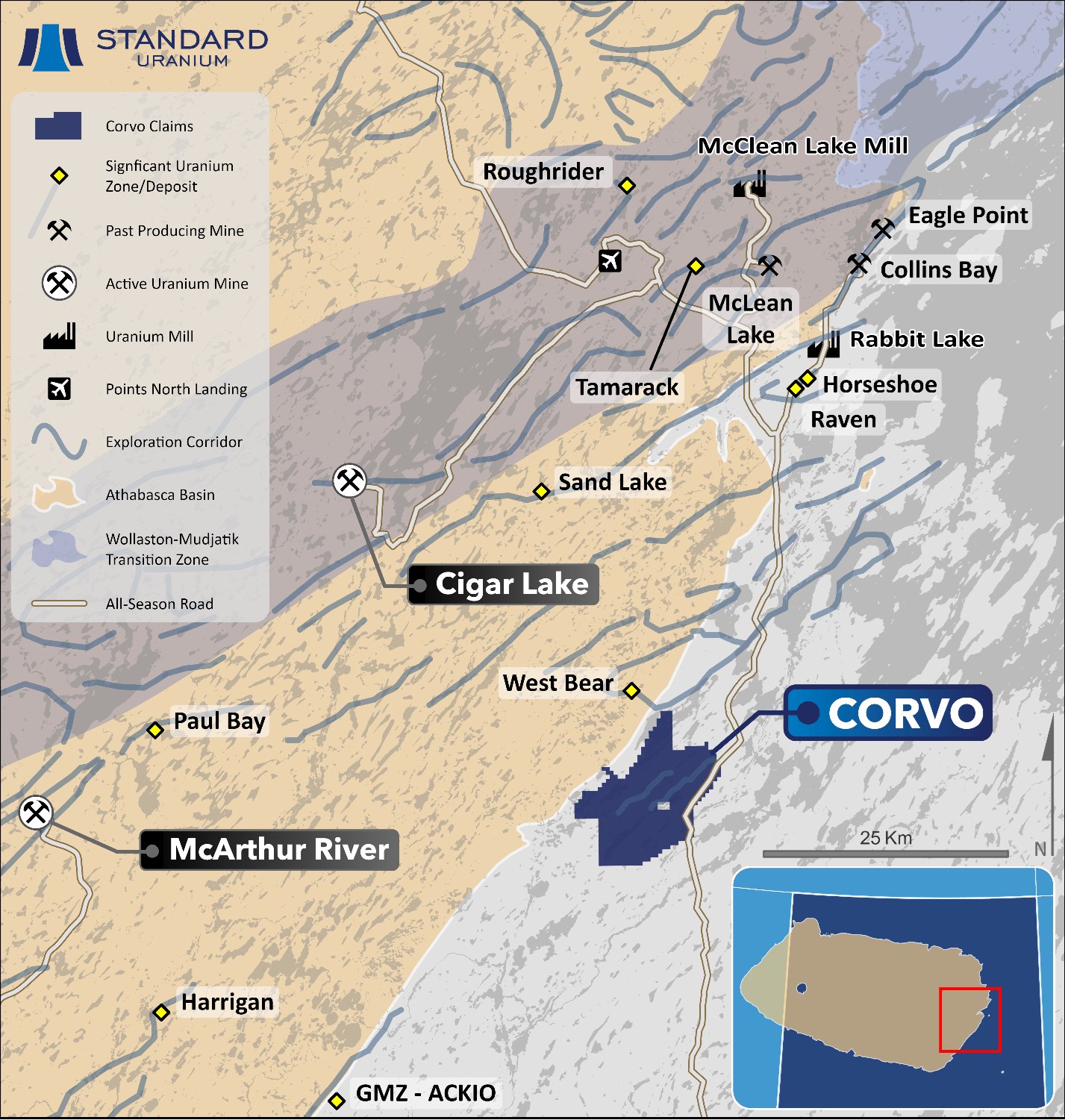
Standard Uranium Ltd (TSX-V:STND, OTCQB:STTDF) has reported positive results from a high-resolution airborne Time Domain Electromagnetic (TDEM) survey completed at its Corvo uranium project in northern Saskatchewan, Canada.
The survey confirmed and refined previously identified conductive corridors, outlining 29 kilometres of prospective conductor strike length and defining multiple high-priority target areas for follow-up exploration.
"Upgrading and confirming the presence of conductive corridors across the project is an ideal first step in our exploration efforts at Corvo,” Standard Uranium president and vice president exploration Sean Hillacre said.
“Along with the recently completed prospecting and sampling program this month, we've confirmed the presence of at least 29 kilometres of conductive stratigraphy as well as multiple radioactive occurrences at surface.”
The Corvo project is currently under a three-year earn-in option agreement with Aventis Energy.
Conducted earlier in 2025, the TDEM survey was carried out by Axiom Exploration Group, in partnership with New Resolution Geophysics, using the Xcite helicopter-borne system.
A total of 1,670.5 line-kilometres of electromagnetic and magnetic data were collected across all 13 mineral claims at 100-metre line spacing, covering an area of approximately 122.65 square kilometres.
The objective of the program was to detect and characterize conductive and magnetic anomalies beneath glacial cover, with a focus on identifying targets potentially associated with uranium-bearing graphite- and/or sulphide-rich metasedimentary rocks.
Standard Uranium reported that the survey was completed on time and on budget, delivering high-resolution data that will support future drill targeting efforts.
The results validate and enhance historical geophysical interpretations, identifying multiple conductive trends that correlate with existing geochemical anomalies and drill holes with known uranium mineralization, according to the company.
The magnetic component of the survey also revealed previously unrecognized fault systems and structural trends, adding further context to the project’s geological setting.
To complement the airborne data, a detailed ground mapping, prospecting, and sampling program was completed from July 4 to July 16. The field team collected surface samples to verify historical uranium showings, including the Manhattan Showing, which returned historical values up to 59,800 ppm U.
The samples have been submitted to Saskatchewan Research Council Geoanalytical Laboratories for analysis, with results to be incorporated into the company’s first NI 43-101 technical report on the project.
Additional ground-based geophysical work is being planned to further refine targets, including a high-resolution gravity survey to identify hydrothermal alteration halos.
A maiden diamond drill program is scheduled for the first quarter of 2026 to test priority targets defined through the 2025 exploration program.
"We look forward to receiving our prospecting assay results as we complete the first NI 43-101 report on the project and plan our next phase of geophysical surveys building towards targets for the 2026 drill program,” Hillacre added.
Shares of Standard Uranium opened around 5.3% higher in Toronto at C$0.10.