
The global vanadium market is gaining new momentum as its role in grid-scale energy storage solidifies, building on its traditional stronghold in steel applications.
Once considered a niche application, vanadium flow batteries (VFBs) are emerging as a major driver of future vanadium demand as global decarbonisation targets accelerate the need for long-duration energy storage solutions.
While the majority of vanadium has historically been used to strengthen steel in construction, automotive, aviation and other heavy industries, the energy transition is shifting focus to battery technologies. According to Vanitec, the international association that promotes vanadium use, this pivot is creating new long-term demand prospects for the metal.
“Since 2022, vanadium in energy storage applications has been the second largest and fastest growing consumer of vanadium, and has remained there since, driven primarily by Chinese VFB installations,” Vanitec CEO John Hilbert said.
Market rebound after short-term oversupply
Between 2022 and 2024, the vanadium market experienced a surplus, with softening global steel demand resulting in elevated inventories. That trend has now reversed, with output tightening due to a reduction in steel slag recovery in China and the loss of production from a key South African supplier.
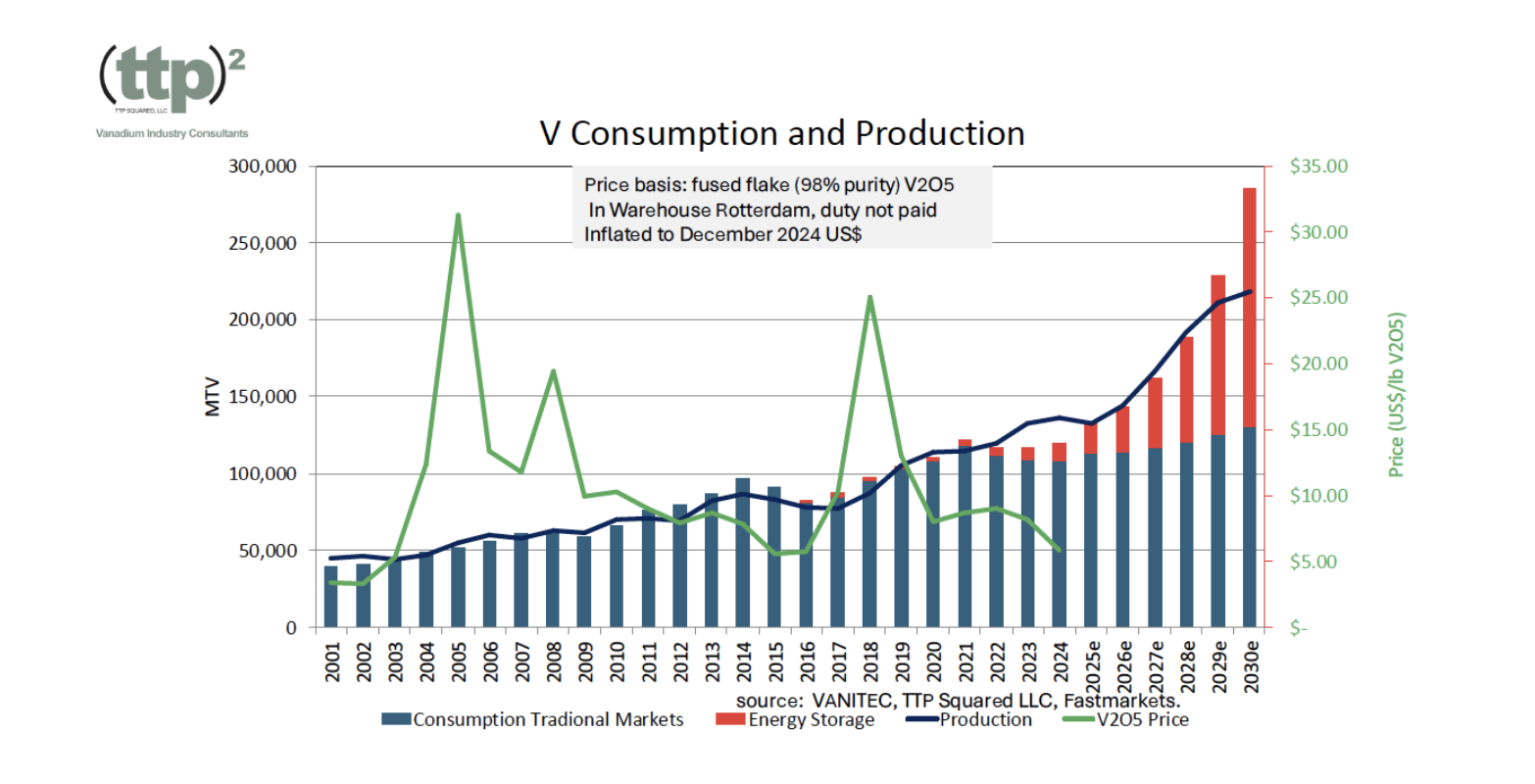
Terry Perles, President of TTP Squared and a leading vanadium industry expert, noted: “With a potential supply shortfall by 2029, the vanadium market has an opportunity to grow by unlocking existing and new sources of production to meet surging demand, driven mainly by growth in battery energy storage.”
China leads the charge on vanadium battery deployment
Some of the world’s most ambitious VFB projects are already online in China, including the 400 megawatt-hour (MWh) Dalian system and the 1 gigawatt-hour (GWh) Xinjiang project completed by Rongke Power earlier this year — currently the largest of its kind globally.
Although deployments outside China are currently more modest, analysts expect that to change rapidly. Market research firm Guidehouse Insights projects that global VFB installations could rise to 32.8 GWh annually by 2031.
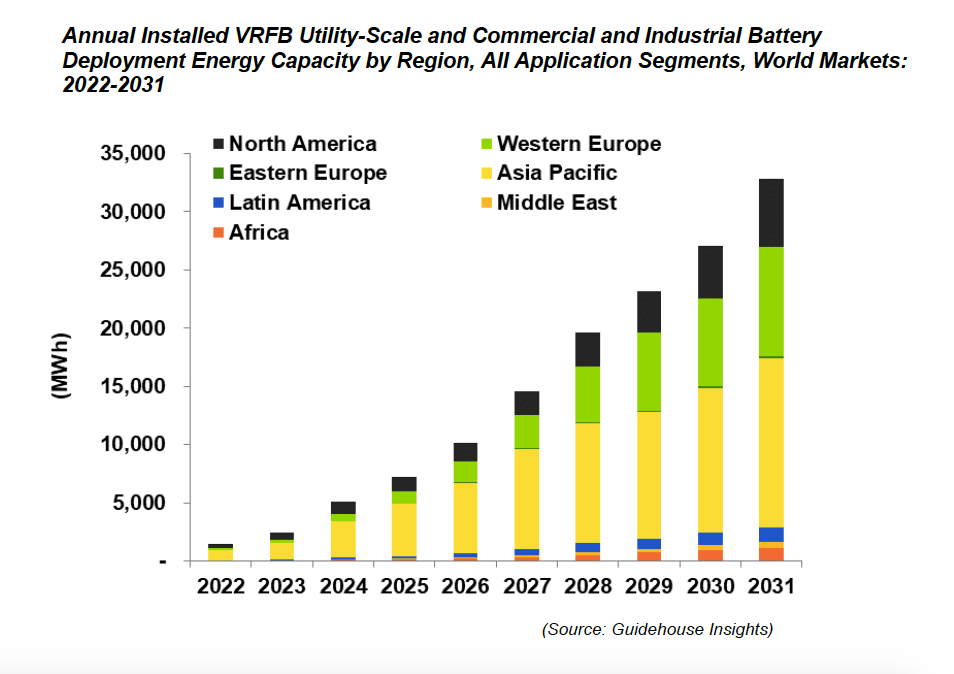
“Based on the VFB deployment projections by Guidehouse Insights, an estimated 155,000 metric tonnes a year of new vanadium will be needed to meet this level of VFB deployment by 2030. This equates to more than double current annual demand,” Perles said. He also chairs Vanitec’s Market Development Committee.
Supply response in motion
Vanadium supply is geographically diverse, offering resilience and flexibility to support both legacy and emerging end markets. In addition to primary production from mines, the metal can be recovered from oil residues and co-produced during steelmaking.
“With sufficient vanadium resources and known reserves to meet the significant long-term vanadium demand growth, there are also new sources of vanadium that can be unlocked. These new sources could account for as much as 70,000 metric tonnes of additional production, over and above the about 120,000 metric tonnes of vanadium that was produced globally in 2024,” Perles said.
While new mines take time to bring online, short-term supply is expected to benefit from restarts of idled capacity and new operations in Australia and Kazakhstan. Secondary sources in China, Saudi Arabia and Kazakhstan are also set to play a role in bolstering availability.
“In the short term, growth in supply is expected to be supported mainly by the restart of idled primary sources of production, potential new vanadium mines in Australia and Kazakhstan as well as increased production of vanadium from secondary sources in China, Saudi Arabia and Kazakhstan,” Perles added.
Long-term strategy needed
As the shift toward lighter, stronger materials and advanced energy storage systems gathers pace, vanadium’s role in the clean energy supply chain is becoming more prominent. From lithium-ion battery components to fusion reactor alloys, vanadium is positioned to support a wide range of energy applications beyond steel.
According to Vanitec, strategic planning will be crucial to ensure supply aligns with growing demand — both in traditional markets and the fast-evolving battery storage segment.
Vanitec is a not-for-profit global member organisation that brings together stakeholders from across the vanadium value chain to promote the use and development of vanadium-based technologies.