
More visible gold and copper mineralisation has been intersected at Solis Minerals Ltd (ASX:SLM, TSX-V:SLMN, OTCQB:SLMFF)'s 100%-owned Chancho al Palo Project in Peru, with a second diamond drill hole (CAP-002-2025) completed to a depth of 697 metres.
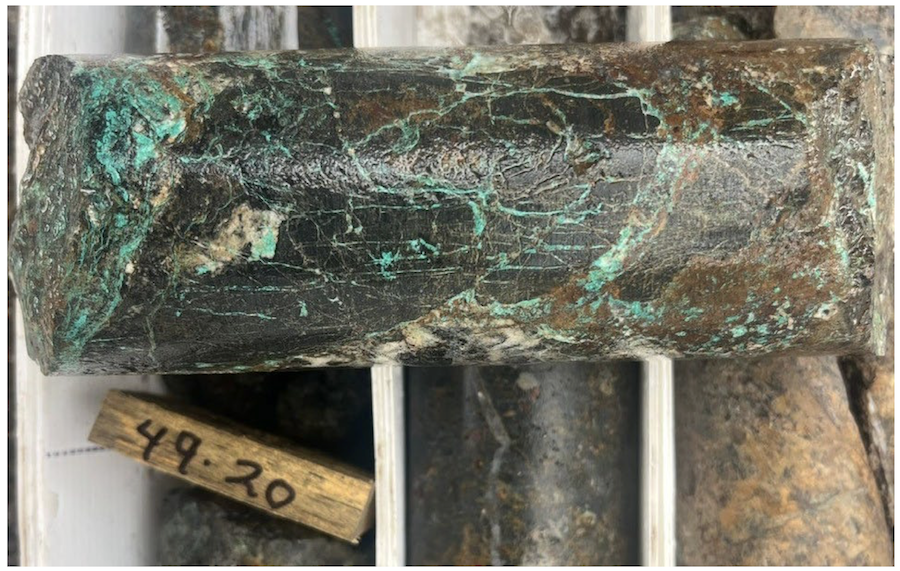
CAP-002-2025 drill core at 49.20 metres displaying tourmaline/specularite breccia with malachite (copper oxide) mineralisation hosted in diorite intrusive. Visually estimated grade 0.5% Cu. Laboratory assays are due in July / August 2025.
The early results reinforce Solis’ targeting rationale in a region near key Southern Copper and Anglo American infrastructure.
The hole follows up on the first drill hole which encountered fault-bounded iron oxide copper-gold (IOCG) and porphyry-style mineralisation.
Laboratory assays for both holes are expected in July or August 2025.
“We’re encouraged by further evidence of a mineralised system at Chancho al Palo, with our second drill hole also intersecting visible copper and some gold,” SLM CEO Mitch Thomas said.
“The coexistence of IOCG and porphyry-style mineralisation, reinforced by alteration features and geochemical indicators, continues to validate our targeting approach. We believe these early results strengthen the case for a potential copper-gold system, aligned with our objectives.”
The total program at Chancho al Palo is planned for approximately three to five drill holes. Once drilling is complete, Solis will send the rig and geological team to its 100%-owned Ilo Este Project.
Chancho al Palo drilling targets priority copper anomalies in Peru
The Chancho program is focused on testing high-priority geophysical and geochemical anomalies interpreted to represent IOCG and porphyry-style mineralisation systems.
The key objectives of the program are as follows:
1. Target validation
The program aims to confirm the geological and structural interpretations derived from induced polarisation and magnetic survey data. These models have guided the vectoring of drill targets believed to host IOCG and porphyry-style copper systems.
2. Mineralisation confirmation
Drilling will seek to intersect and characterise primary copper mineralisation, along with associated hydrothermal alteration halos — such as sodic-calcic and potassic — and sulphide zonation. The presence of potential pathfinder elements, including iron, gold, molybdenum and rare earth elements, will also be assessed.
3. Alteration system mapping
A key focus is mapping the geometry and scale of hydrothermal alteration zones to help vector towards the mineralisation core and identify potential fluid pathways.
4. Structural controls
The campaign will investigate the structural architecture of the system, particularly the role of faults, breccias and intrusive contacts in localising mineralisation within interpreted feeder zones and structural corridors.
5. Resource potential assessment
The company will compile detailed geological, mineralogical and geochemical data to inform future step-out drilling and support an initial evaluation of the project's broader resource potential.
Drilling progress and geological context
CAP-002-2025 targeted coincident magnetic and chargeability anomalies with favourable surface geology.
The hole was drilled from Platform P-05 at an azimuth of 250 degrees and a dip of -75 degrees, and concluded at 697 metres.
Drilling intersected multiple lithological units including Jurassic-aged tuffs and volcanosedimentary rocks of the Chocolate Formation, hornfels and brecciated zones with visible copper oxide (malachite) and finely disseminated gold.
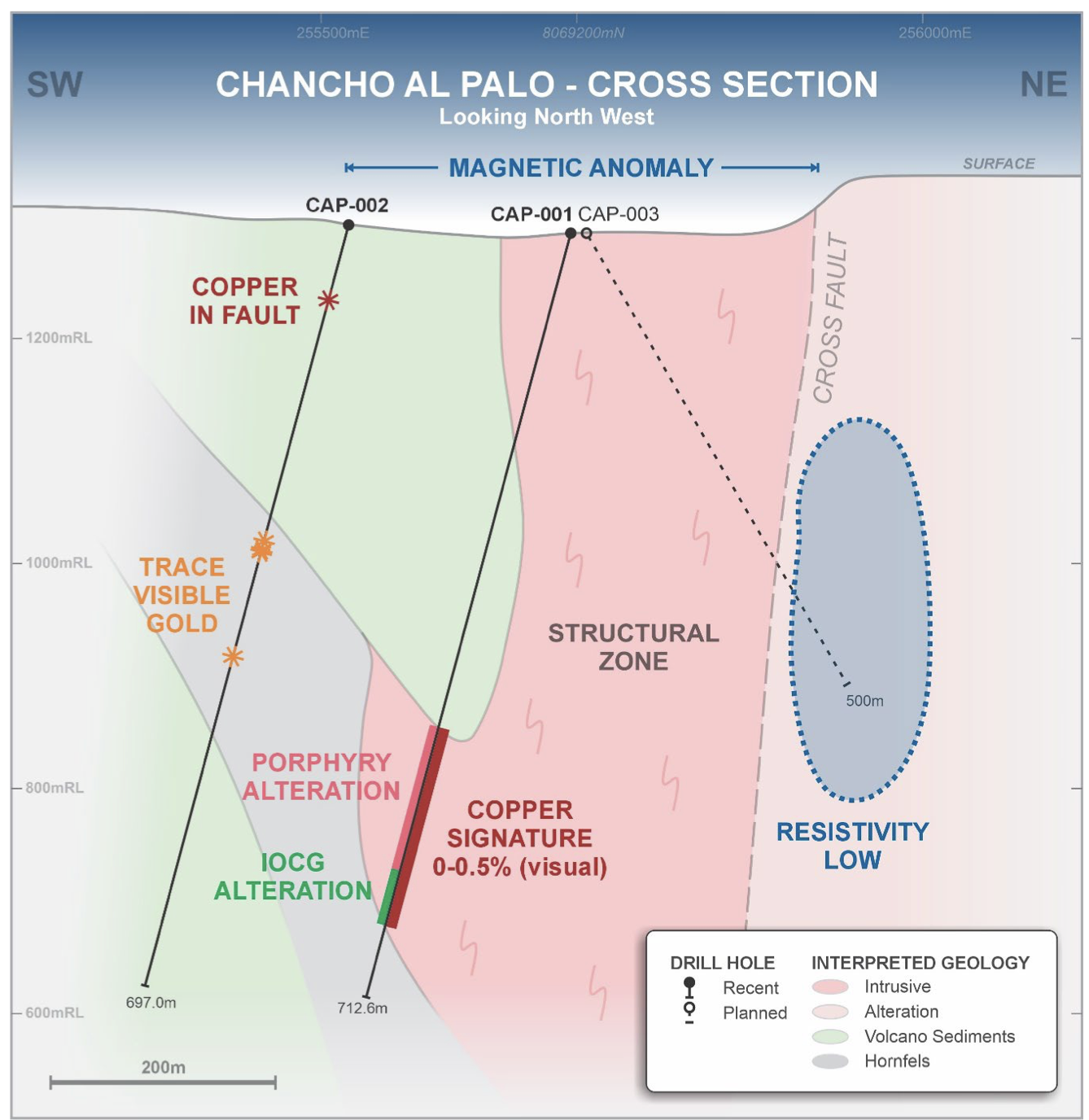
Geological section interpretation across drill holes CAP-001, CAP-002 and CAP-003 (in progress with geophysical resistivity target indicated) with visual indications of copper and gold also indicated. Visual estimates of mineral abundance should never be considered a proxy or substitute for laboratory analyses where concentrations or grades are the factor of principal economic interest. Visual estimates also potentially provide no information regarding impurities or deleterious physical properties relevant to valuations. Laboratory assays are due for release in July / August 2025.
Alteration styles observed include propylitic, actinolite and chlorite replacement, with local pyrite concentrations up to 5%. A faulted zone with strong malachite expression was encountered between 47.75 and 50.30 metres.
Solis notes the presence of both IOCG and porphyry signatures, with the hornfels-hosted gold intervals suggesting a possible late-stage intrusive system.
Structural targeting and next steps
The third hole (CAP-003-2025) is underway from the same site as CAP-001-2025 but oriented to test a regional cross-fault, known as a potential control for mineralisation.
These structural zones are common conduits for porphyry-style systems, as observed at Solis’ Ilo Este Project, located 17 kilometres southeast. Geophysical targeting combines induced polarisation (IP) and magnetic data to map potential mineralised zones.
Solis expects results to clarify mineral assemblages, alteration systems and potential feeder structures.
Tenement status update
As part of its annual tenure review, Solis confirmed it holds 74 tenements covering 63,400 hectares across its Peruvian portfolio.
This includes 44 granted licences totalling 36,500 hectares and 30 pending applications over 26,900 hectares.
Three tenements were not renewed due to low geological priority, while four competitive applications (three in Cinto and one in Canyon) were unsuccessful.
Despite this, Solis retains a dominant footprint in the region, with exploration focused on high-priority targets within granted areas.